
A triggered email is an automated message sent because of something a person did, such as downloading an eBook or visiting your pricing page. A drip campaign is a set of messages sent in a fixed order on a fixed schedule, no matter what the person does. Drip runs on the calendar. Triggered runs on behavior.
I write follow-up messages for a living, and I don’t sell automation software, so I have no favorite tool to push. This page explains both kinds, shows what a triggered flow looks like, and helps you decide which to set up first. For many small firms, the answer is the simpler one.
What are drip campaigns?
A drip campaign is a set of messages delivered in a predetermined order over a predetermined time period. Here is a typical one:
- A visitor fills out a form on your website to download an eBook.
- Within an hour, they receive a thank-you email with a link to the eBook.
- One day later, they get a reminder to download it if they haven’t yet.
- Two days after that, they get an offer for a free consultation.
The series might have more or fewer steps. The key is that everyone who downloads the eBook gets the same messages at the same intervals.
Almost every email service provider can do this. You may know the feature as an autoresponder.
What are triggered emails?
A triggered email is sent in response to something the person does. Their behavior triggers your response.
Take the same eBook example. With triggers, you can respond differently to someone who downloaded it within minutes than to someone who didn’t click the link until days later. The first person is engaged and might be ready for a conversation. The second may need a reason to look at it again.
Or compare two website visitors. One spent time on your pricing page. The other spent most of their time on your careers page. They are looking for very different things, and a triggered system can send each a different message, or send one nothing at all.
What are some common types of triggered emails?
For a B2B firm, these are the ones worth considering first:
- Download follow-ups. Someone gets an eBook, checklist, or guide. The next message depends on whether they opened it.
- Demo or consultation requests. Someone fills out the form. They get an immediate confirmation and, if they don’t book, a note a day or two later.
- Pricing-page visits. Someone views the pricing page more than once in a short period. This is often a good moment for a personal note from a person, not a newsletter.
- Abandoned forms or carts. Someone starts a request or checkout and doesn’t finish.
- Re-engagement. Someone who used to open your emails goes quiet.
- Post-purchase or onboarding. Someone becomes a client. The first messages help them get started.
How do drip and triggered emails compare?
| Drip campaign | Triggered email | |
|---|---|---|
| Timing | Set in advance, by the calendar | Set by what the person does |
| Personalization | Same series for everyone who enters | Different path depending on behavior |
| Setup effort | Low. Write the messages, set the delays. | Higher. You decide what to track, what counts as a trigger, and what each path says. |
| Best use | Welcome series, a short follow-up after a download, a simple nurture | Moments of visible interest, such as a pricing-page visit or a demo request |
What does a triggered flow look like?
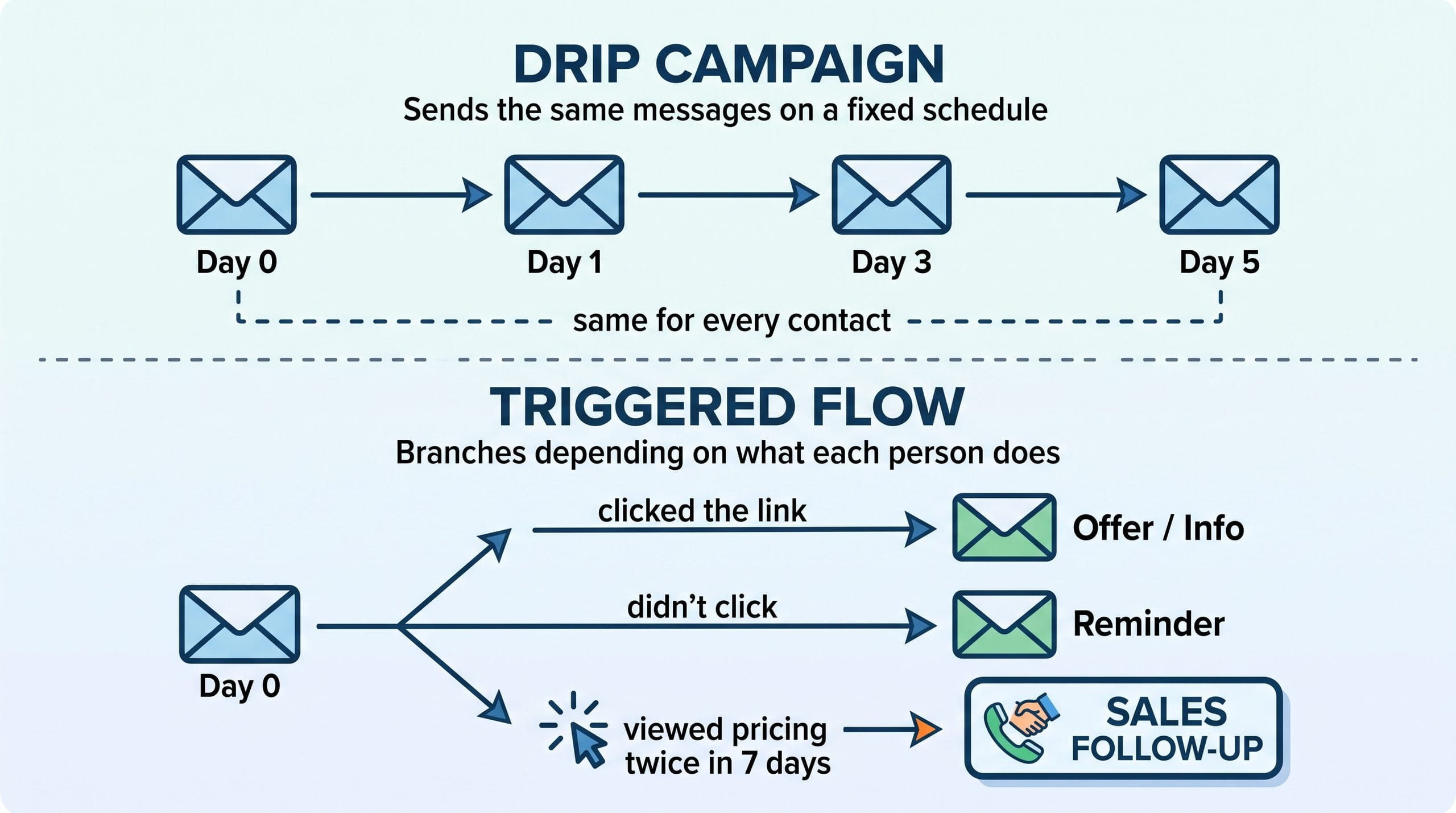
Here is one example. I built this illustration to show the mechanics, not a client result, and the timings are starting points you can adjust.
- Day 0: A visitor downloads your guide. They get the guide link immediately.
- Day 2, trigger: they haven’t clicked the link. Send a short reminder with the link again.
- Day 2, trigger: they did click. Wait a day, then send one related article.
- Any day, trigger: they view the pricing page twice within 7 days. Notify the person who handles sales, and have them send a plain-text email asking whether a conversation would help.
In a drip campaign, steps 2 and 3 would be one message sent to everyone. Step 4 wouldn’t exist because a drip campaign doesn’t know what anyone did.
Which should you use?
Use a drip campaign when:
- You have one offer and one clear next step.
- You don’t yet track behavior on your website or in your emails.
- You want follow-up running this month, not next quarter.
Add triggers when:
- Your sales cycle is long enough that timing matters.
- Your tool can see actions like page visits and clicks.
- Someone is available to act when a trigger fires. A pricing-page alert nobody reads does nothing.
Most working programs use both. A drip series handles the predictable first few messages, and triggers handle the moments when someone shows interest. If you are sending no follow-up at all today, three well-written drip emails will do more for you than an elaborate flow you never finish building.
What tools support triggered emails?
Several widely used platforms can send behavior-based emails, including HubSpot, ActiveCampaign, Mailchimp, and Klaviyo (more common in e-commerce). Which triggers you get depends on the platform and the plan, so ask before you buy. Specifically, ask whether it can send based on page visits and email clicks, not just form submissions.
Does this only apply to email?
I’ve written about drip and triggered emails here, but the same ideas apply to drip and triggered messages in general. Good follow-up often uses more than email: a phone call, a text message, a letter, or a postcard. Some marketing automation tools handle multiple channels better than others, so ask about that when you are shopping.
Is a drip campaign the rookie and a triggered email the veteran?
There’s a fair comparison to sales. A rookie salesperson follows the script. A veteran listens to the prospect and responds with the right information and follow-up questions.
That makes drip the script and triggers the listening. A rookie is better than no salesperson, and a drip campaign is better than no follow-up. Over time, triggers help you reach the next level faster because your messages arrive when they matter to the reader. Either way, the software only delivers the message. The message still has to be worth reading.
Frequently asked questions
What is a trigger email? A trigger email is an automated email sent in response to something a person did, such as filling out a form, clicking a link, or visiting a specific page. It is also called a triggered email or a behavior-based email.
What’s the difference between triggered and drip emails? Drip emails go out in a fixed order on a fixed schedule to everyone in the series. Triggered emails go out when a person takes a specific action, so different people get different messages at different times.
Is a welcome email triggered or drip? The first welcome email is triggered because it sends when someone signs up. If it is followed by a fixed series of messages, that series is a drip campaign. Most programs blend the two.
Can I use both? Yes, and most do. Start with a short drip series for the predictable messages, then add triggers for the moments that show interest, such as a pricing-page visit or a demo request.
Need help with what the messages say?
Rebar Business Builders is a B2B copywriting and sales enablement firm for founder-led accounting, consulting, and other expertise-led firms. If you are setting up follow-up and want help with what the messages say, not just when they send, book a call.