
It’s not a question of either-or. It’s a question of sequencing.
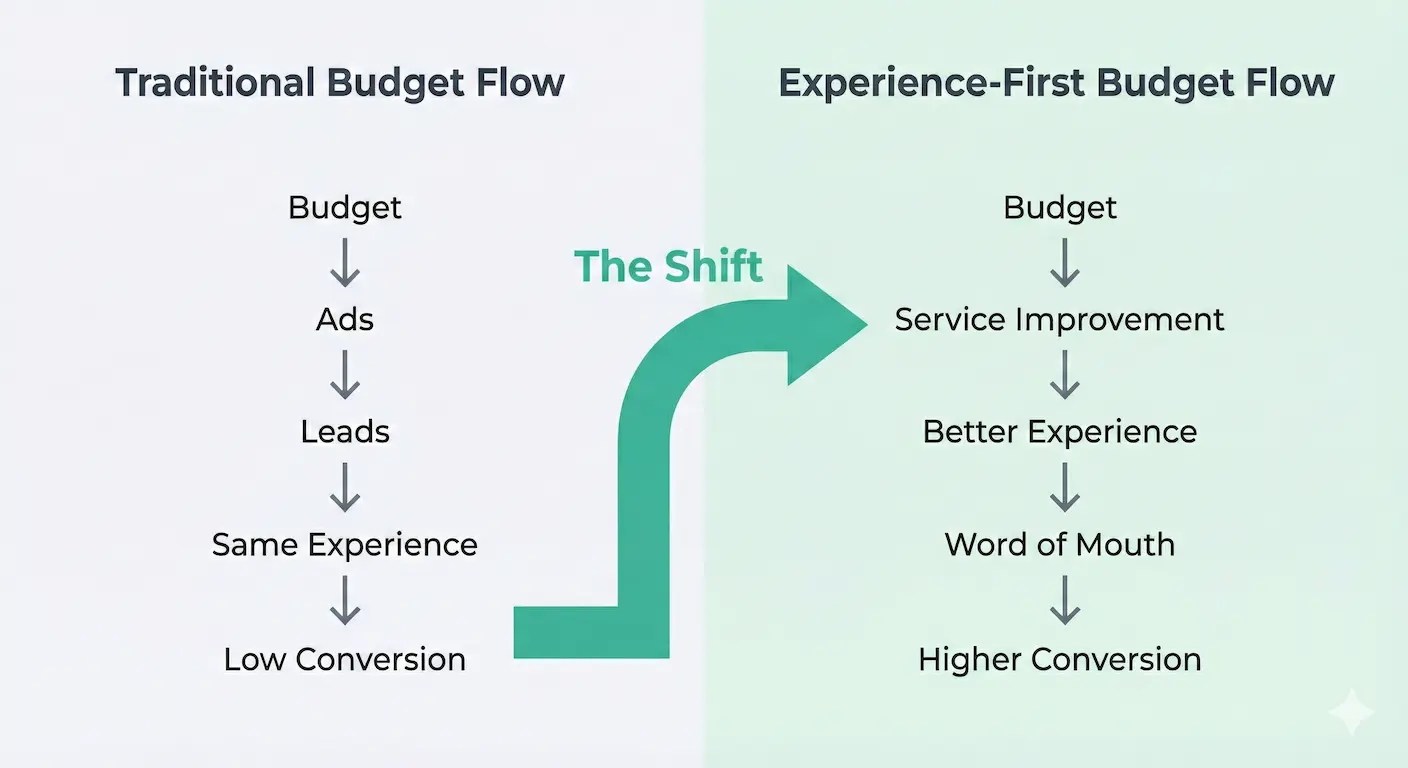
Most consulting and accounting firms that struggle with growth aren’t suffering from a lack of advertising. They’re advertising (and I mean advertising in the broadest sense – organic and paid) something that isn’t ready to be amplified.
They’re generating more reach, more awareness, more leads, but with the same friction-filled experience waiting at the other end.
The budget conversation that keeps repeating itself goes something like this: revenue is flat, the pipeline needs work, and someone says what everyone’s thinking – “we need to spend more on advertising.”
Others argue, “We can’t afford to buy advertising. Let’s work on referrals.”
But it’s not an either-or choice between paid advertising and word of mouth marketing for consulting firms. It’s a question of sequencing, particularly if you want to maximize your return on ad spend.
It feels logical. Every marketing dashboard reinforces it. Every agency pitch confirms it.
What they don’t tell you is that for boutique professional service firms, the highest-ROI marketing decision usually isn’t more ads. It’s improving what clients actually experience when they work with you. And then letting that do the marketing.
Bill Bernbach, one of the most influential figures in advertising history, put it bluntly:
“Nothing kills a bad product faster than good advertising.”
Jerry Della Femina extended the point: great advertising just helps people discover sooner that your service isn’t worth coming back to.
These aren’t anti-advertising radicals. These are people who built the advertising industry. And they are telling you that the product, or in your case, the service, comes first.
This post is about the sequence. How to find where your experience has friction, how to fix it, and how to calculate whether your marketing budget is going to the right place first.
The reframe: your best marketing investment is probably not an ad
Rory Sutherland’s Eurostar example brings this into the modern era and makes the point impossible to ignore.
Eurostar spent 6 billion pounds to cut 40 minutes off the London-to-Paris journey. A massive engineering project. Logical. Measurable. Defensible in a board meeting.
Sutherland pointed out that for 10% of that budget, you could serve free champagne to every passenger for the entire trip…
… and have 5 billion pounds left over. Passengers might actually ask for the trains to be slowed down.
The lesson: companies systematically over-invest in the logical, engineering-minded fix and under-invest in the experiential one. Not because the experiential fix doesn’t work, but because it’s harder to justify in a spreadsheet.
Bezos ran with the same logic. Amazon spent almost nothing on traditional advertising in its early years. Instead, the money went into free shipping and easy returns. His bet was simple: make the customer experience so good that customers do the marketing for you.
It worked. Bezos has said repeatedly that advertising is the price you pay for having an unremarkable product.
For boutique service firms, this reframe matters even more than it does for product companies. Here’s why:
Your clients talk. Professional services run on relationships. Your clients have peers, industry contacts, and professional networks. When someone asks, “Do you know a good accountant?” or “Who handles your IT?” – the answer they give is your most powerful marketing channel.
No ad can replicate a trusted peer saying, “You should call these people.”
You can’t outspend larger firms on ads. But you can out-experience them. A large firm has budget advantages. They don’t have service advantages. One remarkable client interaction, like a proactive call that saves them from a problem they didn’t see coming, or a follow-up that goes beyond what was expected, creates more referrals than a month of LinkedIn ads.
Customer experience vs. advertising isn’t even close in terms of ROI. The math almost always favors experience improvements. A single delighted client who refers two others generates more lifetime value than most ad campaigns, at essentially zero acquisition cost.
This isn’t about abandoning advertising entirely. It’s about fixing the sequence. Improve the experience first. Then amplify it.
How to redirect your marketing budget toward what actually works
Here’s where it gets practical. Three steps you can take before your next budget conversation.
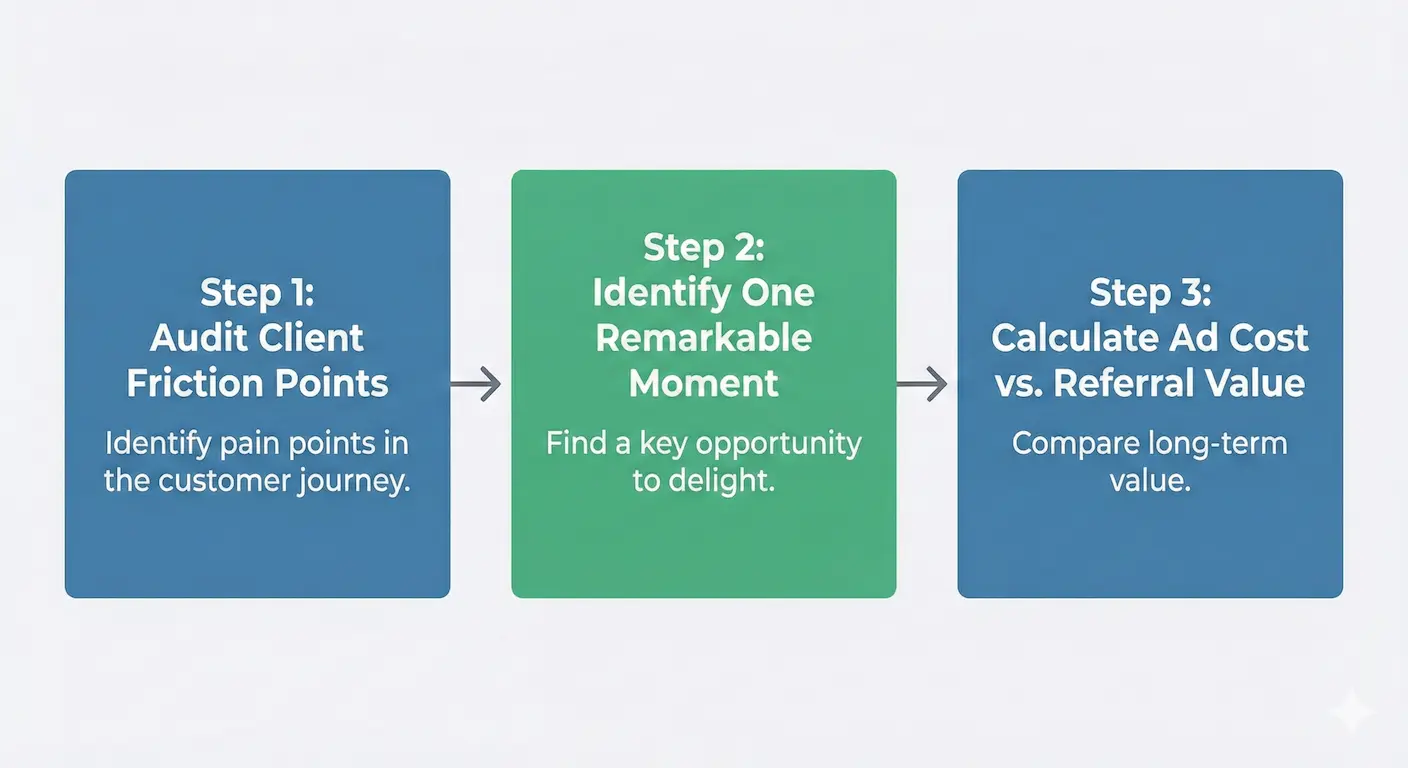
Step 1: Audit where clients drop off or complain – before buying more ads
This is the constraint-thinking approach. Before you bring more people to the experience, make sure it’s worth bringing them.
Most firms skip this step. They see a pipeline problem and reach for the ad budget. But if 40% of your proposals don’t convert, doubling your leads just doubles the number of unconverted proposals. You haven’t fixed anything — you’ve just made the bottleneck more expensive.
How to do it:
- Map your client journey from first contact through delivery and follow-up.
- Identify the 2-3 points where prospects stall, drop off, or complain.
- Talk to clients who didn’t buy. Ask what happened. (Most firms never do this.)
- Talk to clients who did buy. Ask what almost stopped them.
- Fix the biggest friction point before spending another dollar on ads.
Bad example 👎
“We’re not getting enough leads. Let’s double the Google Ads budget and add a retargeting campaign.”
Good example 👍
“Before we spend more on ads, let’s look at why 40% of our proposals don’t convert. Three prospects last quarter said our onboarding process was confusing. Let’s fix that first, then see if we even need more leads.”
Common mistake to avoid: Don’t try to fix everything at once. Theory of Constraints applies here. Find the one bottleneck that’s costing you the most and fix that first.
Step 2: Identify one experiential improvement that would make clients talk about you unprompted
This is the word-of-mouth marketing question. Not “how do we get clients to refer us?” but “what would make them want to?”
There’s a difference between a referral program and a referral-worthy experience. Incentives can generate introductions. But the introductions that convert, the ones where the prospect shows up already trusting you, come from genuine enthusiasm, not a gift card.
How to do it:
- Think about the last time you recommended a service provider to someone without being asked. What prompted it?
- Look at your current client experience. Where’s the moment that could be genuinely remarkable?
- It doesn’t have to be expensive. Often it’s about timing and thoughtfulness, not budget.
Bad example 👎
“Let’s create a referral program with a $500 incentive for every new client introduction.”
Good example 👍
“For every new consultation, we now send a one-page summary within 24 hours of our first meeting. We restate their problem, our approach, and expected outcomes in plain language. Three clients have forwarded it to their partners saying, ‘This is why I hired them.'”
That one-page summary costs essentially nothing to produce. But it signals competence, attention, and professionalism in a way that no ad can replicate.
Step 3: Calculate the real cost of ads vs. word of mouth
This is the step most firms have never taken, and it’s the one that changes the conversation. When you put real numbers on customer experience vs advertising, the case usually makes itself.
Here’s a worked example:
Let’s say you’re a boutique consulting firm. Your numbers look something like this:
Cost to acquire a client through ads:
- Monthly ad spend: $3,000
- Leads generated per month: 15
- Conversion rate from lead to client: 10%
- Clients acquired per month from ads: 1.5
- Cost per acquisition: $2,000
Cost to acquire a client through referral:
- Number of active clients: 20
- Referrals per year from all clients: 6
- Conversion rate from referral to client: 50% (referrals convert at much higher rates)
- Clients acquired per year from referrals: 3
- Cost of generating referrals: essentially $0 (or the cost of the service improvement that prompted them)
- Cost per acquisition: ~$0
Now, here’s where it gets interesting. What if you took $500/month of that $3,000 ad budget and invested it in a service improvement that generated just two more referrals per quarter?
The math:
- Additional referrals per year: 8
- Conversion rate: 50%
- Additional clients per year: 4
- Revenue per client (let’s say): $15,000
- Additional revenue: $60,000
- Investment: $6,000/year
- Marketing ROI: 10x
Compare that to putting the same $6,000 into ads:
- At $2,000 per acquisition, that’s 3 additional clients
- Additional revenue: $45,000
- Marketing ROI: 7.5x
The referral path wins, and that’s being conservative with the numbers. In practice, referral clients tend to have higher lifetime value, lower churn, and shorter sales cycles than ad-sourced clients.
The exercise for your firm: Run these numbers with your own data. Most firms have never done this calculation. When they do, the budget conversation changes.
Common objections (and honest answers)
“But we need ads to get new customers. Word of mouth takes too long.”
Fair point. Word of mouth isn’t instant. But neither is advertising. Most ad campaigns take months to optimize and generate consistent returns.
The real question isn’t “ads or word of mouth.” It’s “are we advertising something worth talking about?” If your service isn’t generating referrals organically, more ads won’t fix that. Fix the experience, then use ads to accelerate what’s already working.
“Our service is already good. This doesn’t apply to us.”
Maybe. But “good” and “remarkable” are different things. “Good” means clients are satisfied. “Remarkable” means they remark on it; they tell other people without being prompted.
Ask yourself: when was the last time a client referred you without you asking? If you can’t remember, there may be room between “good” and “worth talking about.”
“We can do both, improve service AND advertise more.”
You can. But most firms have limited budgets and limited attention. The question is where to put the next dollar. If your service experience has obvious friction points, fixing those first will make every ad dollar more effective. Sequence matters.
“How do we know which part of the experience to fix first?”
Start with complaints. Start with where prospects drop off. Start with the question you keep getting asked that signals confusion.
If you’re not sure, ask five recent clients: “What was the one thing about working with us that could have been better?” You’ll get your answer fast.
“This works for Amazon, but we’re a small business.”
Actually, it works better for small businesses. Amazon had to spend billions before the flywheel kicked in. A boutique firm can make a meaningful service improvement this week and see an impact on referrals within a quarter.
Small firms have an advantage here. You’re close to your clients. You can move fast. You can make changes that a large firm would need six months of committee meetings to approve.
Real-world example: a consulting firm redirects budget from ads to experience
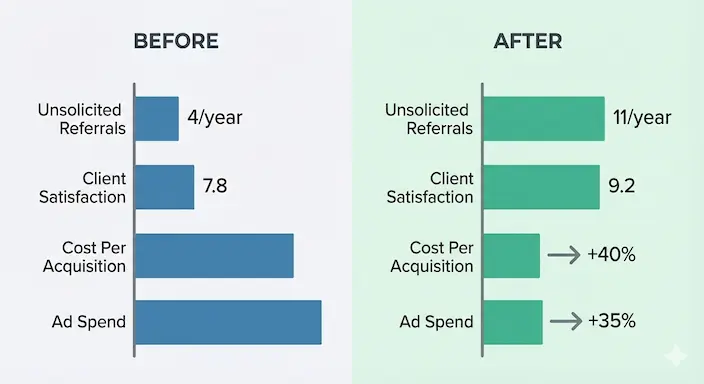
A 15-person management consulting firm was spending $4,000/month on LinkedIn ads and Google PPC. They were generating leads, but conversion was inconsistent and the cost per client kept climbing.
The situation: The firm had strong delivery. Clients got results. But their intake process was clunky. New clients described the first two weeks as “confusing.” The onboarding documents were dense. Communication expectations were unclear. By the time the real work started, some clients were already frustrated.
What they tried first: More ad spend. A new agency. Better targeting. Conversion rates improved marginally, then plateaued.
The shift: Instead of increasing the ad budget, they redirected $1,500/month toward improving three things:
- A streamlined onboarding kit — one page, plain language, clear timeline
- A “first 48 hours” protocol — personalized welcome call, one-page project summary sent within 24 hours
- A quarterly check-in call focused not on deliverables, but on the client’s broader goals
The results over 12 months:
- Client satisfaction scores went from 7.8 to 9.2
- Unsolicited referrals increased from 4/year to 11/year
- Referral conversion rate held steady at ~45%
- Net new clients from referrals: 5 (vs. 2 the previous year)
- Ad spend reduced by 35% with no drop in total client acquisition
- Overall cost per acquisition dropped by 40%
The key insight: The firm didn’t have a lead problem. They had an experience problem that was suppressing the word of mouth their good work should have been generating. Once they fixed the experience, the marketing took care of itself.
The bottom line: fix the service before you amplify it
Here’s what this comes down to.
- Audit before you advertise. Find where clients experience friction. Fix that before spending more to bring new people to the same broken spots.
- Invest in one remarkable moment. What would make a client talk about you unprompted? That moment is worth more than a month of ad spend.
- Do the math. Calculate what a referral is actually worth compared to an ad-sourced lead. Most firms have never run this comparison. When they do, the budget priorities shift.
- Fix the sequence. This isn’t anti-advertising. It’s about making sure you’re advertising something worth talking about.
This week, try this: pick one friction point in your client experience and fix it. Something small. Something you can do by Friday. Then watch what happens over the next 90 days.
The firms that grow through word of mouth didn’t get lucky. They made the deliberate choice to invest in the thing being talked about.
And if you’d like some help figuring out where your marketing budget should actually go, give me a shout.
Want more insights like this?
Subscribe to The Business Builder, my weekly newsletter for boutique B2B and professional service firm founders who want to increase authority, generate consistent leads, improve sales effectiveness, and build stronger client relationships.
Every week, I share frameworks, strategies, and practical steps you can implement immediately — no fluff, no generic advice, just actionable insights for professional service firms.