
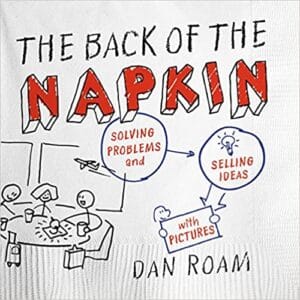
The Back of the Napkin: Solving Problems and Selling Ideas with Pictures , is a wonderful instructional manual from Dan Roam that teaches you the power of visual thinking in four lessons – introduction to visual thinking, discovering ideas, developing ideas, and selling ideas.
I wish I had read it 10 years ago.
About the Author
Dan Roam helps organizations make better decisions by visualizing information. His work appears regularly on CNN, MSNBC, CBS News, ABC News, FOX News, NPR and many others. He is also the author of four books including “Back of Napkin Math,” “The Back of the Napkin Guide to Thinking Visually,” and “The Back of the Room.”
Simple Drawings – If I can do it…
Dan explains how you don’t have to be a “visual person” to take advantage of the power of visual thinking. He lays out a specific four-step process of visual thinking that anyone can follow.
I can’t draw to save my life, but I’m already benefiting from following the process and using my simple pictures scrawled on bar napkins to capture and work through ideas.
Frameworks Make Effective Tools
This is a practical business book that provides you with a set of frameworks for solving the different types of problems you will run into in business. Roam also provides simple-to-follow rules to help you decide which framework to use to solve your particular type of problem and communicate your ideas to your particular audience.
One of these frameworks is the Visual Thinking Process – look, see, imagine, show. I love this as a problem-solving approach, and it’s a highly effective way of explaining your solution to others.
A Business Creativity Book
The Back of the Napkin is divided into 4 main sections:
- Introduction/Overview of Visual Thinking
- Discovering Ideas
- Developing Ideas
- Selling Ideas
The last section of the book presents an MBA school-style lesson. The author presents a walk-through of a complete case study. He demonstrates all the tools outlined in the book. You see how to progress from one tool to the next – first defining the problem, then exploring solutions, and then presenting those solutions to key decision-makers.
In the last chapter, the author walks his talk by demonstrating how to create a picture to describe your new visual thinking toolkit to your colleagues. Using a simple sketch of a Swiss Army knife, he summarizes the:
- 3 basic visual thinking tools
- 4 steps of the visual thinking process
- 5 questions that help us open our mind’s eye, and the
- 6 ways that we see
Be sure to check out his creative acknowledgments section at the back of the book. This was the longest I’ve ever spent looking at an author’s acknowledgments.
I highly recommend this book. It won’t take you long to read, and your problem-solving skills will increase so dramatically, you’ll wish you read it 10 years ago.