
Someone at a conference mentions lead scoring software.
A marketing consultant tells you it’s essential for “modern sales.”
You look it up and find demos of platforms that track every click, assign point values to every page visit, and automatically rank your prospects from hottest to coldest.
It sounds sophisticated. Big companies use it. Maybe you should too.
Or maybe not.
Most lead scoring advice was built for companies with thousands of leads, dedicated marketing teams, and product-focused sales cycles. It wasn’t built for a 10-person accounting firm generating 15 qualified leads a month. Or a boutique management consulting practice where every deal starts with a conversation.
Applying standard lead scoring to a professional service firm is like using an industrial conveyor belt to run a custom tailor shop. The scale is wrong. The process is wrong. And the way value gets communicated is fundamentally different.
But that doesn’t mean lead scoring doesn’t matter. It means you need a version of it that actually fits your business.
In this guide, I’ll explain what lead scoring actually is, why the software-first approach often fails professional service firms, and how to build a lead evaluation process that helps you prioritize the right prospects without over-engineering your sales process.
I’ve worked with accounting firms, consulting practices, and other boutique B2B firms on this exact challenge. The good news: it’s simpler than the software vendors want you to believe.
Let’s start with where standard lead scoring advice goes wrong.
Why Standard Lead Scoring Advice Doesn’t Fit Professional Services
Where Lead Scoring Came From
Lead scoring wasn’t invented for accounting firms or boutique consulting practices. It was developed by enterprise software companies (HubSpot, Marketo, Pardot, etc) to help large B2B and B2C companies manage hundreds or thousands of leads moving through complex, multi-touch sales funnels.
The math makes sense at scale. If you generate 500 leads per month and your sales team can only call 100 of them, you need a way to identify which 100 deserve the call. Assign points for behaviors (downloaded a white paper: +10, visited pricing page: +25, attended a webinar: +15), combine with profile data (company size: +20, job title: +15), and suddenly you have a ranked list your sales team can work through in priority order.
At scale, this works well.
The problem is that most professional service firms are not operating at that scale. The way they sell is fundamentally different.
The Hidden Costs of Getting This Wrong
When a boutique firm adopts enterprise lead scoring without adapting it, a few things typically happen.
First, they invest in software they don’t need. Marketing automation platforms with lead scoring functionality cost anywhere from $400 to $2,000+ per month. For a firm generating 15-20 qualified leads per month, that’s an expensive way to manage a spreadsheet.
Second, they spend time configuring a system that doesn’t fit. Lead scoring requires defining criteria, assigning weights, building workflows, and ongoing maintenance. That time usually comes from the partner or owner who was already stretched thin.
Third, they end up with a system that nobody actually uses. When you have 12 leads in your pipeline, and you know each prospect personally, you don’t need software to tell you who deserves a call.
What Makes Professional Services Different
Professional services are relationship-driven businesses. Yes, you know that already, but it’s import context for this discussion.
The decision to hire an accounting firm, consultant, or law firm is high-stakes and personal. Prospects aren’t clicking “add to cart.” They’re evaluating whether they trust you with something that matters – their finances, their business strategy, their legal exposure.
That means two things.
Relationship signals matter more than behavioral signals. A prospect who visited your website 40 times might be a competitor doing research. A prospect referred by your best client and downloaded one white paper is a completely different opportunity. Regardless of what the software says.
Personal contact is part of the selling process, not just the close. In professional service sales, the relationship starts before the sale, not after. The coffee meeting, the discovery call, and the introductory conversation are all part of how prospects evaluate you. No automated scoring system replaces that.
This doesn’t mean lead qualification doesn’t matter. It means you need a process that accounts for how professional services actually get sold.
The Better Approach: Lead Evaluation Over Lead Scoring
What Changes When You Reframe It
Instead of thinking about lead scoring as software that automatically ranks your leads, think about it as a process for evaluating and prioritizing your follow-up.
Same goal. Different execution.
I call this the Lead Evaluation Framework: a simple, process-based approach to qualifying and prioritizing leads that fits the way boutique firms actually operate.
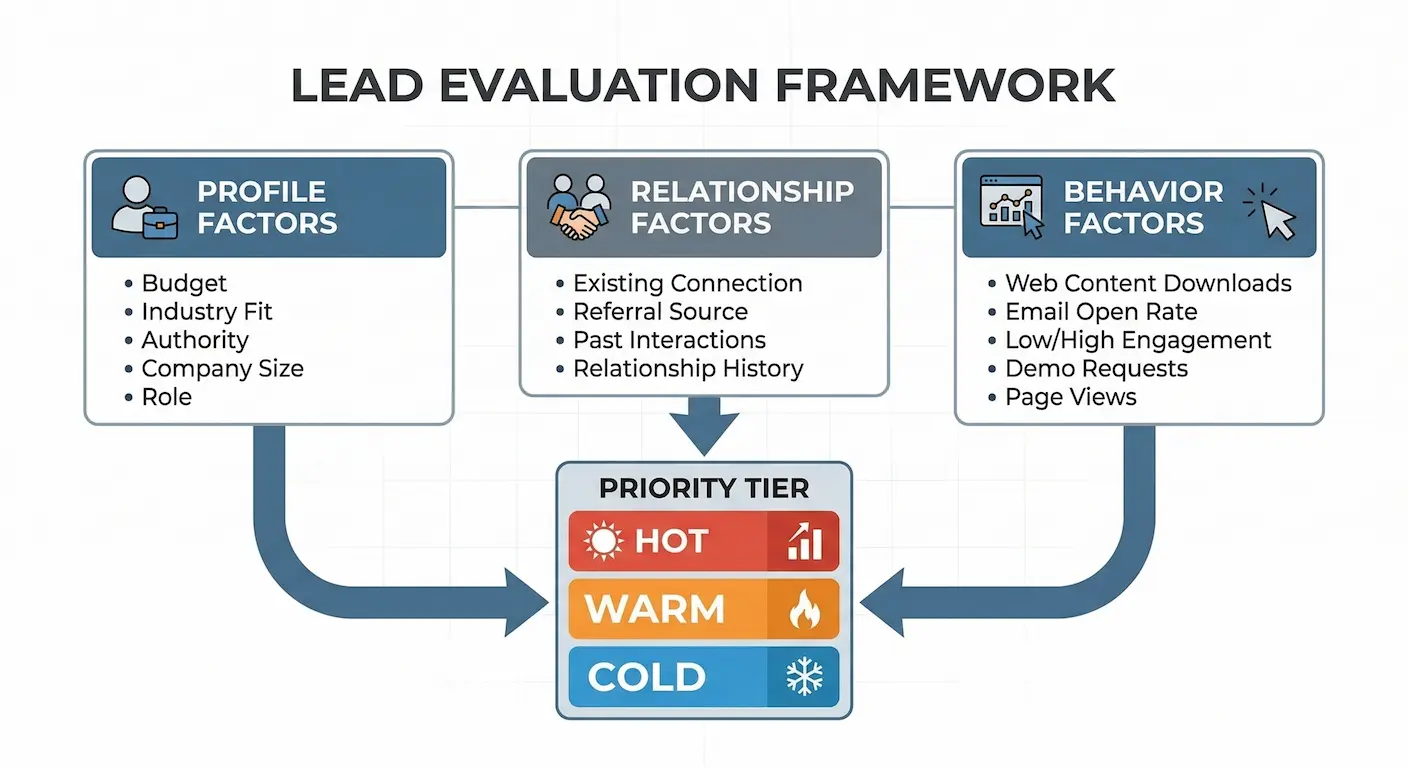
The framework has three components:
- Profile factors – Who is this prospect? Do they fit your ideal client profile?
- Relationship factors – How did they find you? What’s the connection?
- Behavior factors – What have they done? What’s the level of engagement?
Together, these three factors give you a clear picture of which leads deserve immediate attention and which can wait.
Here’s why this works better than standard lead scoring for professional service firms.
It accounts for relationship quality. A referral from a trusted client is worth more than 50 website visits. Automated software treats them the same. A human evaluation process doesn’t.
It’s proportionate to your volume. If you get 20 leads per month, you don’t need software to rank them. You need a consistent way of thinking about them. The framework gives you that without the overhead.
It’s flexible enough for your situation. Different firms weigh factors differently. An accounting firm specializing in high-net-worth individuals cares about different signals than a management consultancy targeting mid-market manufacturers. The framework adapts; canned software doesn’t.
How It Looks Across Different Firms
Accounting firm: A current write-up client who downloads your payroll services information is a very different lead than an unknown prospect from another state who signed up for your webinar. The first deserves a personal call this week. The second goes into a nurture sequence.
IT consulting practice: A prospect referred by your best client who asked specific technical questions in the inquiry form is a priority. A prospect who filled out a generic contact form after finding you on Google is not. At least not yet.
Management consulting: A prospect who attended your webinar, connected on LinkedIn, and then asked a specific question about your methodology is clearly engaged. A prospect whose admin assistant submitted an inquiry form on their behalf requires a different approach.
In each case, the evaluation isn’t just about points on a spreadsheet. It’s about understanding the context and making a judgment call about where to invest your follow-up time.
How to Build Your Lead Evaluation Process: A Step-by-Step Guide
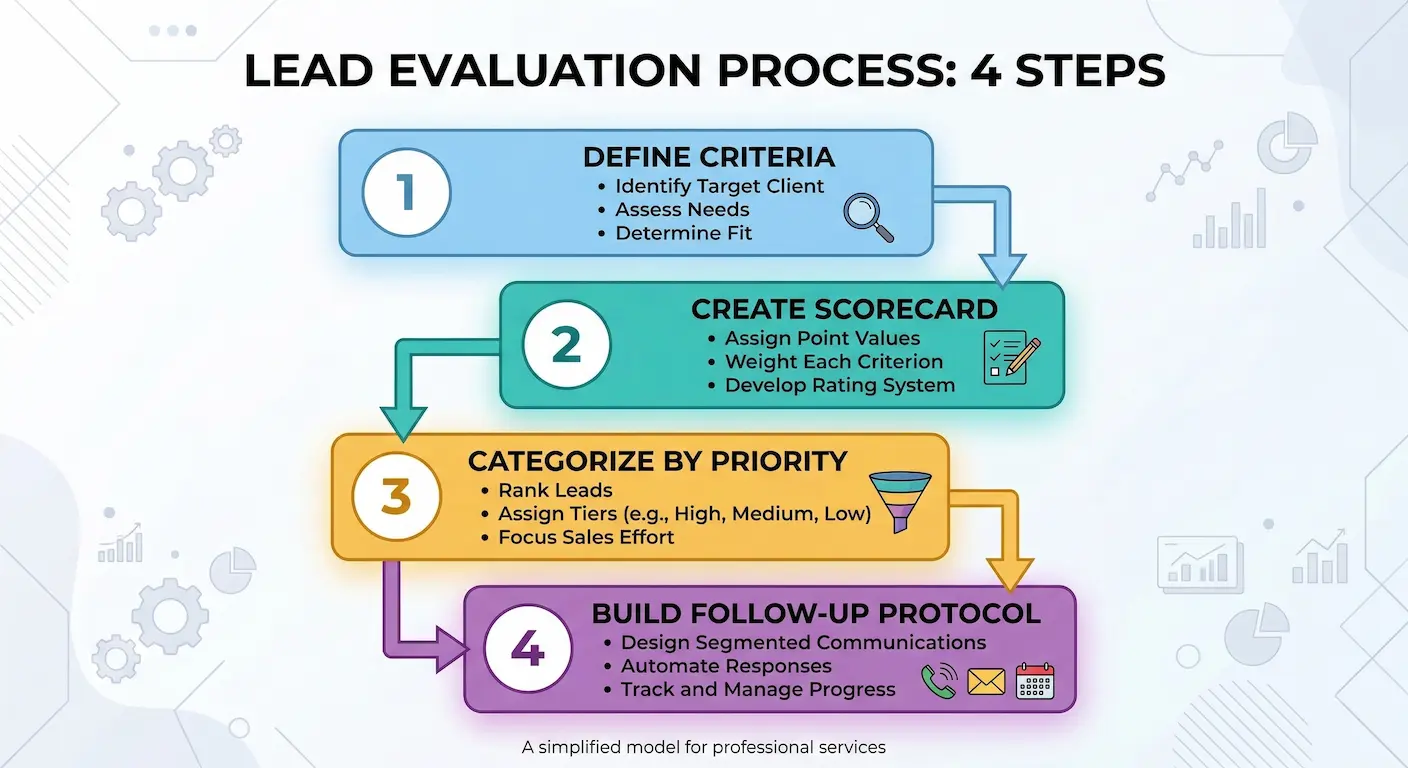
Step 1: Define Your Lead Evaluation Criteria
Why This Matters
You can’t prioritize leads consistently if your criteria live only in your head. The moment you write them down, two things happen: your process becomes repeatable, and you can actually test whether it’s working.
How to Do It
Start by identifying the factors that have historically predicted which leads turn into good clients.
Profile factors to consider:
- Industry or firm type (do they match your target market?)
- Company size or revenue range
- Geographic location (if relevant to your service model)
- Role or title of the person contacting you
- Current situation (are they in a crisis, a growth phase, or steady state?)
Relationship factors to consider:
- Source of the lead (referral, speaking engagement, content, cold search)
- Who referred them, and how well you know that person
- Prior relationship with you or your firm
- Shared connections in your professional network
Behavior factors to consider:
- What prompted them to reach out (specific trigger event vs. general interest)
- What they’ve consumed (one white paper vs. multiple pieces of content)
- How specific their inquiry was (vague interest vs. specific questions about your process)
- Timeline, do they have an urgent need or are they just exploring?
What Good Looks Like
You’ll know your criteria are solid when a new team member could use them to evaluate a lead without asking you 10 questions.
Avoid This Common Mistake
Don’t try to assign precise numerical weights to every factor. The goal is a consistent evaluation process, not a formula that pretends to be more scientific than it is. Relationships and context matter too much for pure point systems.
Step 2: Create a Simple Lead Evaluation Scorecard
Why This Matters
Once you have your criteria, you need a consistent way to apply them. A simple scorecard makes the process fast and replicable, even for leads you didn’t handle personally.
How to Do It
You don’t need software for this. A simple spreadsheet or even a printed template works.
The process:
- List your top 5-7 evaluation criteria from Step 1.
- Assign a weight to each (High / Medium / Low, not precise point values).
- For each new lead, quickly evaluate them against each criterion.
- Make a judgment call: Hot, Warm, or Cold.
Sample scorecard for a boutique consulting firm:
| Factor | Weight | Notes |
|---|---|---|
| Referral source | High | Referred by existing client = immediate priority |
| Fits target profile | High | Must match ideal client criteria |
| Specific inquiry | Medium | Detailed questions signal genuine interest |
| Content engagement | Medium | Multiple touchpoints increase credibility |
| Timeline | High | Urgent need = higher priority |
| Geographic fit | Low | Unless you have service area restrictions |
What to Look For
You should be able to evaluate most leads in under 5 minutes. If it takes longer, your criteria are too complicated.
Tools/Resources
- A simple Google Sheet or Excel template
- Your CRM’s contact notes field (if you use one)
- A one-page reference guide with your criteria and weights
Step 3: Categorize Leads by Priority
Why This Matters
The whole point of evaluation is action. Once you’ve assessed a lead, you need to know exactly what happens next. And that should vary based on priority.
How to Do It
Keep it simple: three tiers.
Hot: Strong profile match, high-quality referral source or specific engagement, clear urgent need. These leads get personal attention within 24 hours – a phone call, not an email.
Warm: Good profile match, some engagement, but no immediate urgency or weaker referral source. These go into a structured follow-up sequence: a personal email, then a call within the week.
Cold: Poor profile match, generic inquiry, no referral context, no timeline. These go into a nurture sequence. You stay in front of them, but you don’t prioritize them over hot and warm leads.
What to Look For
If you’re putting everything in the “Warm” category, your criteria aren’t specific enough. Push yourself to differentiate.
A Common Mistake to Avoid
Don’t let Hot leads sit while you process all the Warm ones. Hot leads cool quickly. If someone is ready to talk, they’re having that conversation with someone. It might as well be you.
Step 4: Build a Follow-Up Protocol for Each Tier
Why This Matters
A lead evaluation system only works if it’s connected to specific action. Otherwise, you’ve done the work of evaluation but not the work of follow-up.
How to Do It
Define your follow-up protocol for each tier before the leads arrive, not after.
Hot lead protocol:
- Respond within 24 hours
- Personal phone call or video meeting request (not just email)
- Reference the referral source or specific inquiry in your outreach
- Propose a specific next step (a discovery call, not a vague “let’s connect”)
Warm lead protocol:
- Respond within 48-72 hours
- Personal email with relevant content (case study, relevant article)
- Follow up with a call within 5 business days if no response
- Add to newsletter or nurture sequence if no response after 2 attempts
Cold lead protocol:
- Standard acknowledgment email
- Add to newsletter or nurture sequence
- Set a 90-day reminder to reassess
- No hard follow-up unless they re-engage
Tools/Resources
- Calendar reminders or CRM tasks for follow-ups
- 2-3 email templates for each tier (personalized, but based on consistent frameworks)
- A simple tracking method (CRM, spreadsheet, or even a paper system)
Questions to Ask Yourself
- Do I actually follow up differently with Hot vs. Warm vs. Cold leads right now?
- If I handed this to someone else to manage, would they know what to do with each tier?
- Am I spending follow-up time in proportion to lead priority?
Common Questions About Lead Evaluation for Professional Services
“But my lead volume is so low, do I even need a system?”
Maybe not software. But you need a process.
Even with 5 leads a month, you still need to decide which to prioritize. Without consistent criteria, you’ll default to who reached out most recently, who’s most persistent, or who you personally like. None of which are reliable predictors of fit or revenue potential.
A simple process takes 30 minutes to set up and pays for itself the first time it saves you from chasing the wrong lead.
“Won’t software just handle this automatically?”
Sometimes, eventually. But software doesn’t create your evaluation criteria. You do. And in most boutique professional service firms, the relationship context that matters most can’t be captured by software.
Start with a manual process. Once your volume grows to the point where manual evaluation isn’t realistic, you’ll have well-defined criteria that make software implementation much easier. And much more likely to actually work.
“This sounds like extra work. I’m already stretched thin.”
The goal isn’t to add a process. It’s to replace an inconsistent, reactive approach with a consistent, proactive one. Most founders are already making these judgment calls informally. Writing down the criteria takes 30 minutes. Using the scorecard adds 5 minutes per lead.
The time you save by not chasing cold leads more than covers the investment.
“I’ve tried to organize my follow-up before and it never sticks.”
Most follow-up systems fail for one of two reasons: they’re too complicated, or they’re not connected to specific actions.
Keep your evaluation criteria to 5-7 factors. Define exactly what happens for each tier. Put the follow-up actions in your calendar or CRM the moment you categorize a lead. Simple systems get used; complex ones don’t.
“When should I consider actual lead scoring software?”
When you have consistent volume (50+ leads per month), a dedicated person managing follow-up, and a defined process that you’ve already validated manually. At that point, software makes your process faster and more scalable.
If you don’t have those things yet, software solves the wrong problem.
The Bottom Line: Process First, Technology Second

Lead scoring is a valuable concept. The idea of evaluating and prioritizing leads based on profile fit and engagement behavior makes sense for virtually any professional service firm.
The mistake most firms make is starting with software instead of starting with process.
Here’s what to remember:
- Standard lead scoring software was built for high-volume, product-focused sales. It doesn’t fit how professional services sell
- The relationship context of a lead (who referred them, how they found you) often matters more than behavioral data alone
- A manual lead evaluation process (defined criteria, simple scorecard, tiered follow-up) gives you most of the benefit without the software overhead
- Process first, technology second: build the manual version before you invest in automation
Your Next Steps
This week, write down the 5-7 factors that most reliably indicate a good lead for your firm. Start with profile fit and referral source. Those two alone will improve your prioritization immediately.
Once you have your criteria, you’ve done the hard part. The scorecard and follow-up protocol follow naturally.
Six months from now, you’ll spend your follow-up time on the leads most likely to turn into clients. Not just the most recent ones or the most persistent ones. That’s what a good lead evaluation process actually does.
Want More Insights Like This?
Subscribe to The Business Builder, my weekly newsletter for boutique B2B and professional service firm founders who want to generate consistent leads, improve their sales process, and build stronger client relationships.
Every week I share frameworks and practical steps you can implement immediately. No fluff, no generic marketing advice, just what actually works for professional service firms.