
How to Close Deals Faster & Defend Premium Fees
Sales enablement copywriting assets matter because they make it easier for a buyer to say “yes.”
In professional services, most firms don’t lose deals because of capability. They lose deals because prospects don’t fully understand the offer, can’t retell the value internally, or don’t have anything in writing to justify the investment.
That is where sales enablement copywriting comes in. It packages your value, proof, and process in a way that reduces friction, moves conversations forward, and helps you defend premium fees without discounting.
The Unique Challenges of Selling Professional Services
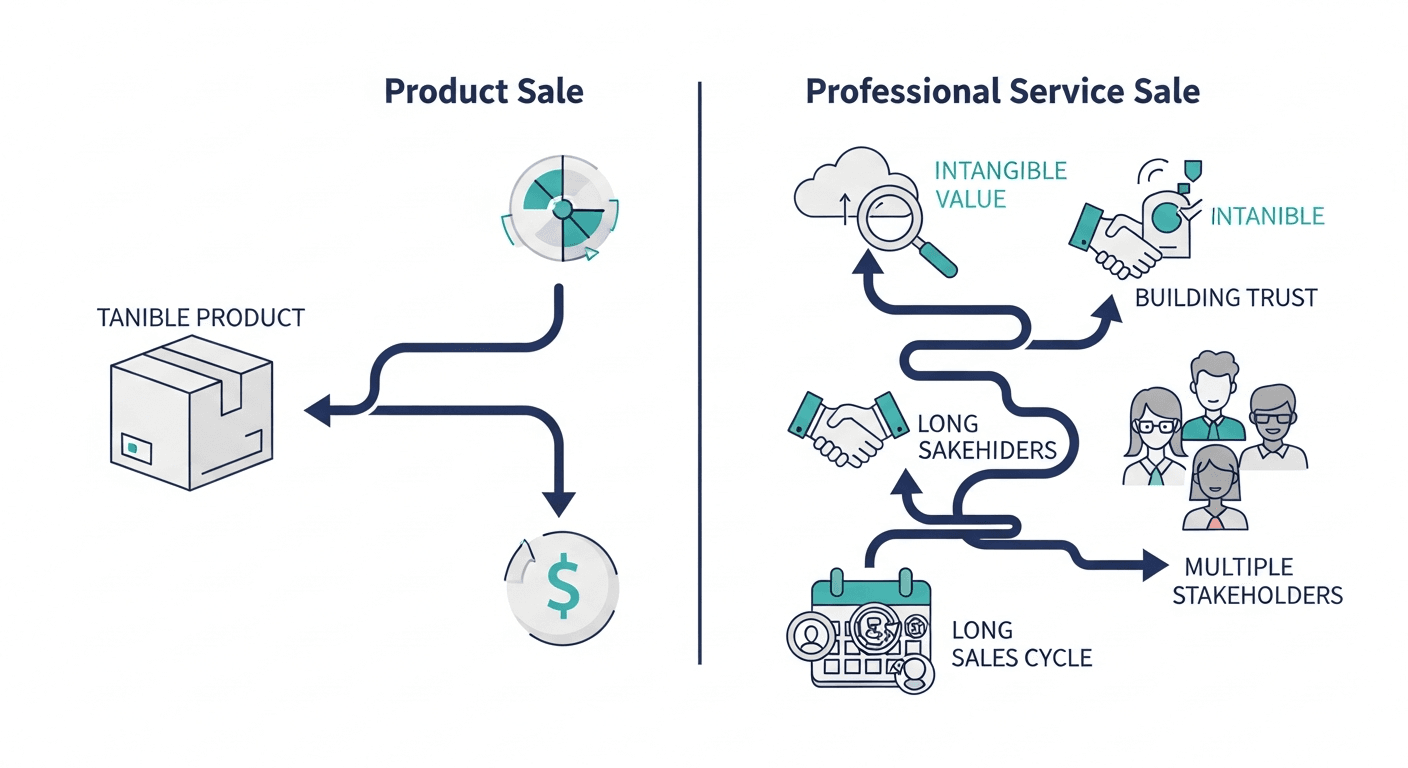
Selling professional services is harder than selling products. A product is tangible. You can demo it, touch it, and see what you’re getting.
Professional services? Not so much.
You’re selling expertise, strategy, and outcomes that don’t exist yet. Buyers are investing in your ability to solve problems they may not fully understand themselves. They’re looking for a partnership, not just a transaction.
This creates several challenges:
The sales cycle is long. Multiple stakeholders need to weigh in. Each one needs different information at different times.
Trust takes time to build. You can’t just show a prototype. You have to prove competence through conversation, credentials, and case studies.
Differentiation is difficult. When five firms can all claim similar capabilities, how do you stand out?
Value is hard to quantify. The ROI of strategic consulting or specialized legal advice isn’t always immediately clear.
Generic sales content makes all of this worse. It creates doubt instead of confidence, and it pushes buyers toward cheaper alternatives because they can’t see the difference in value.
Why Generic Sales Content Fails Premium Services
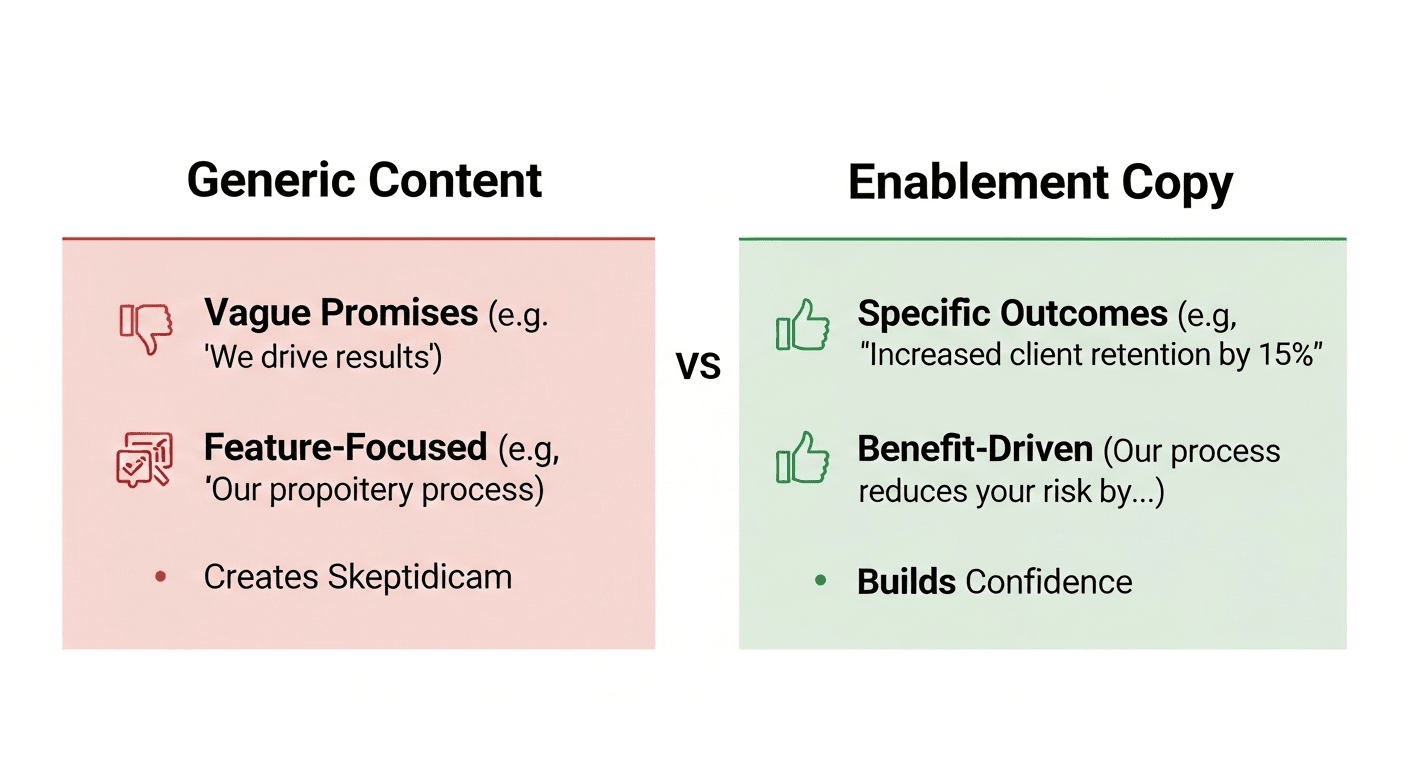
Generic content kills premium pricing.
When a buyer is evaluating specialized expertise, they’re not looking for one-size-fits-all solutions. They’re looking for proof that you understand their specific situation, have solved similar problems before, and can articulate exactly how you’ll deliver results.
Generic content misses on all three counts.
Here’s what happens when your sales materials rely on vague promises and industry buzzwords:
- Buyers question your expertise. If you can’t clearly explain your value, they assume you don’t have a differentiated approach.
- You trigger price sensitivity. When buyers can’t see the difference between you and a cheaper competitor, price becomes the only decision factor.
- You lose internal champions. Even if someone wants to hire you, they can’t make the case to their team without specific, compelling proof points.
The fix isn’t more content. It’s better content. Content that speaks to specific outcomes, addresses real concerns, and demonstrates your unique methodology in clear terms.
What This Article Will Cover
This guide will show you how to create sales enablement copy that actually moves deals forward.
You’ll learn:
- The foundational principles of persuasive communication for professional services
- How to map content to the buyer’s journey so you’re delivering the right message at the right time
- Specific techniques to shorten sales cycles and increase win rates
- How to justify premium pricing through strategic messaging
- Which content assets matter most and how to write them
- How to use research, client intelligence, and data to inform your copy
- Ways to leverage AI and technology without losing the human touch
By the end, you’ll have a clear roadmap for transforming your sales collateral into a powerful tool for closing deals faster and defending the premium fees your expertise deserves.
For additional proven methods and tactical frameworks, check out our guide on sales enablement copywriting best practices.
Understanding Sales Enablement’s Role in Professional Services
Sales enablement is more than brochures and battle cards.
It’s the strategic function that equips your sales team with the right content, messaging, and tools to engage buyers at every stage of the decision process. For professional services, this matters even more because the buying decision is tied directly to trust, relationship, and proven expertise.
The numbers back this up:
- The professional services industry was valued at $6.4 billion in 2023 and is projected to reach $10.1 billion by 2032
- Sales teams with strong alignment between marketing and sales grow 41% more in reaching quotas
- The global sales enablement market is expected to grow from $5.23 billion in 2024 to $12.78 billion by 2030
Good sales enablement helps firms capture more of that growth. It gives your team the assets they need to move deals forward, defend premium pricing, and close faster.
Defining Sales Enablement Beyond Basic Training
Sales enablement in professional services goes well beyond training your team on product features or pitch decks.
It’s the strategic alignment of marketing and sales. It’s providing relevant, persuasive content at every stage of the buyer’s journey. It’s implementing technology that streamlines processes and tracks what’s working. And it’s the continuous development of your sales team’s skills and knowledge.
Think of it as creating an ecosystem where every sales interaction is informed, supported, and optimized. Your team doesn’t just have product knowledge. They have the right tools, the right messaging, and the right content to navigate complex buying processes, build meaningful relationships, and communicate your unique value clearly.
The goal is simple: make your sales team more productive, consistent, and successful in ways that directly impact your bottom line.
The Sales Journey in Professional Services: Trust, Expertise, and Relationship Building
The professional services sales journey isn’t linear. It’s not about features and price comparisons.
It’s fundamentally about building trust and demonstrating expertise.
Your buyers are investing in confidence. Confidence that you understand their complex problems, possess the expertise to solve them, and have the talent to execute effectively.
This journey includes:
- Multiple touchpoints across different channels
- Extensive due diligence and vetting
- Conversations with multiple stakeholders
- The gradual development of a trusted advisor relationship
Effective communication at every stage is critical. You need to showcase not just what you do, but how you do it and the tangible impact you’ve had on similar clients’ outcomes.
How Strategic Copy Transforms the Sales Experience
Strategic copywriting is what drives a positive and persuasive sales experience.
It transforms abstract capabilities into compelling narratives that resonate with buyer needs. Well-crafted content can:
- Preemptively answer questions before they become objections
- Address unspoken concerns about risk, implementation, or ROI
- Articulate your unique methodology in ways that buyers can understand and remember
- Guide prospects through their decision-making process with confidence
By tailoring your messaging to the specific pain points and aspirations of each buyer segment, you foster a sense of understanding and partnership. This doesn’t just accelerate the path to a decision. It lays the groundwork for a strong, long-term client relationship.
The Link Between Effective Copy and Business Growth
Good sales enablement copy directly impacts business growth.
When your copy accurately and persuasively communicates value, several things happen:
- Win rates increase
- Sales cycles shorten
- You can defend and maintain premium pricing
- Client relationships strengthen, leading to repeat business and referrals
The data support this. Organizations with formal sales enablement programs achieve a 49% higher win rate on forecasted deals.
That translates to real revenue and profitability gains. In a competitive market, effective sales enablement copywriting isn’t a nice-to-have. It’s a critical lever for market share expansion and sustainable growth.
The Foundation: Core Principles of Sales Enablement Copywriting for Professional Services
The most effective sales enablement copy is built on a foundation of core principles.
These principles ensure your content doesn’t just inform, but persuades, builds trust, and clearly articulates the unique value you bring to clients.
Establishing Trust and Authority
Trust is currency in professional services.
Your copywriting must be engineered to build and solidify that trust from the first interaction. This means:
- Presenting accurate, well-researched information
- Demonstrating deep knowledge about the client’s industry and challenges
- Backing up claims with proof points, not just declarations
Authority isn’t established through bold statements alone. It comes from showcasing a proven track record, a deep understanding of complex issues, and a confident articulation of solutions.
Highlight your team’s expertise through structured narratives and credible insights. Position your firm as a thought leader. When prospects see you as an authority, they’re more receptive to your recommendations and more willing to invest at premium rates.
Beyond Jargon: Crafting Clear, Concise, and Compelling Content
Professional services often involve complex concepts and specialized terminology. But using excessive jargon in sales content alienates prospects and obscures your message.
Effective copywriting prioritizes clarity and conciseness.
Your goal is to ensure every prospect, regardless of their technical background, can grasp the essence of your offering and its benefits. That means:
- Stripping away unnecessary buzzwords
- Using active voice
- Structuring content logically to guide the reader
- Translating complex ideas into digestible information
When you present information with precision and clarity, you enhance the perceived professionalism and expertise of your firm.
Focusing on Client Outcomes, Not Just Service Features
One of the biggest mistakes in selling professional services is focusing on what you do rather than on what the client achieves.
Feature-focused copy talks about your services and methods. Outcome-focused copy shows the real benefits and solutions your services provide.
Compare these two approaches:
Feature-focused: “We offer advanced data analytics.”
Outcome-focused: “We leverage advanced data analytics to uncover actionable insights that drive a 15% increase in customer retention for our clients.”
By shifting the focus to client outcomes, you demonstrate a deep understanding of their goals and provide concrete evidence of the value and ROI your firm delivers. This makes your business case far more compelling.
For more on structuring compelling value propositions, see our guide on how to craft B2B offers that sell.
Differentiating Your Firm in a Crowded Market
In a marketplace where many firms offer similar services, your unique approach is a powerful differentiator.
Your sales enablement copy must effectively communicate what sets you apart. This could be:
- Your specific industry focus or niche expertise
- Your proprietary methodology or framework
- Your innovative approach to problem-solving
- The collective talent and experience of your team
Storytelling plays a vital role here. Use narrative to weave together your firm’s journey, core values, and the distinctive way you approach client challenges.
Articulating this unique positioning builds a strong connection with prospects and makes your firm more memorable and desirable.
Empathy-Driven Messaging: Addressing Client Pain Points and Aspirations
The most persuasive copy is rooted in empathy.
It demonstrates genuine understanding of the prospect’s pain points, challenges, and aspirations. This requires thorough research into your ideal client profile and a deep dive into industry-specific issues relevant to their role.
By acknowledging their struggles and articulating how your services provide relief and enable success, you build rapport and establish your firm as a trusted advisor.
Empathy-driven messaging shows you’re not just selling a service. You’re offering a solution that genuinely addresses their needs and helps them achieve their goals.
The Art of Storytelling to Showcase Expertise and Impact
Storytelling transforms dry facts and features into engaging narratives that capture attention and resonate emotionally.
For professional services, stories powerfully illustrate how your expertise and talent have been applied to solve complex problems and achieve significant client success.
Use these storytelling vehicles:
- Case studies that detail the challenge, your approach, and quantifiable results
- Client testimonials that provide authentic validation
- Anecdotes about overcoming specific obstacles or breakthrough moments
By framing your expertise within a narrative structure, you make your firm more relatable and memorable. This enhances perceived value and drives stronger response from prospects.
Strategies for Crafting Copy That Accelerates Deal Closure
Effective sales enablement copy doesn’t just inform. It actively guides prospects toward a decision.
The right content, delivered at the right time, can significantly shorten sales cycles and increase win rates.
Mapping Copy to the Professional Services Buyer’s Journey
Understanding the buyer’s journey is fundamental to creating copy that accelerates deal closure.
Prospects move through distinct phases: awareness, consideration, and decision. Your copy needs to match where they are.
Awareness stage: Focus on problem identification and education. Help them understand the challenge they’re facing.
Consideration stage: Highlight solutions and differentiate your firm’s approach. Show them why your methodology works.
Decision stage: Build confidence, address final concerns, and provide clear paths to engagement.
This means developing a range of assets tailored to each stage:
- Insightful blog posts and thought leadership for awareness
- Detailed case studies and methodology overviews for consideration
- Proposals, ROI calculators, and implementation plans for decision-making
Strategic mapping ensures information is delivered precisely when it’s most impactful.
Writing Action-Oriented Language and Clear Calls to Action
Every piece of sales enablement copy should have a clear purpose. Usually, that purpose involves prompting a specific action.
Action-oriented language, coupled with strong, unambiguous calls to action (CTAs), guides prospects toward the next logical step.
Instead of passive phrases, use verbs that inspire immediate response:
- “Schedule Your Consultation”
- “Download the Guide”
- “Request a Proposal”
- “Book a Discovery Call”
Make sure CTAs are prominently placed and clearly communicate the benefit of taking action. This directness prevents ambiguity and encourages engagement, propelling deals forward more efficiently.
Proactively Addressing Objections and Concerns
Unresolved objections and unanswered concerns are major factors in lengthening sales cycles.
Effective sales enablement copy anticipates these potential roadblocks and addresses them proactively.
This could involve:
- Including sections in proposals that detail your risk mitigation strategies
- Elaborating on implementation timelines and resource requirements
- Providing detailed FAQs that clarify common points of confusion
- Addressing pricing concerns with ROI justification
By addressing potential objections head-on, you demonstrate transparency, build credibility, and alleviate buyer apprehension. This smooths the path to conversion and shortens the time it takes to close a deal.
Personalization at Scale: Leveraging Client Data for Targeted Messaging
Personalization is no longer a luxury. It’s an expectation.
Leveraging client data and using technology such as CRM systems enables you to personalize sales enablement content at scale.
This means tailoring:
- Emails to reference specific pain points or previous conversations
- Proposals to reflect industry-specific challenges
- Website content to adapt based on visitor behavior
- Follow-up materials to align with expressed interests
For professional services, this level of personalization signals a deep understanding of the client’s unique context and a commitment to delivering bespoke solutions.
It transforms generic communications into highly relevant dialogues that foster stronger connections and accelerate the buying process.
The Strategic Use of Meeting Recaps and Follow-Up Communications
The communication after a meeting or call is often as critical as the interaction itself.
Well-crafted recaps and follow-up messages serve to:
- Reinforce key discussion points
- Clarify next steps and timelines
- Maintain momentum in the sales process
For professional services, these communications are prime opportunities to reiterate value, demonstrate continued engagement, and showcase your attention to detail.
Structure your follow-ups to include:
- Summary of agreed-upon actions
- Proposed timelines
- Relevant supplementary information or resources
- Clear next steps
This consistent, professional follow-up builds trust and keeps deals moving forward.
Defending Premium Fees: How Copy Justifies Your Value and Expertise
Your pricing often reflects the specialized talent, deep expertise, and extensive experience you bring.
Effectively defending these premium fees requires copywriting that clearly articulates the superior value and ROI your firm delivers.
Quantifying the Intangible: Articulating ROI
One of the biggest challenges in selling professional services is quantifying the return on investment for intangible offerings.
Your sales enablement copy must bridge this gap by translating expert advice and strategic solutions into measurable business outcomes.
Use these approaches:
- Leverage data from past client engagements
- Present case studies with specific metrics
- Include testimonials that reference quantifiable improvements
- Create ROI calculators or models
Show how your services lead to:
- Increased revenue
- Reduced costs
- Improved efficiency
- Mitigated risk
- Enhanced market position
Presenting these quantifiable benefits helps prospects understand that your premium pricing is an investment with a clear, positive financial return, not just an expense.
Showcasing Your Unique Methodology and Proprietary Approach
Your firm’s unique methodology, processes, and proprietary approaches are powerful justifications for premium pricing.
Your sales enablement copy should clearly articulate these differentiating factors. Explain how your distinct way of working leads to superior results.
Whether it’s:
- A specific framework you’ve developed
- A data-driven analytical model
- A client-centric engagement process
- Proprietary tools or technology
Highlight these unique aspects to showcase your expertise and provide concrete reasons why your services are more valuable than lower-cost alternatives.
This detailed explanation builds confidence and creates a perception of exclusivity.
Building a Narrative of Exclusive Expertise and Value
Effective copywriting constructs a compelling narrative around your firm’s exclusive expertise and the unique value it provides.
Frame your services not just as solutions, but as strategic advantages that position clients for greater success.
Consistently reinforce:
- Your deep domain knowledge
- Your specialized talent and credentials
- Your proven track record
- Your thought leadership in the industry
This narrative elevates your firm beyond a mere vendor to a trusted partner indispensable to the client’s long-term business objectives.
It creates a strong perceived value that directly supports premium pricing.
Leveraging Social Proof: Testimonials, Case Studies, and Industry Recognition
Social proof is powerful for justifying premium pricing.
Strategically integrate these elements into your sales enablement copy:
Testimonials from satisfied clients provide authentic validation of your expertise and impact.
Detailed case studies showcase successful outcomes and demonstrate ROI. Structure them to illustrate:
- The specific challenges faced by a similar client
- The innovative solutions your firm provided
- The quantifiable results achieved
Industry accolades and recognition serve as independent validation of your firm’s expertise.
This collective proof builds immense credibility and helps justify your fees.
The Power of Comparison: Differentiating from Lower-Cost Alternatives
When prospects evaluate your premium services, they’re often comparing you to less expensive alternatives.
Your copywriting must proactively address this by highlighting the critical differences in value, not just price.
Emphasize:
- The depth of your expertise and specialized knowledge
- The quality and experience of your talent
- The rigor of your methodology
- The long-term benefits that lower-cost options may not provide
Frame the comparison not as a matter of cost, but as a choice between short-term expediency and sustainable, high-impact business solutions.
This strategic differentiation reinforces why your premium offering is the more prudent and ultimately more valuable investment.
Articulating Risk Mitigation and Long-Term Value Creation
Premium pricing can often be justified by the value your services provide in mitigating risk and ensuring long-term success.
Your sales enablement copy should articulate how your expertise and proven processes help clients:
- Avoid costly mistakes
- Navigate complex regulatory landscapes
- Secure their future market position
- Protect their reputation
- Ensure compliance
By highlighting your firm’s ability to foresee and circumvent potential pitfalls, you demonstrate the inherent value in your specialized knowledge.
This focus on risk mitigation, coupled with the long-term value creation your services enable, provides a robust rationale for premium fees.
Key Sales Enablement Content Assets: Copywriting Best Practices
To effectively implement sales enablement strategies, you need a robust toolkit of carefully crafted copywriting assets.
Each asset should be designed for maximum impact at specific stages of the buyer’s journey.
Note: For a comprehensive overview of both internal and external asset types, see our guide to sales enablement assets that drive revenue.
Sell Sheets (aka One Sheets)
One of the most versatile and effective assets in your toolkit is the sell sheet. A sell sheet is a focused, single-page (double-sided) tool that addresses one specific buying decision.
Learn how to create sell sheets that actually drive buying decisions
Winning Proposals and Statements of Work (SOWs)
Proposals and SOWs are pivotal documents in the professional services sales cycle.
The copywriting within these assets must be:
Persuasive – Making a compelling case for why your firm is the right choice
Clear – Removing any ambiguity about scope, deliverables, and expectations
Detailed – Providing enough specificity to build confidence
Structure your proposals to:
- Demonstrate deep understanding of the client’s business and challenges
- Translate client needs into a precise scope of work
- Outline your methodology and approach
- Articulate expected outcomes with measurable success criteria
- Clearly define deliverables, timelines, and milestones
- Address potential risks and mitigation strategies
The language you use here not only solidifies the agreement but also reinforces the prospect’s decision and sets clear expectations for the engagement.
Compelling Case Studies and Success Stories
Case studies are perhaps the most potent sales enablement asset for professional services.
They provide concrete evidence of your firm’s capabilities and showcase real-world application of your expertise.
Effective case studies go beyond project descriptions. They tell a story of transformation:
The Challenge: Detail the client’s initial situation and specific problems
The Approach: Explain your methodology and unique strategy (without giving away proprietary details)
The Obstacles: Show how you navigated challenges during the engagement
The Results: Present quantifiable outcomes and business impact
This narrative approach, rich with authentic client experience, builds immense credibility and justifies premium pricing by demonstrating tangible ROI.
If you’re considering working with a professional writer to create compelling case studies, read our guide on what to expect when creating a B2B case study.
High-Impact Capabilities Decks and Pitch Materials
Capabilities decks and pitch materials are often the first in-depth content prospects encounter.
These assets must deliver essential information concisely and impactfully.
Your copywriting should:
- Clearly articulate your firm’s core competencies
- Highlight your unique selling propositions
- Define your target markets and ideal clients
- Present your value proposition compellingly
- Showcase relevant experience and credentials
Each slide or page should convey a clear message, moving the prospect through your firm’s story logically.
Make a strong impression that encourages further engagement. Avoid the temptation to cram too much information into these materials. Clarity and focus are more powerful than comprehensiveness.
While capabilities decks provide a comprehensive overview of your firm, they’re often too broad for specific sales conversations. For prospects evaluating you for a particular service, you need something more focused: a sell sheet. Unlike capabilities decks that try to showcase everything, sell sheets address one buying decision with laser focus.
Effective Email Sequences
Email sequences are crucial for nurturing leads and maintaining relationships throughout the buyer’s journey.
For professional services, these sequences should be:
Personalized – Referenced to specific conversations or expressed interests
Insightful – Offering valuable information, not just sales pitches
Value-driven – Providing thought leadership or relevant insights
The goal is to build trust, establish your firm as a knowledgeable resource, and encourage engagement.
Structure your sequences to:
- Welcome new prospects and set expectations
- Share relevant content based on their stage in the journey
- Provide industry insights or thought leadership
- Invite engagement through calls, consultations, or events
- Follow up on previous interactions with relevant next steps
This consistent, high-quality communication moves prospects through the funnel naturally.
Creating effective email sequences requires more than just good writing. It demands a deep understanding of professional services buyer psychology, strategic frameworks for different scenarios, and the ability to balance automation with authentic personalization.
For a comprehensive guide to creating email templates that actually convert, including specific frameworks for cold outreach, follow-up sequences, and trigger-based emails, read our detailed article on sales email templates for professional services.
When following up with prospects after discovery calls or meetings, one of the most effective attachments is a targeted sell sheet that addresses their specific need. Discover how to create sell sheets that complement your email sequences.
Webinar and Event Invitations and Follow-ups
Hosting or participating in webinars, events, and virtual experiences is a key strategy for professional services firms.
The copywriting for invitations must be compelling and informative:
Invitations should:
- Clearly articulate the value proposition of attending
- Highlight key takeaways and learning objectives
- Showcase the expertise of speakers or panelists
- Make registration simple and friction-free
Follow-up communications should:
- Reinforce the key learnings
- Provide access to recordings, slides, or resources
- Include clear calls to action for next steps
- Offer personalized consultations or deeper engagement
These touchpoints are critical for lead generation and nurturing. Treat them as opportunities to demonstrate expertise and move relationships forward.
FAQs and Objection Handling Guides for Sales Teams
Empowering your sales team with readily accessible, well-written responses to common questions and objections is essential.
FAQs and objection handling guides provide your sales team with:
- Consistent messaging across all client interactions
- Accurate information that builds credibility
- Persuasive responses that reinforce value
- Confidence to address concerns effectively
The copywriting here needs to be clear, concise, and confident.
Structure these guides to include:
- Common questions about your services, process, or pricing
- Typical objections and recommended responses
- Competitive differentiators to emphasize
- Proof points and supporting data
This ensures a unified front and streamlines conversations, ultimately leading to faster deal closures.
The Role of Research and Intelligence in High-Performance Sales Enablement Copy
The most impactful sales enablement copy isn’t born from guesswork. It comes from deep research and strategic intelligence.
Understanding your audience and market is fundamental to crafting messages that resonate.
Deep Dive into Ideal Client Profiles
A thorough understanding of your Ideal Client Profile (ICP) is the foundation of effective sales enablement copywriting.
Go beyond basic demographics to include:
Psychographics – Their values, attitudes, and decision-making styles
Goals – What they’re trying to achieve in their role and organization
Pain Points – The specific challenges and frustrations they face
Decision Process – How they evaluate vendors and make purchasing decisions
Gather this intelligence through:
- Market research and industry analysis
- Analysis of past client data and patterns
- Direct conversations with your sales team
- Client interviews and feedback
Armed with this deep understanding, you can craft copy that speaks directly to their needs, demonstrating empathy and positioning your services as the ideal solution.
Competitive Intelligence: Identifying Your Unique Selling Proposition
Understanding the competitive landscape is crucial for differentiation and justifying premium pricing.
Competitive intelligence involves:
- Analyzing what your competitors offer
- Understanding how they position themselves
- Identifying their strengths and weaknesses
- Recognizing gaps in the market
This information allows you to identify your unique selling proposition (USP). What makes your firm distinctly valuable?
Your sales enablement copy should consistently highlight this USP, ensuring prospects clearly understand why your firm is the superior choice, especially when compared to lower-cost alternatives or established competitors.
Mining Sales Calls and Customer Interactions for Voice of the Customer (VOC) Insights
The most authentic intelligence often comes directly from your prospects and clients.
Mining data from sales calls, customer meetings, support interactions, and feedback surveys reveals invaluable insights into:
- The exact language your target audience uses
- Their true priorities and concerns
- Unspoken needs or desires
- Common objections or hesitations
Analyzing Voice of the Customer (VOC) allows you to incorporate their exact phrasing, concerns, and desired outcomes into your copywriting.
This approach ensures your content is not only relevant but also speaks the language of your prospects, making it significantly more persuasive and effective.
Data-Driven Copy Optimization: A/B Testing
High-performance sales enablement copy evolves through continuous optimization.
Utilizing data analytics and A/B testing allows you to refine your messaging for maximum impact.
Test different:
- Headlines and subject lines
- Calls to action
- Value propositions
- Content structures and formats
- Email send times and sequences
This data-driven approach moves beyond assumptions, providing empirical evidence to inform your copywriting strategy.
The insights gained from this iterative process ensure your content remains relevant, engaging, and effective in accelerating deals and defending premium fees.
Utilizing Market and Industry Intelligence
Leveraging broader market intelligence can inform strategic messaging in your sales enablement copy.
Stay informed about:
- Industry trends and emerging challenges
- Economic forecasts affecting your clients’ sectors
- Regulatory changes or compliance requirements
- Technological innovations impacting the industry
By demonstrating awareness of the larger business context in which your clients operate, you position your firm as a forward-thinking partner with deep expertise.
This allows you to anticipate future challenges and opportunities, offering proactive solutions and reinforcing the long-term value of your services.
This sophisticated application of intelligence significantly enhances your credibility and justifies premium pricing.
Leveraging Technology and AI to Enhance Sales Enablement Copywriting
Technology and AI are transforming how sales enablement copy is created, distributed, and personalized.
Used strategically, these tools offer significant opportunities for efficiency and effectiveness.
AI as a Copywriting Assistant
AI tools are becoming valuable assistants for copywriting tasks.
They can:
- Rapidly generate initial drafts of emails, proposals, and social media posts
- Conduct background research on industries and competitors
- Brainstorm creative ideas for content angles
- Help overcome writer’s block
- Speed up creation of boilerplate content
- Ensure consistency in messaging
For professional services, AI can increase productivity for sales and marketing teams, allowing them to focus on strategy and personalization.
However, AI should not replace human insight and strategic direction. Use it as a tool to enhance, not replace, your team’s expertise.
For specific AI use cases in B2B sales, check out our guide on using Grok AI to close more deals.
CRM Integration: Personalized Communication and Content Delivery
Integrating your sales enablement content with your Customer Relationship Management (CRM) system is essential for effective personalization.
CRMs store valuable client information that allows you to:
- Trigger targeted email sequences based on prospect behavior
- Suggest relevant collateral based on the prospect stage
- Track engagement with content
- Personalize outreach based on previous interactions
- Identify which content is most effective
This seamless integration empowers sales teams to deliver highly relevant messages that resonate with each prospect, fostering stronger relationships and driving faster conversions.
Content Management Systems for Accessibility and Consistency
A robust Content Management System (CMS) is critical for organizing, storing, and distributing your sales enablement assets.
A well-managed CMS ensures:
- Your sales team always has access to the latest, most accurate versions of content
- Consistent messaging across all client interactions
- Easy search and retrieval of relevant materials
- Version control to prevent outdated content usage
- Analytics on how content is being used
This prevents the use of outdated or inconsistent messaging, maintaining brand integrity and professionalism.
Analytics and Reporting Tools: Measuring Engagement
Understanding how your sales enablement copy is being consumed is vital for optimization.
Analytics tools integrated with your CMS, CRM, and other platforms provide insights into:
- Which assets are being accessed most frequently
- How long prospects are engaging with content
- What actions prospects take after consuming content
- Which content correlates with closed deals
Track metrics like:
- Email open and click-through rates
- Content download numbers
- Time spent on key proposal sections
- Conversion rates from specific content assets
This data allows you to measure engagement, identify high-performing content, and pinpoint areas for improvement.
Automation: Streamlining Asset Creation and Distribution
Automation plays a key role in making sales enablement copywriting scalable and efficient.
Automation can:
- Send email sequences for lead nurturing
- Generate personalized proposal sections based on client data
- Distribute content at optimal times
- Follow up on content engagement automatically
- Ensure crucial communications are sent on schedule
This frees up valuable time for sales professionals and marketing teams, allowing them to focus on strategic engagement rather than repetitive tasks.
It ensures the sales process becomes more fluid and responsive, directly contributing to faster deal closure.
Measuring the Impact of Sales Enablement Copy
The ultimate test of any sales enablement strategy is its impact on tangible business outcomes.
Measuring this impact allows for continuous improvement and demonstrates the ROI of your copywriting efforts.
Connecting Copy Effectiveness to Key Sales Metrics
The effectiveness of your sales enablement copywriting can be directly measured by its impact on:
Sales Cycle Length: Shorter sales cycles indicate that your content effectively guides prospects through the decision-making process.
Win Rates: Higher win rates suggest your messaging is compelling and persuasive, effectively differentiating your firm.
Average Deal Value: The ability to maintain or increase your average deal value, despite competitive pressures, indicates success in defending premium fees.
Quota Attainment: When your team consistently hits or exceeds quota, effective enablement content is often a contributing factor.
By tracking these metrics over time, you can attribute improvements to your copywriting strategy and identify areas for further refinement.
Organizations with formal sales enablement programs achieve a 49% higher win rate on forecasted deals.
Key Performance Indicators for Copy Performance
Specific KPIs provide a quantitative lens for assessing copy effectiveness:
- Email open and click-through rates: Indicate subject line and content engagement
- Content download numbers: Show which resources prospects find most valuable
- Time spent on key pages: Reveals which content holds attention
- Lead conversion rates: Tracks which content assets move prospects to the next stage
- Close rate by content asset: Identifies which collateral is most effective in closing deals
- Average deal size: Measures whether copy is successfully defending premium pricing
The increase in usage of enablement content from 40% to 59% between mid-2022 and mid-2023 (a 48% increase) highlights its growing importance and effectiveness.
The Ultimate Business Outcome: Growth and Profitability
The ultimate measure of success for sales enablement copywriting is its contribution to overall business growth and profitability.
When your copy consistently:
- Helps close deals faster
- Justifies premium pricing
- Strengthens client relationships
- Enhances your firm’s reputation
It directly impacts your bottom line.
Investing in strategic copywriting isn’t merely a marketing expense. It’s a fundamental investment in your firm’s ability to compete, thrive, and lead in a dynamic marketplace.
This focus on quantifiable business results elevates sales enablement from a tactical function to a strategic imperative.
Final Thoughts
Mastering sales enablement copywriting is a strategic imperative for professional services firms.
The intangible nature of your offerings demands a deliberate and thoughtful approach to communication. Generic content won’t cut it. Your copy needs to build trust, demonstrate expertise, and articulate value in ways that resonate with sophisticated buyers.
This guide has shown you how to:
- Map copywriting to the buyer’s journey
- Address objections proactively
- Personalize messaging at scale with technology
- Justify premium pricing through strategic content
- Leverage research and intelligence for better messaging
- Create specific assets that drive results
The firms that excel in competitive markets are those that communicate clearly and compellingly. Whether you’re navigating complex regulatory environments, providing specialized expertise, or competing against lower-cost alternatives, your ability to articulate value through strategic copy makes the difference.
Ultimately, investing in high-quality sales enablement copywriting is an investment in your firm’s future success. It’s about building trust, demonstrating expertise, and ensuring your value is not only understood but recognized.
This allows you to close deals faster and defend your premium fees with confidence.
Ready to implement these strategies but need expert help? Learn what to look for when hiring a sales enablement copywriter to ensure you get the results your firm deserves.