
You’ve probably seen them at every industry conference and networking event. Those polished capability decks that accounting and consulting firms proudly distribute. Twenty glossy pages showcasing services, team headshots, and a collection of client logos arranged like trophies.
They look expensive. They feel substantial. They communicate professionalism.
And they don’t sell anything.
Here’s what most professional service firms don’t realize: there’s a fundamental difference between marketing materials and sales tools.
Your capability deck, your services brochure, and even your beautifully designed proposal template are great for brand awareness. But they’re terrible at moving prospects toward a buying decision.
What you actually need in sales conversations is something much simpler and far more focused: a sell sheet.
Not a mini-website printed on glossy paper. Not a condensed version of your entire service portfolio. But a single-page tool designed to answer one question: “Should I hire you for this specific need?”
In this guide, I’ll show you exactly what sell sheets are, why professional services firms need them, and – most importantly – how to write sell sheets for professional services that actually work. Even if you never plan to write one yourself, you’ll be able to tell the difference between one that sells and fluff.
Sell sheets are just one component of a comprehensive sales enablement strategy. For a complete overview of all the sales enablement assets your firm needs, see our complete guide to sales enablement copywriting assets for professional services.
We’ll also dive deep into the critical distinction between sales copywriting and marketing copywriting. Understanding this difference will transform not just your sell sheets, but your entire approach to business development.
The Capability Deck Trap: Why Professional Services Confuse Marketing with Sales
Let’s start with a hard truth: most of the “sales materials” you’re creating aren’t sales materials at all. They’re marketing materials being forced into a sales role. And that mismatch is costing you deals.
The problem starts with how professional service firms think about differentiation. When you ask a firm to explain what makes them different, you typically hear some version of: “We offer comprehensive solutions with a personalized approach, delivered by experienced professionals who are committed to excellence.”
This language comes directly from marketing thinking. The goal is to sound professional, credible, and appealing to a broad audience. It’s designed to create positive impressions and maintain brand consistency.
But here’s what happens when a CFO is evaluating three accounting firms for fractional CFO services:
They don’t need your brand story. They don’t care that you’ve been in business since 2010 or that you have “over 100 combined years of experience.” They definitely don’t need to hear about all seven service lines you offer when they’re only interested in one.
What they need is an answer to a very specific question: “Can you solve my cash flow forecasting problem, and how do I know you’re better than the other two firms I’m considering?”
Marketing copy can’t answer that question. Marketing copy is designed to cast a wide net, create awareness, and establish credibility across multiple audiences and use cases. It’s optimized for breadth, not depth.
Sales copy, on the other hand, is laser-focused on a single buying decision. It starts with the buyer’s specific problem, demonstrates understanding of their situation, and presents your solution in concrete terms. It provides the evidence they need to choose you. It’s optimized for conversion, not awareness.
When you try to use marketing language in a sales context, you end up with generic statements that could apply to anyone. Your prospect reads through your materials and thinks, “This all sounds nice, but I still don’t know if they’re right for my situation.”
The real cost isn’t just lost deals. It’s the time wasted in unnecessary sales cycles. Extra meetings required to clarify what you actually do. And the pricing pressure that comes from failing to differentiate clearly.
This is where sell sheets come in. Done right, they’re the bridge between first contact and serious consideration. They answer the prospect’s immediate questions, demonstrate your expertise, and make the evaluation process easier.
This distinction between marketing and sales materials is fundamental to building an effective sales enablement strategy. While this guide focuses specifically on sell sheets, understanding how all your sales enablement assets work together is crucial. Learn how to build a complete sales enablement asset library.
What Sell Sheets Actually Are (And Why You Need Multiple Versions)
A sell sheet is a single-page (front and back) sales presentation tool focused on one specific offering, target audience, or buying scenario.
Think of it as a longer elevator pitch in document form. The front side presents the core value proposition – what it is, who it’s for, what problem it solves, and what makes your approach different. The back side provides supporting detail – how it works, key features and benefits, proof points, and next steps.
Here’s what makes sell sheets different from other sales materials:
Sell sheets are focused. Unlike a capability deck that tries to showcase everything you do, a sell sheet addresses one buying decision. If you offer tax planning, fractional CFO services, and M&A advisory services, you need three separate sell sheets, not one document listing all three.
Sell sheets are buyer-centric. They’re organized around the prospect’s evaluation process, not your service delivery process. Every section answers a question the buyer actually has.
Sell sheets are scannable. Prospects comparing multiple firms will scan, not read. Your sell sheet needs clear headers, visual hierarchy, and enough white space to make the key points immediately visible.
Sell sheets are versatile. You can email them as PDFs, leave them behind after meetings, include them in proposals, or make them available on your website. They work in multiple contexts because they’re self-contained and focused.
The Power of Multiple Versions
Here’s something most firms don’t realize: you should have 20-30 different sell sheet variations. Not 20 completely different services, but different versions of the same core offerings, targeted to different situations.
For example, if you’re a boutique consulting firm offering change management services, you might create sell sheets for:
Industry-specific versions:
- Change Management for Healthcare Systems
- Change Management for Financial Services Firms
- Change Management for Technology Companies
Title-specific versions:
- Change Management (CFO perspective—focused on ROI and risk)
- Change Management (Operations Director perspective—focused on implementation)
- Change Management (CEO perspective—focused on strategic outcomes)
Problem-specific versions:
- Managing Post-Merger Integration
- Navigating Digital Transformation
- Restructuring During Rapid Growth
Sales stage versions:
- Discovery stage (overview, problem/solution fit)
- Evaluation stage (detailed methodology, differentiation)
- Proposal stage (implementation approach, success metrics)
Each version addresses the same core service, but frames it through a different lens. This might sound like a lot of work, but once you have your core template and messaging, creating variations is relatively quick.
And the impact on your close rate makes it absolutely worth the investment.
The Critical Distinction: Sales Copywriting vs. Marketing Copywriting
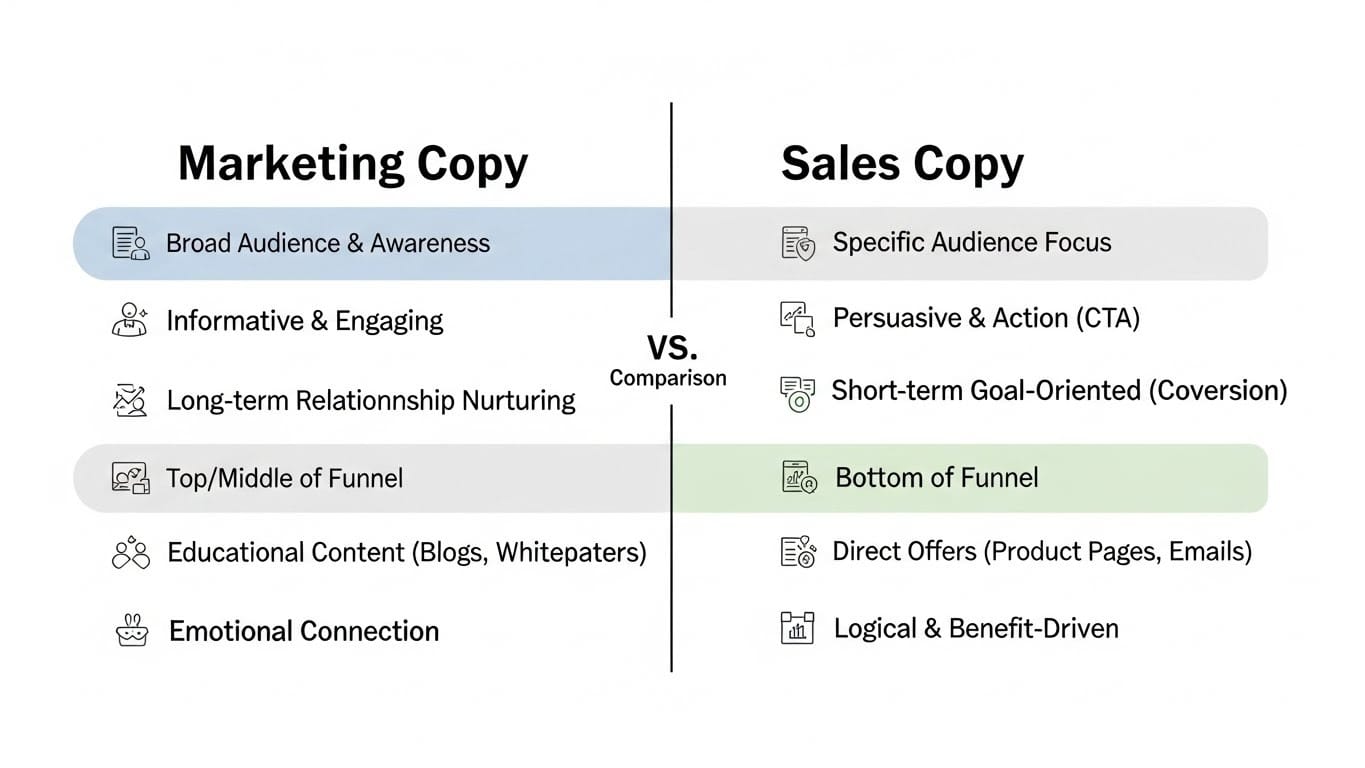
Before we dive into how to write effective sell sheets, you need to understand the fundamental difference between sales copywriting and marketing copywriting. This distinction will change how you approach all your business development materials.
Marketing Copywriting: Building Awareness and Credibility
Marketing copy is designed to:
- Create awareness of your firm and services
- Establish credibility and professionalism
- Appeal to a broad audience
- Reinforce brand identity
- Generate interest and inquiries
- Support long-term relationship building
Marketing copy typically includes:
- Your origin story and mission
- Team bios and credentials
- Full services portfolio
- Brand personality and values
- Thought leadership positioning
Example of marketing copy: “Founded in 2010, ABC Accounting has grown to serve over 300 clients across multiple industries. Our team of certified professionals brings innovative thinking and personalized service to every engagement. We’re committed to building long-term partnerships based on trust, expertise, and results.”
This isn’t bad copy. It’s just not designed to close a specific sale. It’s designed to make you look credible and professional to anyone who encounters your brand.
Sales Copywriting: Driving Buying Decisions
Sales copy is designed to:
- Address a specific buying decision
- Demonstrate understanding of the buyer’s situation
- Present your solution to their specific problem
- Differentiate your firm from alternatives
- Provide evidence of effectiveness
- Remove obstacles to moving forward
- Prompt action
Sales copy typically includes:
- Buyer’s specific problem or goal
- Your unique solution approach
- Concrete outcomes and benefits
- Proof of results (case studies, metrics)
- Clear differentiation
- Strong call to action
Example of sales copy: “Most SaaS companies between $5M-$20M in revenue leave $100K-$300K in R&D tax credits on the table every year because they don’t properly document qualifying expenses. Our specialized R&D Tax Credit Recovery process for software companies captures these credits by identifying eligible expenses that general accounting firms typically miss – from cloud infrastructure costs to failed feature development. Our average client recovers $180K in the first year.”
Notice the difference? This speaks directly to a specific buyer (SaaS companies in a revenue range), names their exact problem (missing R&D credits), quantifies the cost (dollar amounts), presents a specific solution, and hints at differentiation (specialized vs. general firms).
Why This Matters for Your Sell Sheets
When you understand this distinction, you realize why most professional service firms’ sales materials fall flat. They’re written in marketing language but used in sales contexts.
A prospect evaluating your firm for a specific project doesn’t need to know your mission statement or company history. They need to know:
- Do you understand my specific situation?
- What’s your approach to solving this problem?
- What outcome can I expect?
- Why should I choose you over alternatives?
- What’s the next step?
Sales copy answers these questions directly. Good marketing comes close, but most general marketing copy talks around them.
Your sell sheets must be written as sales copy, not marketing copy. That means:
- Lead with the buyer’s problem, not your credentials
- Focus on one specific offering, not your full portfolio
- Use concrete language and specific outcomes, not vague claims
- Demonstrate differentiation explicitly, not implicitly
- Include proof and evidence, not just assertions
- End with a clear next action, not a generic “contact us.”
Now, let’s look at how to actually create sell sheets.
How to Create Effective Sell Sheets: A Step-by-Step Framework
A step-by-step framework for creating sell sheets that drive buying decisions, not just brand awareness
Total Time: 7 days
Define Your Specific Target and Use Case
Get crystal clear on the specific service, target buyer (industry, role, company size), their problem, and their buying stage before writing a single word.
Craft Your Elevator Pitch
Create a 30-second pitch answering three questions: What is it? What’s the big benefit? What makes it special?
Structure Your Front Side for Maximum Impact
Design your front page with benefit-driven headline, specific problem statement, your unique solution, and clear overall benefit in 150-200 words.
Design Your Back Side for Detailed Evaluation
Include how it works (3-5 phases), feature-benefit pairs, explicit differentiation, proof points, and specific call to action.
Write with Sales Discipline
Description: “Use the 5% challenge to tighten copy, show don’t tell with specific examples, use client language, and maintain buyer focus with ‘you’ over ‘we’.
Collaborate with Your Designer
Work together on space constraints, visual hierarchy, white space balance, and brand alignment to create professional, scannable layouts.
Test and Iterate
Put sell sheets in front of real prospects, track which questions they still ask, identify resonating sections, and refine quarterly based on feedback.
Creating effective sell sheets requires both strategic thinking and disciplined execution. Here’s the complete process:
Step 1: Define Your Specific Target and Use Case
Before you write a single word, get crystal clear on exactly what this sell sheet is for.
Ask yourself:
- What specific service or offering does this cover?
- Who is the target buyer (industry, role, company size)?
- What problem or goal does this buyer have?
- What stage of the buying process are they in?
- What do they need to know to move forward?
Example of poorly defined scope: “A sell sheet for our consulting services.”
Example of well-defined scope: “A sell sheet for our revenue growth consulting service, targeted at boutique professional service firm founders earning $1M-$3M who are stuck at a revenue plateau and evaluating consultants during their discovery phase.”
The more specific you are, the more effective your sell sheet will be. Generic sell sheets produce generic results.
Gather the right information:
- Talk to your sales team: What questions do prospects ask most often?
- Review win/loss analysis: Why did you win the deals you won? Why did you lose others?
- Interview recent clients: What made them choose you? What concerns did they have?
- Analyze competitors: What are prospects comparing you to?
Step 2: Craft Your Elevator Pitch (The Foundation of Your Front Side)
The front side of your sell sheet is essentially an extended elevator pitch. It needs to answer three fundamental questions in about 30 seconds of reading time:
1. What is it? (Clear definition of the service) 2. What’s the big benefit? (The primary value to the client) 3. What makes it special? (Your unique differentiation)
👎 Bad example: “We provide innovative consulting solutions designed to help growing businesses achieve their full potential through our comprehensive, client-focused approach.”
This tells the prospect nothing concrete. What kind of consulting? What problem does it solve? Who is it for? What makes you different?
👍 Good example: “We help boutique consulting firms break through the $1M-$3M revenue plateau using our Constraint Mapping Process: we identify your biggest growth bottleneck—usually authority, lead generation, or sales conversion—then build a 90-day action plan focused exclusively on removing that constraint. While most consultants give you a long list of improvements, we help you focus on the one change that will have the biggest impact.”
This is specific: the target (boutique consulting firms), the problem (revenue plateau), the approach (Constraint Mapping Process), the differentiation (focus vs. long lists), and the outcome (break through the plateau).
The formula:
We help [specific target] achieve [specific outcome] through [your unique approach/process]. Unlike [typical alternative approach], we [your key differentiation].
Practice this until you can say it naturally in under 30 seconds. This becomes the core of your sell sheet’s front side.
Step 3: Structure Your Front Side for Maximum Impact
Your front side should include these elements, in roughly this order:
Headline (Benefit-Driven): Don’t just name your service. State the primary benefit or outcome.
❌ “Fractional CFO Services” ✅ “Stop Running Your Business on Gut Feel: Get Real-Time Financial Clarity.”
The Problem: Describe the specific situation your target buyer faces. Make it concrete enough that they recognize themselves.
“Most boutique consulting firms hit a revenue ceiling around $2M because the founder is the only rainmaker. Every new client requires their personal involvement. Growth means working 70-hour weeks… or revenue stalls.”
Your Solution: Briefly describe your approach and what makes it different.
“Our Revenue Architecture Framework gives you a systematic approach to generating predictable leads and delivering client work without founder dependency.”
The Big Benefit: State the overall outcome clearly.
“Build predictable revenue growth while reducing your personal delivery burden…so you can scale without burning out.”
Visual Element: Include a simple diagram, icon, or image that reinforces your key message. White space is valuable, let the page breathe.
Keep your front side to roughly 150-200 words. If you need more space to explain, that’s what the back is for.
Step 4: Design Your Back Side for Detailed Evaluation
The back side provides the information prospects need to seriously evaluate your offering. Structure it with clear sections:
How It Works: Give a brief overview of your process or methodology. 3-5 phases/steps is ideal.
“Phase 1: Constraint Audit (identify your biggest bottleneck) Phase 2: Solution Design (create focused 90-day plan)
Phase 3: Implementation Support (execute and measure results)”
This removes uncertainty and shows you have a systematic approach.
Features and Benefits: Use a feature-benefit-feature-benefit format. Each feature should have a corresponding benefit that explains why it matters.
❌ “We conduct a comprehensive assessment.”
✅ “Comprehensive Assessment → Get clarity on exactly what’s blocking your growth, not a generic diagnosis.”
❌ “We provide ongoing support.”
✅ “Weekly Implementation Calls → Stay on track with direct guidance when you hit obstacles.”
Use benefit-driven subheads to make this section scannable.
What Makes Us Different: Create a visually distinct section that explicitly states your unique value proposition.
Don’t bury differentiation throughout the document or expect prospects to infer it. State it directly:
“Unlike traditional consultants who give you a 50-page report and disappear, we focus on one constraint at a time and stay with you through implementation. You get results in 90 days, not a shelf-ware document.”
Proof/Social Proof: Include evidence that this works:
- “Our clients typically break through their revenue plateau within 6 months.”
- “Average revenue increase: 40% in year one.”
- Short testimonial quote if space allows
Call to Action: End with a specific next step:
❌ “Contact us for more information.”
✅ “Schedule a 20-minute Constraint Mapping call to identify your biggest growth bottleneck, no obligation.”
The next step should make sense to the prospect. Asking for a sales meeting after sending an initial case study usually doesn’t make as much sense as asking for a 20-minute meeting to answer questions about the case study and how it can be applied to the prospect’s business.
Step 5: Write with Sales Discipline
Now that you have your structure, here are the key principles for actually writing the copy:
Use the “5% Challenge”: Sell sheets have strict space limitations. After writing your first draft, cut 5% of the words without losing quality. This forces you to eliminate weak phrases and tighten your language.
Remove:
- Unnecessary adjectives (“innovative,” “comprehensive,” “cutting-edge”)
- Redundant phrases (“each and every,” “first and foremost”)
- Vague qualifiers (“very,” “really,” “quite”)
- Weak benefits that don’t differentiate
Show, Don’t Tell: Replace vague claims with specific examples:
❌ “We help you improve efficiency.”
✅ “We reduce your month-end close from 15 days to 5 days.”
❌ “Our approach gets results.”
✅ “Our average client captures $180K in previously missed R&D tax credits.”
Use Client Language: Write the way your prospects think and talk about their problems, not the way you talk about your services internally.
If clients say they’re “stuck” or “spinning their wheels,” use that language. Don’t translate it into formal consultant-speak like “experiencing growth impediments.”
Maintain Buyer Focus: Count the ratio of “you” to “we” in your copy. Sales copy should be heavily weighted toward “you.” If every sentence is about “we” and what “we” do, it’s time for a rewrite.
❌ “We provide comprehensive analysis using our proprietary methodology that we’ve refined over 15 years…”
✅ “You get a clear diagnosis of your biggest constraint within the first week, so you can focus your energy where it matters most…”
Step 6: Collaborate with Your Designer
Don’t wait until the copy is done to involve a designer. Good sell sheets require tight collaboration between writer and designer.
Discuss upfront:
- Space constraints: How much copy can realistically fit?
- Visual hierarchy: Which elements need the most emphasis?
- Balance: How will you use white space vs. content?
- Brand alignment: How does this fit your existing materials?
Key design principles:
- Professional, not flashy (you’re not selling energy drinks)
- Ample white space (don’t cram every inch with content)
- Clear visual hierarchy (guide the eye to key points)
- Benefit-driven headlines (use design to emphasize value)
- Consistent branding (fonts, colors, style should match your brand)
Step 7: Test and Iterate
Don’t expect your first version to be perfect. Put it in front of real prospects and pay attention to what happens:
- What questions do they still ask after reading it?
- What sections do they reference in conversations?
- Which points seem to resonate most?
- Where do they get confused or need clarification?
Use this feedback to refine:
- Strengthen sections that are working
- Clarify sections that cause confusion
- Add information that’s missing
- Remove content that’s not valuable
Plan to update your sell sheets quarterly. As you learn more about what messages resonate, as your services evolve, and as the competitive landscape changes, your sell sheets should evolve too.
Common Mistakes That Sabotage Your Sell Sheets
Even when firms understand the concept of sell sheets, it’s easy to make mistakes in execution. Especially when sales copywriting isn’t something you do every day. Here are the most common ones I see – and how you can avoid them:
Mistake #1: Trying to Cover Everything
The problem: You want prospects to know about all your capabilities, so you list every service, credential, and client type on one sheet.
Why it fails: When everything is a priority, nothing is a priority. The prospect can’t figure out what you’re actually good at or whether you’re right for their specific need.
The solution: Create multiple targeted versions. Each sell sheet should focus on one offering for one type of buyer. If a prospect needs to know about other services, send them a different sell sheet.
Mistake #2: Leading with Credentials
The problem: Your sell sheet opens with “Founded in 2010… 15 CPAs on staff… Over 500 clients served…”
Why it fails: Credentials matter, but only after you’ve demonstrated that you understand the buyer’s problem.
The solution: Lead with the problem and your solution. Put credentials in the footer or a small section on the back. Let your approach and results demonstrate expertise, rather than claiming it upfront.
Mistake #3: Feature-Only Focus
The problem: Your sell sheet lists what you do without explaining why it matters.
“We conduct a comprehensive assessment, develop a customized strategy, and provide ongoing support.”
Why it fails: Features without benefits leave prospects doing mental math: “What does this mean for me?” Many won’t bother.
The solution: Every feature needs a corresponding benefit. Remember: [Feature] → [Benefit]
“Comprehensive Assessment → You get complete clarity on what’s really blocking your growth, not surface-level symptoms.”
Mistake #4: Vague Differentiation
The problem: You claim you’re “different” but don’t explain how.
“Our unique approach combines deep expertise with personalized service to deliver innovative solutions.”
Why it fails: This could describe literally any professional service firm. There’s no actual differentiation here. Just generic claims.
The solution: Create a specific, visually distinct “What Makes Us Different” section. State your differentiation explicitly:
“While most accounting firms provide monthly financials 15 days after month-end, our Predictive Close Framework gives you real-time visibility into your numbers as the month progresses, so you can make decisions faster.”
Mistake #5: One-Size-Fits-All Approach
The problem: You use the same sell sheet for discovery calls, evaluation meetings, and final proposals.
Why it fails: Prospects at different stages need different information. Someone just learning about you needs different content than someone comparing you to two competitors.
The solution: Create versions for different sales stages. Your discovery-stage sell sheet focuses on problem/solution fit. Your evaluation-stage sell sheet includes detailed methodology and differentiation. Your proposal-stage version emphasizes implementation and success metrics.
Mistake #6: Weak or Mismatched Call to Action
The problem: Your sell sheet ends with “Contact us for more information” or just lists your phone number and email.
Why it fails: Generic CTAs don’t motivate action because they’re disconnected from what the prospect just read. After learning about your R&D tax credit recovery service, “contact us” feels like starting over. The prospect thinks: “Contact you about what, exactly? Do I need to re-explain everything?”
More importantly, the CTA doesn’t make sense as a next step. If your sell sheet convinced them you understand their problem, the logical next move isn’t a vague conversation—it’s a specific diagnostic or assessment related to that problem.
The deeper issue: Mismatched CTAs break the buying journey. If someone just read about your month-end close automation service and the CTA says “Schedule a consultation to discuss your accounting needs,” you’ve essentially reset the conversation. The prospect was focused on one specific problem; now you’re asking them to broaden the discussion to “accounting needs” in general.
The solution: Your call to action must be the natural next step in the buyer’s journey—specific to what they just learned about and proportional to their level of commitment.
Examples of logical next steps:
❌ Generic (doesn’t connect): “Contact us to learn more.”
✅ Logical next step: “Schedule a 15-minute Revenue Diagnostic call to identify your biggest growth constraint.”
Why this works: If they just read about your constraint-focused consulting approach, the logical next step is to identify their constraint. It’s directly relevant and low-commitment.
❌ Mismatched (too big a leap): “Sign up for our comprehensive assessment package.”
✅ Right-sized next step: “Get your free Month-End Close Efficiency Scorecard—see where you’re losing time.”
Why this works: After reading about month-end close problems, a quick scorecard is a natural next step. It’s valuable, relevant, and doesn’t require a big commitment. Asking them to “sign up for a package” is several steps too far.
❌ Disconnected (doesn’t build on momentum): “Visit our website for more resources.”
✅ Builds on interest: “Download our R&D Tax Credit Eligibility Checklist for SaaS Companies—find out if you’re leaving money on the table.”
Why this works: They just learned about missed R&D credits. The checklist lets them self-assess whether this applies to them. It maintains momentum and provides immediate value.
The test for effective CTAs:
Ask yourself: “If a prospect just read this sell sheet and found it relevant, what would be the most natural thing for them to want to do next?”
- If they read about a problem they have, they want to assess how bad it is for them specifically
- If they read about a methodology, they want to see how it applies to their situation
- If they read about an outcome, they want to understand if that outcome is achievable for them
- If they’re comparing vendors, they want the specific information needed to make a decision
Your CTA should offer exactly that—not a generic meeting request, but the logical next step that moves them closer to a decision.
Pro tip: Match your CTA to the sell sheet’s purpose. Discovery-stage sell sheets should offer low-commitment diagnostics or assessments. Evaluation-stage sell sheets can offer walkthroughs of methodologies or deep dives into case studies. Proposal-stage sell sheets might offer implementation roadmap reviews or ROI calculators.
The goal isn’t just to get a response. It’s to move prospects forward in a way that feels natural and valuable to them.
Mistake #7: Design That Works Against You
The problem: Cramming too much text, using tiny fonts, eliminating white space, or creating a design that’s either too plain or too flashy.
Why it fails: Poor design makes your sell sheet hard to scan and signals either a lack of sophistication (too plain) or a wrong audience fit (too flashy).
The solution: Invest in professional design that balances content with white space, uses visual hierarchy to guide the eye, and reflects the sophisticated, professional nature of your services.
Your Next Steps: Creating Your First Sell Sheets
If you’re ready to create sell sheets that actually move prospects toward buying decisions, here’s how to get started:
This Week: Examine and Prioritize
- Examine your current messaging – Review your current sales materials. How much is marketing copy (about you, your history, your values) vs. sales copy (about the buyer’s problem and your specific solution)?
- Identify your top 3-5 opportunities – Which services or target markets would benefit most from focused sell sheets? Look for situations where:
- Sales cycles are longer than they should be
- Prospects ask the same questions repeatedly
- You’re competing against multiple alternatives
- Your differentiation isn’t clear to buyers
- Interview recent wins – Talk to 2-3 clients who recently chose you. Ask: “What specific problem were you trying to solve? What made you choose us? What concerns did you have before signing?”
Next 30 Days: Create Your First Sell Sheet
- Choose one focus area – Pick your highest-priority sell sheet. Be specific about the service, target buyer, and use case.
- Write your elevator pitch – Use the three-question framework: What is it? What’s the big benefit? What makes it special? Refine until you can deliver it naturally in 30 seconds.
- Draft your content – Write front side (problem → solution → benefit) and back side (how it works → features/benefits → differentiation → proof → CTA). Use the 5% Challenge to tighten the copy.
- Work with a designer – Collaborate on layout, visual hierarchy, and white space. Aim for professional sophistication, not flashy marketing.
Next 90 Days: Expand and Optimize
- Test with real prospects – Use your sell sheet in actual sales conversations. Pay attention to the questions prospects still ask and the sections they reference.
- Create 3-5 core versions – Based on what’s working, develop sell sheets for your other priority areas.
- Train your team – Make sure everyone understands when to use which version, how to customize for specific prospects, and how the sell sheets fit into your overall sales process.
- Measure impact – Track close rate, sales cycle length, and average deal size. Compare before and after.
The goal isn’t perfection on the first try. It’s getting focused, buyer-centric sales materials in front of prospects, and learning what works.
Frequently Asked Questions
Q. How many sell sheet versions do I really need?
A. Start with 3-5 core versions for your most important services or target markets. As you see what works, expand to 15-20+ versions covering different industries, buyer roles, and sales stages. Many successful firms eventually have 30+ variations.
Q: Should I include pricing on sell sheets?
A: Generally, no for professional services. Your pricing depends on scope, and including it can create sticker shock before value is established. Save pricing discussions for proposals after you’ve had discovery conversations. However, ROI information and value statements are appropriate.
Q: How often should I update my sell sheets?
A: Review quarterly, update at least annually. Update immediately when you have significant client wins to use as proof, when competitors change their positioning, when you refine your methodology, or when regulatory changes affect your services.
Q: Can I create effective sell sheets without hiring a professional?
A: You can start with templates and DIY, but professional copywriting and design significantly improve effectiveness. Sales copywriting is a specialized skill. If budget allows, hiring experts typically pays for itself in improved close rates.
Q: What if I offer highly customized services that are different for every client?
A: Focus on your methodology and approach rather than specific deliverables. Show how you think about and solve problems, even if the exact solution varies. Your process is what prospects need to evaluate.
Q: How do I know if my sell sheet is working?
A: Track: (1) How often your sales team actually uses it, (2) Whether prospects reference it in conversations, (3) What questions they still ask after reading it, (4) Changes in close rate and sales cycle length for opportunities where you used it.
Q: How do sell sheets fit with other sales materials like case studies and proposals?
A: Sell sheets are one piece of your sales enablement toolkit. While sell sheets provide focused, scannable overviews for specific services or audiences, case studies offer in-depth proof of results, and proposals present customized solutions. Each asset serves a different purpose in the buyer’s journey. See how all these assets work together in our comprehensive sales enablement guide.
The Bottom Line
If you’re like most firms, you don’t need more marketing materials. You need sales tools that help prospects make buying decisions.
The difference between marketing copy and sales copy isn’t subtle. It’s fundamental. Marketing builds awareness and credibility, and motivates prospects to engage in a sales discussion.
Sales drives specific buying decisions. Your sell sheets must be written as sales documents, not marketing brochures.
When you create focused, buyer-centric sell sheets that lead with problems, demonstrate your unique approach, and provide concrete evidence of effectiveness, something shifts in your sales process.
Conversations become more focused.
Prospects self-qualify faster.
Sales cycles shorten. Close rates improve.
Stop trying to educate prospects about everything you do. Start showing them exactly how you solve their specific problem.
One focused sell sheet at a time.
Want More Insights on Positioning and Marketing for Boutique Firms?
Subscribe to The Business Builder, my weekly newsletter for accounting and boutique consulting firm owners who want to increase authority, leads, sales, and client retention.
Every week, I share practical frameworks and strategies to help you break through revenue plateaus and build a more profitable firm.