
If your website were an employee on your sales team, would you give it a promotion or show it the door? This isn’t just a hypothetical question. Your website is your most persistent salesperson, working 24/7 without breaks. But like any salesperson, it has a distinct personality and sales approach. This personality,whether by design or by accident, impacts how prospects perceive your brand, navigate your product offerings, and ultimately, decide whether to become a customer.
Many businesses treat their website as a digital brochure, a static repository of information. This is a missed opportunity. A high-performing website functions as an active member of your sales team, with a personality tailored to guide visitors through a specific sales process. By understanding what type of salesperson your website currently is, you can begin to train it, optimize its approach, and transform it into a top performer that consistently drives conversions. This article will provide a framework for identifying your website’s sales persona and a roadmap for optimizing it to close more deals.
The Digital Sales Floor: Why Your Website Needs a Personality
Thinking of your website as a digital salesperson re-frames your entire approach to online strategy. It ceases to be a passive asset and becomes an active participant in your revenue generation, shaping every customer interaction from the first click to the final purchase.
Beyond a Brochure: Your Website as a 24/7 Sales Rep
Your best human salespeople build rapport, answer questions, handle objections, and guide prospects toward a solution. Your website should be engineered to do the same. It is the first point of contact for a majority of your prospects, setting the tone for the entire customer relationship. A website with a clear, intentional sales personality can pre-qualify leads, educate potential customers, and streamline the sales process, freeing up your human sales team to focus on high-value, closing activities.
The Impact of Personality on the Customer Journey and Conversions
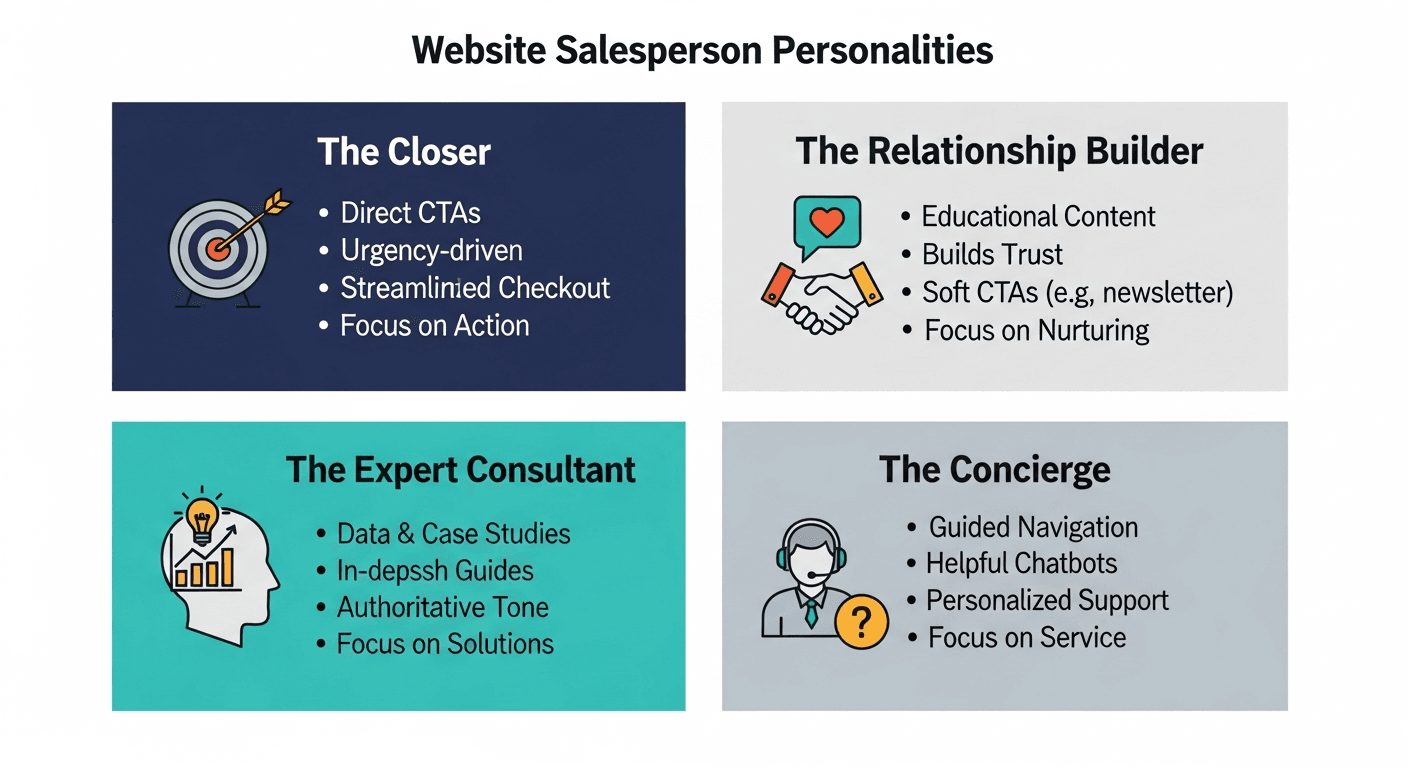
Your website’s personality dictates the customer journey. Each approach is tailored to different user needs, from the direct ‘Closer’ to the supportive ‘Concierge’.
A website’s personality dictates the user experience. A direct, no-nonsense “Closer” personality might appeal to a customer who knows exactly what they want, while a nurturing, “Relationship Builder” personality is better for prospects who require more education and trust-building. An inconsistent or nonexistent personality creates a confusing and disjointed customer journey, leading to high bounce rates and abandoned carts. A well-defined personality creates a cohesive and persuasive experience that builds momentum toward conversion.
Bridging the Gap: Website Personality and Customer Personality Types
Just as a skilled salesperson adapts their approach to match a prospect’s personality, your website can be designed to appeal to your ideal customer profile. By understanding whether your target audience is analytical, decisive, amiable, or expressive, you can shape your website’s tone, content, and user flow. This alignment creates a sense of familiarity and trust, building the essential rapport needed to move a prospect from visitor to lead to loyal customer.
Discovering Your Website’s Sales Persona: Key Archetypes
Websites, like salespeople, fall into distinct personality archetypes. Each has its own strengths, weaknesses, and preferred sales environment. Identifying which archetype your website embodies is the first step toward strategic optimization.
The Consultative Advisor: The Knowledgeable Guide
This website acts as an expert, prioritizing education and building trust over an immediate hard sell. Its primary goal is to provide immense value, answer complex questions, and establish authority in its industry. The sales process is longer, focused on nurturing a lead with insightful content like blog posts, whitepapers, case studies, and webinars. It builds a relationship by being the go-to resource, confident that an informed customer will eventually choose its product or service.
The Efficient Order Taker: The Seamless Transaction Facilitator
The Efficient Order Taker is all about speed, clarity, and convenience. It assumes the customer has a high intent to purchase and its sole purpose is to remove all friction from the transaction. This personality shines in e-commerce environments where the product is well-understood. The sales approach is direct and minimalist, featuring clean layouts, intuitive navigation, simple filtering options, and a streamlined checkout process. Its success is measured in clicks, cart additions, and conversion time.
The Enthusiastic Closer: The Direct Conversion Driver
This website is assertive, persuasive, and relentlessly focused on a single goal: closing the deal now. It uses psychological triggers like scarcity, urgency, and compelling social proof to drive immediate action. You’ll see this personality in action on landing pages for specific campaigns, featuring prominent calls-to-action (CTAs), countdown timers, limited-time offers, and bold testimonials. The sales cycle is short and intense, designed to convert a prospect in a single session.
The Relationship Builder: The Community Cultivator
The Relationship Builder focuses on long-term engagement and loyalty. Its goal is not just a single transaction but creating a brand advocate. This website fosters a sense of community through user forums, customer stories, loyalty programs, and interactive content. It seeks to build an emotional connection, making the customer feel like part of a tribe. The sales approach is soft and continuous, centered on repeat visits and ongoing dialogue rather than a one-time closing event.
Assessing Your Website’s Current Personality (And Desired Future State)
Once you understand the archetypes, you must diagnose your own website. This requires an honest look at its design, content, and performance data to see how it truly behaves as a salesperson.
A Self-Assessment Framework: Questions to Uncover Your Website’s Vibe
Start by asking critical questions from a visitor’s perspective:
- First Impression: What is the immediate feeling a new visitor gets? Is it helpful, urgent, transactional, or welcoming?
- Primary Goal: What is the single most prominent action the site asks me to take? Is it “Learn More,” “Buy Now,” “Join the Community,” or “Sign Up”?
- Content Focus: Is the content primarily educational (blogs, guides), product-focused (specs, pricing), persuasive (testimonials, offers), or community-centric (user content, forums)?
- Path to Conversion: Is the sales process a gentle, multi-step journey or a direct, fast track to checkout?
Analyzing User Behavior: Unmasking Your Website’s True Nature
Your website analytics tell the real story. High time-on-page and multiple page visits before a conversion might indicate a Consultative Advisor. A low number of pages per session but a high conversion rate points to an Efficient Order Taker. A high bounce rate on all pages except a specific landing page could reveal an Enthusiastic Closer. Analyzing user flow, heatmaps, and conversion funnels will provide objective data on your site’s actual sales approach.
Aligning Personality with Your Business Goals and Target Customer Needs
Your website’s personality shouldn’t exist in a vacuum. It must align with your product, sales cycle, and ideal customer. A complex B2B service requires a Consultative Advisor, not an Enthusiastic Closer. A simple, low-cost consumer product thrives as an Efficient Order Taker. The key is to define your desired future state: what kind of salesperson do you need your website to be to achieve your business objectives?
Optimizing for Conversions: Tailoring Your Website to Its Sales Persona
After identifying your website’s current personality and defining its target persona, the next step is “training.” Making specific optimizations to enhance its natural strengths and improve its sales performance.
For The Consultative Advisor Website: Building Trust and Authority
To enhance this persona, double down on expertise. Invest in high-quality, long-form content, detailed case studies, and original research. Implement a robust internal linking strategy to guide users through related topics. Use CTAs that offer more value, like “Download the Ultimate Guide” or “Watch the Webinar.” The goal is to make your site an indispensable resource, which research shows pays dividends, as 89% of U.S. businesses said personalization efforts on their sites led to higher revenue.
For The Efficient Order Taker Website: Streamlining the Path to Purchase
Optimization here is about radical simplification. Minimize clicks to checkout, implement one-click payment options, and ensure product search and filtering are lightning-fast. Use high-quality product imagery and concise descriptions. A/B test button colors, placement, and copy to remove every ounce of friction. The entire sales process should feel effortless and instantaneous for the customer.
For The Enthusiastic Closer Website: Driving Immediate Action
To sharpen this persona, amplify urgency and proof. Make your value proposition impossible to ignore with a bold headline. Feature your most powerful testimonials and trust badges prominently. Use action-oriented language in every CTA (e.g., “Claim Your Discount Now” instead of “Submit”). Ensure the design funnels all attention toward the conversion goal, removing distracting navigation or extraneous links.
For The Relationship Builder Website: Fostering Loyalty and Engagement
Enhance this persona by creating more opportunities for interaction. Implement a customer review and Q&A section on product pages. Launch a loyalty program with exclusive perks. Feature user-generated content and create a dedicated community space or forum. Use personalized email marketing to share relevant content and community highlights, making customers feel seen and valued.
Universal Conversion Pillars: Enhancing Any Website Personality
Regardless of your website’s core personality, certain foundational elements are non-negotiable for success. These pillars support any sales approach and are crucial for converting prospects.
User Experience (UX) and Mobile Responsiveness
A clunky, slow, or confusing website is a terrible salesperson. A seamless UX is paramount. According to one report, a one-second delay in page response can lead to a 7% reduction in conversions. Furthermore, with the majority of traffic coming from mobile devices, a responsive design is essential. In fact, approximately 74% of users are inclined to return to websites that offer a good mobile experience.
Clear Value Proposition and Messaging
Your website must answer a visitor’s primary question within seconds: “What’s in it for me?” Your value proposition should be front and center, communicated with clear, concise messaging that resonates with your target audience. If a visitor can’t quickly understand what you offer and why it matters, they will leave.
Trust Signals and Social Proof
No one buys from a salesperson they don’t trust. Your website needs to build credibility instantly. This is achieved through trust signals like security badges (SSL certificates), clear privacy policies, and professional design. Social proof, including customer testimonials, reviews, ratings, and client logos, is equally critical for validating your claims and easing prospect anxiety.
Strong, Action-Oriented Calls to Action
Every page on your website should have a purpose and a clear next step. Your CTAs must be visible, compelling, and use action-oriented language. Whether you want a visitor to “Request a Demo,” “Add to Cart,” or “Subscribe to Our Newsletter,” the path forward must be unambiguous.
Continuous Testing and Iteration
Your website is not a “set it and forget it” project. The best digital salespeople are constantly learning and adapting. Use A/B testing and multivariate testing to experiment with headlines, layouts, offers, and CTAs. Analyze the results, learn from them, and continuously iterate to improve performance.
Measuring Your Website’s Sales Performance and Adapting
To effectively “manage” your digital salesperson, you need to track its performance with relevant metrics and maintain a process for continuous improvement.
Key Performance Indicators (KPIs) for Each Personality Type
The right KPIs depend on the persona:
- Consultative Advisor: Track metrics like time on page, pages per session, newsletter sign-ups, and content downloads.
- Efficient Order Taker: Focus on conversion rate, average order value, and cart abandonment rate.
- Enthusiastic Closer: Monitor landing page conversion rates, click-through rates on CTAs, and cost per acquisition.
- Relationship Builder: Measure repeat visitor rate, community engagement metrics (comments, posts), and customer lifetime value.
Tools for Tracking and Analysis
A suite of tools is essential for gathering performance data. Google Analytics is the foundation for tracking traffic and user behavior. Heatmap and session recording tools like Hotjar or Crazy Egg provide qualitative insights into how users interact with your pages. A/B testing platforms like Optimizely or Google Optimize allow you to run controlled experiments to validate changes.
The Iterative Process: Refining Your Website’s Sales Approach
Data analysis should lead to actionable insights and hypotheses for improvement. Use these insights to form a continuous loop:
- Analyze performance using your KPIs and tools.
- Hypothesize potential improvements (e.g., “Changing the CTA copy will increase clicks”).
- Test your hypothesis with an A/B test.
- Implement the winning variation.
- Repeat the cycle.
This iterative process is the equivalent of ongoing sales training for your website, ensuring it constantly refines its approach.
Conclusion: Your Website – A Master Salesperson
Your website is far more than a digital placeholder; it is a dynamic, active salesperson representing your brand around the clock. By ceasing to view it as a passive brochure and instead treating it as a core member of your sales team, you unlock its true potential.
The first step is to identify its current sales personality: Is it a knowledgeable Consultative Advisor, a frictionless Efficient Order Taker, a persuasive Enthusiastic Closer, or a loyal Relationship Builder? Once you understand its inherent nature, you can align it with your business goals and begin the crucial work of optimization. This “training” involves leaning into its strengths, whether that’s by building out your content library, streamlining your checkout, sharpening your offer, or fostering your community.
By underpinning this persona-driven strategy with universal pillars like stellar UX, clear messaging, and robust trust signals, you can systematically elevate its performance. Continuously measure its effectiveness with the right KPIs and commit to an iterative process of testing and refinement. By doing so, you will transform your website from a passive cost center into your most valuable and effective salesperson. One that earns its promotion every single day.