
One of the things consulting teaches you is that the best ideas rarely come from inside your own industry.
I’ve worked in around 45 industries over the course of my career. Early on, I noticed a pattern: the firms that made the biggest jumps didn’t just copy what competitors were doing. They borrowed from completely unrelated fields and adapted what they found.
A manufacturing efficiency concept that nobody in professional services had considered. A retail customer experience principle that consultants had never applied. That’s where the interesting moves come from.
The concept I want to share today comes from direct-response marketing. An industry that produces advertising that most firms would dismiss as “unprofessional.” But also an industry that has been measuring, testing, and improving marketing for over a century. It’s called the winning control.
Most professional service firms have never heard of it. Those who adopt it tend to make a noticeable shift in how they think about their marketing. And, more importantly, how they make marketing decisions.
What Is a Winning Control?
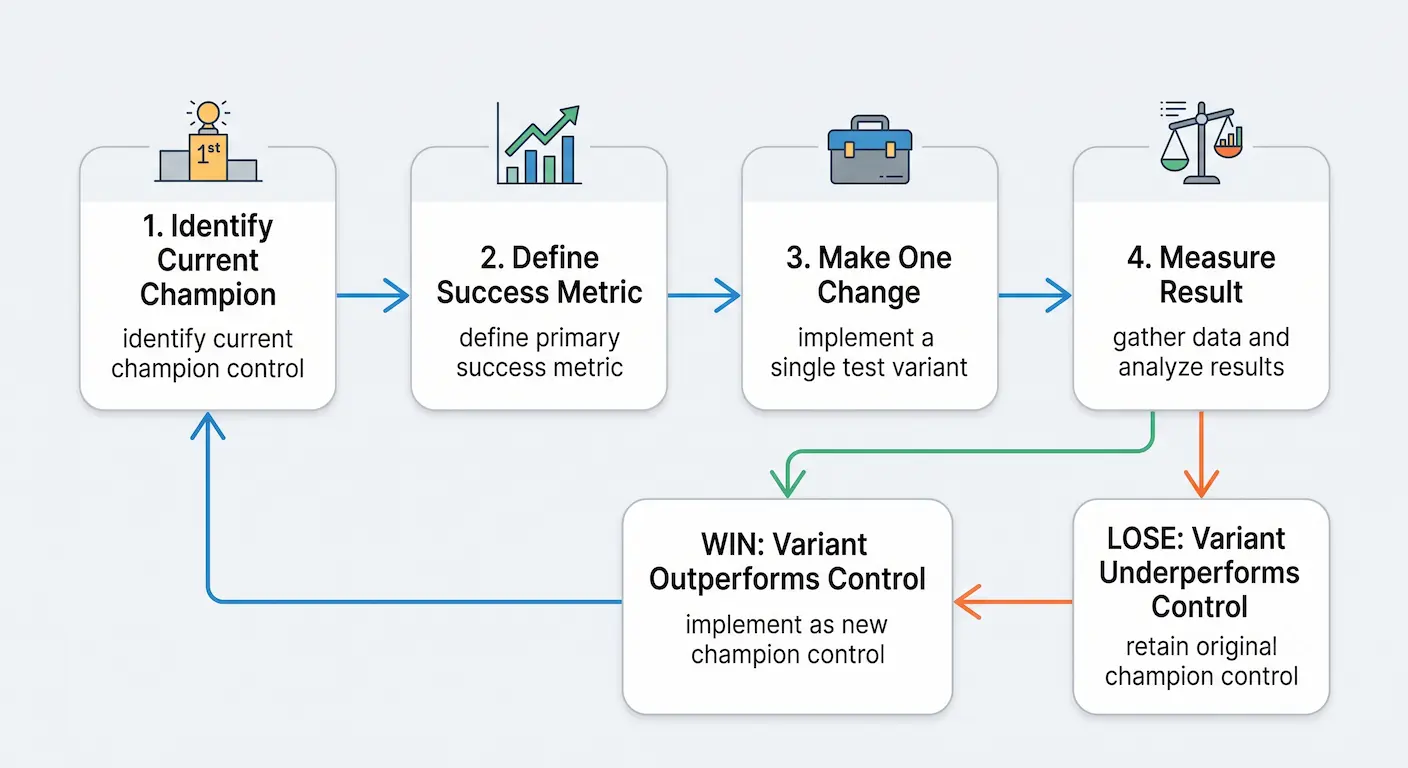
In direct-response marketing, your current champion is the control. It’s the specific letter, a landing page, an email sequence, or display ad that currently generates your highest number of qualified responses.
It’s not the newest thing. It’s not the thing you like best. It’s the thing that works best, measured by actual results.
Once you identify it, your job becomes one thing: beat the control.
Not update the look. Not chasing the latest tech. Not to try whatever your competitor is doing. Your only job is to take what’s already working and find something that works better.
The people who built direct-response marketing into a multi-billion-dollar industry understood this important point… if you’re making changes without measuring them against a standard, you’re not improving. You’re just changing.
Why Professional Service Firms Need This
Most professional service firms make marketing decisions the same way they decide what to order for lunch. Based on what sounds good. Based on what they’re tired of. Based on what someone else recommended. Based on gut.
That might feel like strategy. It isn’t.
Thinking in terms of the winning control helps you break these bad habits.
The Boredom Pivot
A firm rebuilds its website. Not because leads are down. Not because conversion is off. Because the founder is tired of looking at it.
The site that replaced it performs worse. Nobody notices immediately because nobody was measuring the old site’s performance in the first place.
Here’s another way the boredom pivot shows up –
“We used to do that. It was working really well for us but we stopped. I don’t remember why.”
I used to be amazed at how often I would hear that. Now I expect it.
The Shiny Object Chase
Everyone loves new tech. A new platform shows up. Someone in a peer group raves about it. A vendor sends a well-timed pitch. The firm pivots to try it.
Two months later, the firm is back where it started, with less time and a lighter budget.
When you have a control, the question changes. It’s no longer “should we try this?” It’s “will this beat what’s already working?” That’s a harder bar to clear. That’s exactly the point.
Marketing by Opinion
“What does everyone think about the new homepage copy?”
Everyone has an opinion. The founder, the office manager, the longtime client who means well. The feedback pours in and some of it contradicts itself.
The prospects who might actually hire you don’t get a vote.
A control replaces opinion with evidence. The market votes by acting or ignoring. That’s the only vote that counts.
Statistical Significance
I know what you’re about to say: “That’s a direct-mail concept. I don’t have the volume for statistically significant testing.”
You’re right that most boutique firms can’t run proper split tests. A direct-mail house might send 500,000 pieces and test two versions against each other with clean statistical separation. You’re not doing that.
But that’s not a reason to skip the concept.
You can change a headline and track whether it generates more form submissions over the next 90 days. You can test two versions of your proposal introduction and note which one leads more often to a signed engagement. You can try two different subject lines and compare open rates.
None of that is statistically clean. All of it is more useful than nothing.
And here’s what I’ve consistently seen happen: setting up any tracking at all improves your marketing. When you decide what to measure, you have to think clearly about what you’re trying to accomplish.
The Pre-Change Discipline
Before any direct-response test, a good practitioner defines success in advance. What does “this worked” look like? What number needs to move? By how much? Over what period?
This matters because humans are very good at rationalizing outcomes after the fact.
You change your homepage. Traffic goes up slightly. You declare victory. But contact form submissions actually dropped. You didn’t notice because you didn’t define what you were measuring before you started.
Define success first. Write it down. “If the new version generates 5 or more contact form submissions per month consistently over 90 days, it beats the control. If not, we go back.”
Defining success up front allows you to “fail fast” and get to the winning solution more quickly.
How to Identify Your Current Control
If you’ve never thought in terms of controls before, the first question is: what’s your current champion?
Look at the last 12 to 18 months. What’s generating your most qualified conversations?
It might be:
- A specific email you send after an initial conversation that consistently leads to a proposal request
- A one-page firm overview that prospects keep referencing in later conversations
- A particular LinkedIn post or article that generates more inbound messages than anything else you’ve published
- A specific way you frame your introductory conversation that reliably leads to a second meeting
Most boutique firm owners, when they slow down and look carefully, can identify something that works better than everything else they’re doing. They just haven’t named it as a control.
Name it. Write down what makes it work. Decide that your job, for the next 90 days, is to beat it.
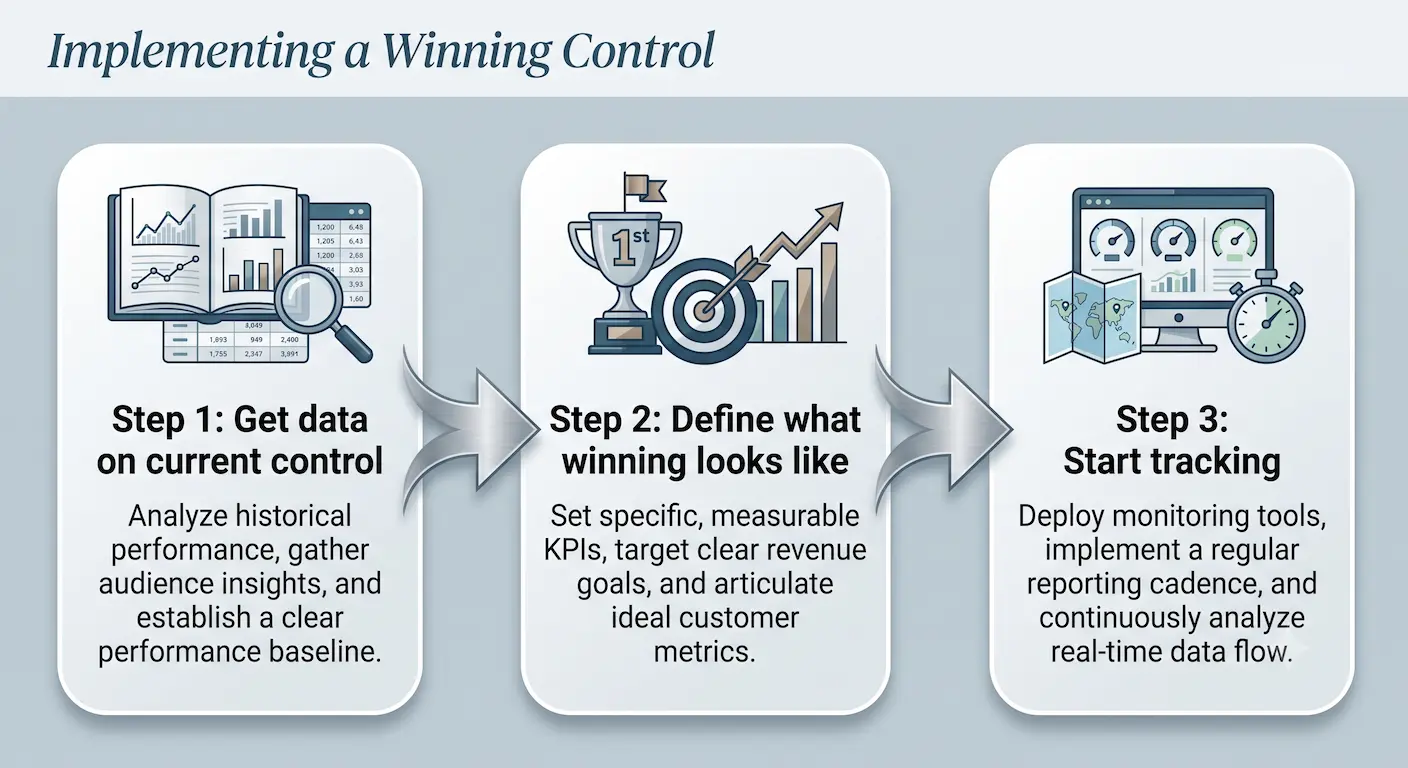
Step 1: Document Your Current Best Performer
The first step is finding your control and writing down what it is, where it’s used, and what result it currently produces.
Why this matters
You can’t beat something you can’t describe. You can’t test anything without a baseline.
How to do it
Start by listing every touchpoint in your marketing: website, email, LinkedIn, your proposal, your introductory conversation, any content you produce.
For each one, ask: do I know what result this produces? In most cases, the answer is no. That is useful information. Now look for the exceptions. What have you tracked, even informally? What do clients or prospects reference or remember about your marketing?
Pick the one thing with the clearest connection to a qualified conversation, a proposal request, or a signed client. That’s your control.
Write down:
- What the asset is (specific — not “the website,” but “the about page on our website”)
- When and how it’s used
- What result you’re currently tracking or can start tracking
- Your baseline number, even if it’s an estimate
👎 Bad example: “Our website and referrals both bring in business. I’m not sure which is more effective. We’ve had a good year.”
👍 Good example: “Our current control is the firm overview PDF we email within 24 hours of an initial consultation call. In the last 12 months, 8 of 12 new engagements came from prospects who received it. We’re tracking how many people who receive it go on to request a proposal.”
One’s a shrug. The other is a starting point.
Step 2: Define What Beating It Looks Like
Before you change anything, write down what success will look like.
Why this matters
Without a defined standard, you’ll rationalize any result. You’ll keep changing things indefinitely without knowing whether anything is working. Or, just as importantly, when to stop.
How to do it
For your current control, state:
- The specific metric you’re tracking
- The current baseline
- What improvement would count as a win
- The timeframe for the test
Keep it simple. If you’re testing a headline change on a webpage, you’re tracking contact form submissions. If you’re testing an email version, you’re tracking replies or click-throughs to your contact page.
👎 Bad example: “We’re going to update the homepage copy and see if things improve.”
👍 Good example: “We’re testing a new headline on our services page. Our current version generates an average of 3 contact form submissions per month over the last 6 months. If the new headline gets 4 or more per month consistently over 90 days, it becomes the new control.”
The discipline is the point. You might not have perfect data. Your numbers might be small. What matters is that you’re deciding what winning looks like before you swing, not after.
Step 3: Start Tracking. Even Imperfectly
The biggest shift most boutique firms can make isn’t running better tests. It’s running any tracking at all.
Why this matters
You can’t manage what you can’t measure. Most firms are flying entirely on intuition.
How to do it
Pick one number that matters and one method for recording it consistently. That’s it.
For a firm just getting started, this might be:
- A spreadsheet where you log contact form submissions each week
- A note in your calendar every Monday with how many qualified conversations you had and what preceded each one
- A column in your CRM that tracks which asset or channel each new client first engaged with
The system doesn’t need to be sophisticated. It needs to be consistent.
👎 Bad example: “We’re thinking about getting a proper analytics setup. Our developer is going to look into it sometime this quarter.”
👍 Good example: “Every Friday afternoon, I spend 10 minutes updating a spreadsheet. I note how many contact form submissions we got that week, how many came from organic search versus referrals, and whether we made any changes to our marketing that week. Two months in, I’ve already learned more than I expected.”
Simple tracking that actually happens beats sophisticated tracking that doesn’t.
Common Objections. And Honest Answers
“My sample size is too small to mean anything.”
Yes and no. Small sample sizes make it harder to be certain. They don’t make observation useless. If you test two homepage headlines and one consistently gets more contact form submissions over 90 days, that’s information worth acting on — even if it doesn’t clear a statistical significance threshold.
The alternative is making changes based on no data at all. That’s worse.
“My business is built on relationships. This feels too mechanical.”
The winning control isn’t about turning your firm into a direct-mail operation. It’s about not making marketing decisions based on boredom or opinion.
You can run a relationship-based firm and still know which email you send tends to convert prospects to clients. Those aren’t in conflict.
“I don’t have time to track all this.”
You’re not tracking all this. You’re tracking one number, consistently.
That’s 10 minutes a week. And it replaces hours of second-guessing, redesigning things that weren’t broken, and debating opinions that can’t be resolved.
“I’ve tried tracking before and never stuck with it.”
Simplify until you can stick with it. One number. One spreadsheet. Five minutes a week.
Imperfect tracking you maintain beats perfect tracking you abandon.
“What if nothing is really working? What if I don’t have a control?”
Then finding that out is the most useful thing you can do. If you can’t identify a current champion, your first job is to try different approaches and find one that’s measurably better than the others.
A Real-World Example
A management consulting firm I know had been rebuilding their website every 18 months or so. Each time, the project consumed significant time and budget. Each time, the new site got positive feedback from people in the firm’s network. And each time, it didn’t produce noticeably more business.
When we looked carefully at what was actually generating new clients, it wasn’t the website at all.
It was a specific email they sent to prospective clients after an initial conversation. A short summary of what they’d discussed and what they could do together. That email had been in use for years. Nobody thought of it as marketing. They called it “the follow-up.”
But when we traced back where each new client engagement had started, that follow-up email showed up consistently. It was the control. Nobody knew.
Once they knew, things changed. They stopped redesigning the website every 18 months and started paying attention to that email. They tested different openings. They tried different structures. They refined it.
The website didn’t change for two years. Business improved.
The control was there the whole time. They just hadn’t named it.
The Mindset Shift Worth Making
I’ll end with something that matters as much as the tactics.
When you hear a concept from another industry, the easiest response is “that won’t work for my business.” Every founder I’ve worked with has said this at least once. A lot of them say it often.
The owners I’ve seen succeed consistently have a different default question: “How can I make that work for me?”
Small shift in language. Very different outcomes.
The winning control comes from direct-response marketing. Your firm isn’t a mail-order catalog. But the underlying principle – know what’s working, measure it, then try to beat it – applies to any marketing in any industry.
Ask yourself how to make it work for you. Then write down the answer.
Key Takeaways
The winning control is a simple idea with significant implications:
- Your current best-performing marketing asset is your control
- Your job is to beat it. Not to change things at random, but to systematically improve on what already works
- Define success before you test, not after
- Track one number, consistently, even if imperfectly
- The act of tracking improves marketing before any test runs
Start here: Look at the last 12 months and identify one asset or touchpoint with the clearest connection to a qualified conversation. That’s probably your control. Write down what it is and what result it currently produces.
If you can do that this week, you’ve already made more progress than most boutique firms make in a year.
Want More Insights Like This?
Subscribe to The Business Builder, my weekly newsletter for boutique B2B and professional service firm founders who want to increase authority, generate consistent leads, improve sales effectiveness, and build stronger client relationships.
Every week, I share frameworks, strategies, and practical steps you can implement immediately — no fluff, no generic advice, just actionable insights for professional service firms.