
You’ve heard it a thousand times: “You need a clear USP to stand out.”
Every marketing book, consultant, and agency says the same thing. Find your unique selling proposition. Claim your space. Be different.
There’s just one problem: most professional service firms don’t actually have a USP. Neither do most other types of businesses. And the harder you try to invent one, the more generic your messaging becomes.
Founders spend weeks agonizing over their positioning, only to land on phrases like “innovative,” “client-focused,” or “full-service.” They sound different on paper, but they mean nothing to buyers.
Here’s what I’ve learned: the real differentiation in professional services isn’t a unique selling proposition. It’s your unique mechanism. It’s not about what you do differently; it’s about how your specific process produces better outcomes for clients.
Once you understand this distinction, everything changes. Your marketing stops trying to sound different and starts showing how you actually work. Let me show you why this matters and how to apply it to your firm.
The USP Trap: Why Professional Services Can’t Play the Product Game
The concept of a Unique Selling Proposition comes from product marketing. Rosser Reeves coined the term in the 1960s to describe how consumer brands differentiate themselves: “M&Ms melt in your mouth, not in your hand.” One product feature, clearly articulated, that competitors can’t claim.
This works beautifully for products because:
- Features are tangible and visible
- Benefits are immediate and obvious
- Comparison shopping is straightforward
- The purchase decision is relatively simple
But professional services operate in a completely different universe.
When a CFO is choosing between three accounting firms or a CEO is evaluating management consultants, they’re not comparing feature lists. They’re trying to answer deeper questions:
- “Can I trust this firm with our most sensitive challenges?”
- “Will they actually understand our specific situation?”
- “What’s their track record with problems like ours?”
- “How do they think about and approach complex issues?”
The service itself is often nearly identical across competitors. Three accounting firms might all offer tax planning, bookkeeping, and CFO advisory services. Three consulting firms might all do strategy work, organizational design, and change management.
So what actually differentiates you?
It’s not the service list. It’s not a clever tagline. It’s your methodology, your philosophy, and your process. What marketers call your unique mechanism.
What Is a Unique Mechanism (And Why It Works Better Than a USP)
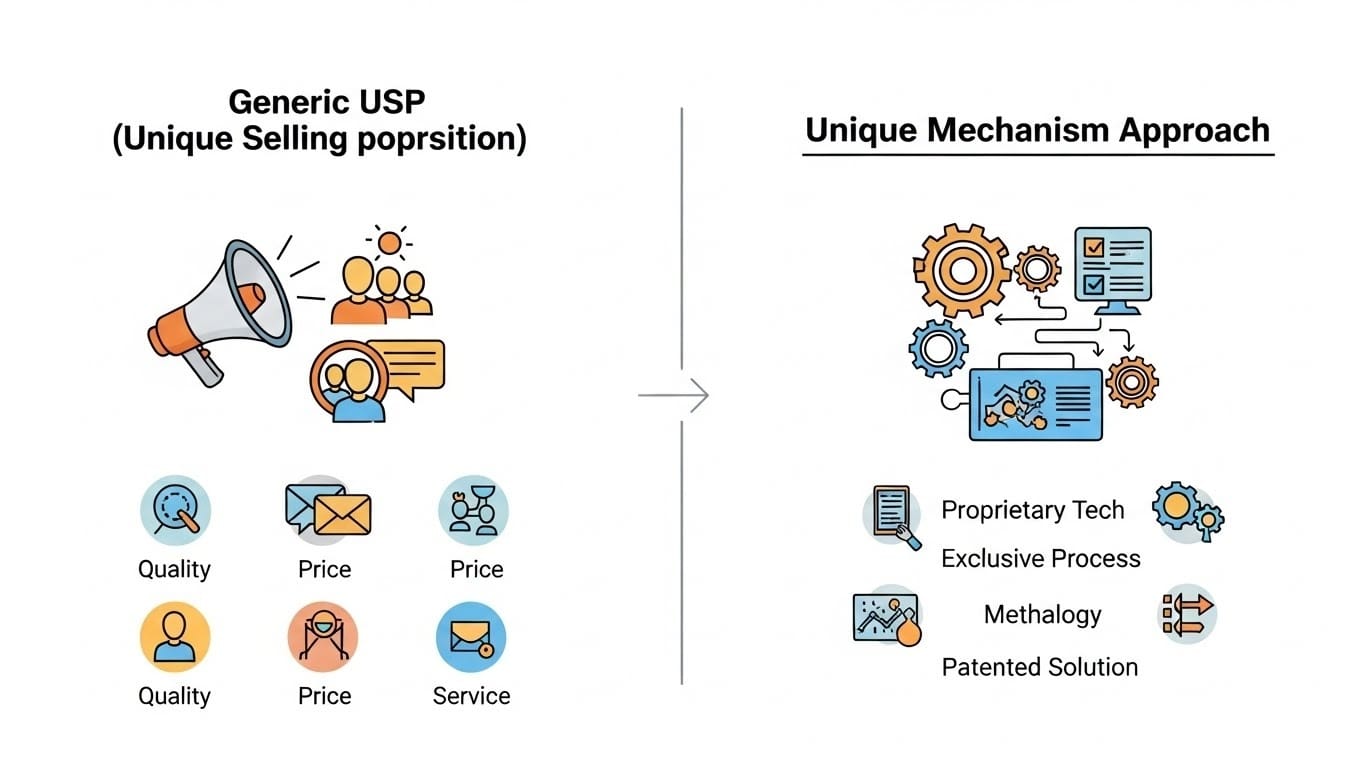
Your unique mechanism is the specific way your firm produces results. It’s the framework, approach, or methodology that guides how you solve problems and deliver outcomes.
Think of it this way:
- A USP says: “We’re different because we do X.”
- A unique mechanism shows: “We produce Y outcome through Z process.”
The difference is subtle but profound.
Why Unique Mechanisms Work in Professional Services
1. They address the real buying decision
Clients don’t buy services. They buy thinking. They buy your approach to solving their problem. A unique mechanism makes that thinking visible and tangible.
When you can say, “Here’s our three-phase framework for reducing compliance risk while improving cash flow,” you’re giving buyers something concrete to evaluate. They can assess whether your thinking aligns with their needs.
2. They’re defensible and ownable
Anyone can claim to be “innovative” or “client-focused.” But your specific process, built from your experience, refined over years, proven with clients – that’s genuinely yours.
A competitor might offer the same service, but they can’t replicate the methodology you’ve developed. That’s real differentiation.
3. They build trust before the sale
When you explain your unique mechanism, you’re demonstrating expertise. You’re showing how you think, how you work, and what makes your approach effective.
This is especially powerful in high-trust services like accounting, legal, and consulting, where the relationship and methodology matter as much as the deliverable.
4. They make marketing and sales easier
Once you have a clear, unique mechanism, marketing becomes easier:
- Case studies show the mechanism in action
- Content explains different aspects of your approach
- Sales conversations focus on fit: “Here’s how we work. Does this align with what you need?”
You’re no longer trying to convince prospects you’re “better.” You’re simply showing them how you work and letting them decide if it’s right for them.
Examples of Unique Mechanisms vs. USPs
Let’s look at the difference in practice:
Generic USP Approach: “We provide innovative, client-focused accounting solutions for growing businesses.”
Problem: Every accounting firm could claim this. What does “innovative” mean? How is “client-focused” different from everyone else?
Unique Mechanism Approach: “We reduce month-end closing chaos for $2-10M companies through our Predictive Close Framework: automated workflow alerts, real-time variance tracking, and proactive CFO advisory built into your monthly cycle.”
Why it works: You can picture exactly what they do, how they do it, and who it’s for. The mechanism (Predictive Close Framework) is specific, defensible, and valuable.
Another Example:
Generic USP: “We take a unique approach to management consulting.”
Problem: Vague and unsubstantiated. What’s unique about it?
Unique Mechanism: “We help professional service firms break through revenue plateaus using our Constraint Mapping Process: we identify your biggest bottleneck (usually authority, lead generation, or sales conversion), then build a 90-day action plan focused exclusively on removing that constraint.”
Why it works: The methodology is clear (Theory of Constraints + focused execution), the outcome is specific (break revenue plateau), and the process is tangible (Constraint Mapping Process).
The Unique Mechanism Framework: How to Identify Yours
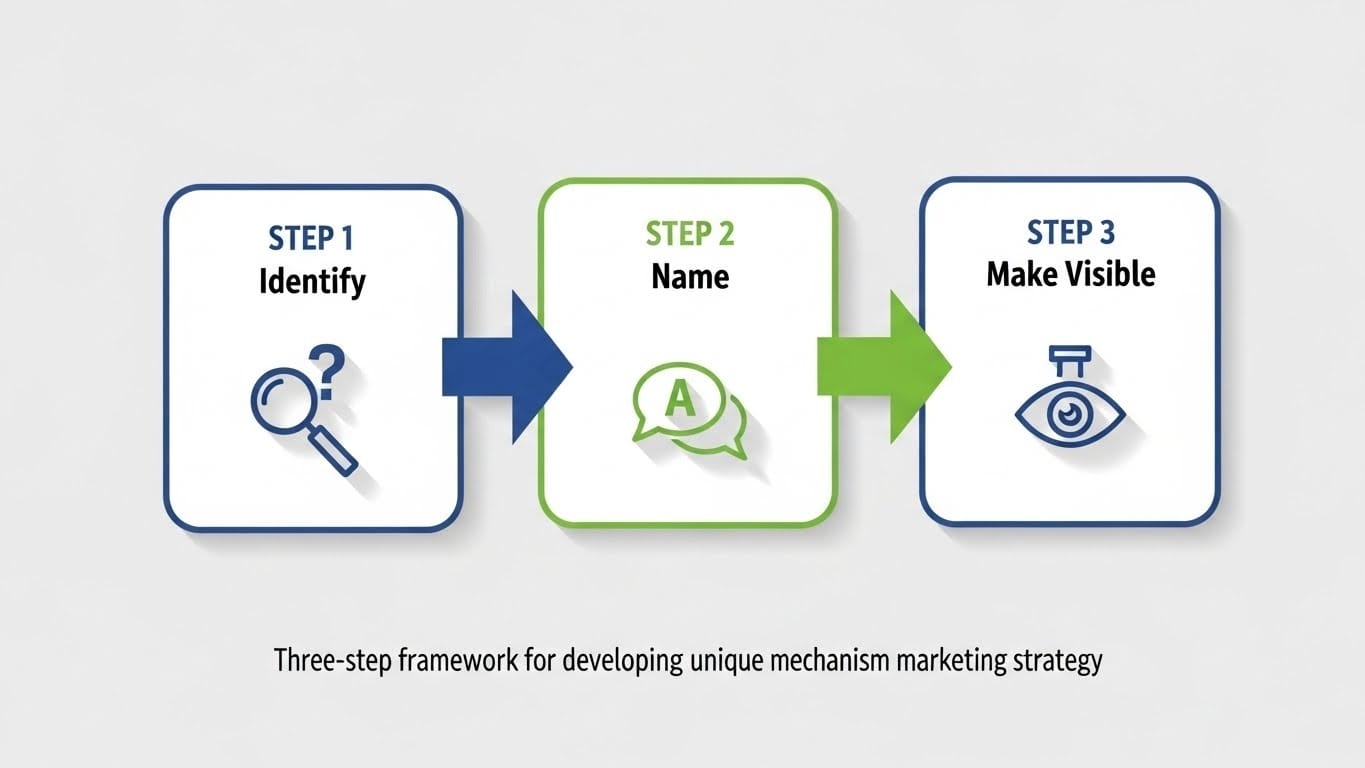
Most firms already have a unique mechanism—they just haven’t articulated it. Here’s how to uncover and refine yours.
Step 1: Identify Your Repeatable Process
Why this matters: Your unique mechanism lives in the process you consistently use to produce results. What do you do the same way with every client because you’ve learned it works?
How to do it:
Start by mapping out your last three successful client engagements. For each one, write down:
- What was the client’s situation when they came to you?
- What specific steps did you take to understand their problem?
- What was your approach to solving it?
- What did you deliver, and in what sequence?
- What made the difference between success and mediocrity?
Look for patterns. Where do your engagements follow the same structure? Where do you make the same moves? That’s where your mechanism lives.
What to look for:
You’re not looking for perfection. You’re looking for consistency. Maybe you always start with a diagnostic phase. Maybe you have a specific framework for prioritizing issues. Maybe you’ve developed templates or tools that you use repeatedly.
Common mistake to avoid:
Don’t describe what every firm does (“We meet with the client to understand their needs”). Identify what YOU specifically do that shapes outcomes.
Bad Example: 👎 “We start by understanding the client’s needs, then we develop a customized solution.”
Why it’s bad: This describes generic consulting. Every firm does this. There’s no mechanism here, just a vague process.
Good Example: 👍 “We start every engagement with what we call a Revenue Architecture Audit: a 3-hour intensive where we map their current lead sources, conversion points, and bottlenecks on a whiteboard. By the end, we’ve identified the 2-3 constraints limiting their growth, and we build our entire engagement around removing those specific constraints.”
Why it works: This is specific, visual, and demonstrates a clear methodology (Theory of Constraints applied to revenue). A prospect can picture what this looks like and understand the value.
Tools/Resources:
- Create a simple flowchart of your typical engagement
- Interview your team: “What do we always do that clients find valuable?”
- Review testimonials for phrases like “Their approach to X was really helpful.”
Step 2: Name Your Framework or Process
Why this matters: A named framework is more memorable, more sharable, and more defensible than a vague approach. It signals that you’ve systematized your thinking.
How to do it:
Once you’ve identified your repeatable process, give it a name. The name should be:
- Descriptive: It should hint at what the framework does
- Memorable: Short and easy to say
- Professional: Sounds legitimate, not gimmicky
- Ownable: Unique enough that it’s clearly yours
Framework naming formulas:
- The [Outcome] Framework: “The Predictable Pipeline Framework”
- [Process Name] Method: “The Constraint Mapping Method”
- [Number]-Step [Process]: “The 5-Phase Revenue Architecture Process”
- The [Metaphor] Approach: “The Lighthouse Strategy” (if you guide firms through uncertainty)
Common mistake to avoid:
Don’t get too cute or clever. “The Revolutionary Synergy Accelerator” sounds like a parody. Keep it professional and clear.
Bad Example: 👎 “We use our proprietary system.”
Why it’s bad: Vague and unsubstantiated. Every consultant claims to have a “proprietary system.” What is it?
Good Example: 👍 “We use the Boutique Scaling Framework: a 4-stage process that helps professional service firms move from founder-dependent delivery to systematic client acquisition and retention.”
Why it works: The name is clear (Boutique Scaling Framework), the target is obvious (professional service firms), and the outcome is specific (systematic client acquisition and retention).
Timeline consideration:
Don’t let naming become a bottleneck. If you can’t decide on the perfect name immediately, use a working title and refine it over time. What matters most is having a defined process.
Step 3: Make Your Mechanism Visible in Your Marketing
Why this matters: A unique mechanism only creates differentiation if prospects actually see it. This is where most firms fail – they have great processes but hide them behind generic messaging.
How to do it:
Infuse your mechanism into every marketing touchpoint:
On your website:
- Create a dedicated “How We Work” or “Our Approach” page
- Include a visual diagram of your process
- Explain each phase with examples
In proposals:
- Lead with methodology, not just deliverables
- Show the framework visually
- Explain why this approach produces better outcomes
In case studies:
- Structure stories around your framework
- Show how each phase of your mechanism played out
- Highlight what would have happened with a generic approach
In content marketing:
- Write about different aspects of your framework
- Share tools or templates from your process
- Demonstrate your thinking through examples
What to look for:
After updating your messaging, test it. When prospects reach out, do they reference your framework? Do they ask how your approach applies to their situation? That’s a sign it’s working.
Common mistake to avoid:
Don’t bury your mechanism in an “About Us” page that no one reads. Make it central to your positioning.
Bad Example: 👎 Homepage: “We provide comprehensive consulting services to help businesses grow.” (No mechanism visible.)
Why it’s bad: Could be any consulting firm. The methodology is hidden or nonexistent.
Good Example: 👍 Homepage: “We help boutique consulting firms break through revenue plateaus using our Constraint Mapping Process. Here’s how it works: [3-phase visual diagram]. See it in action: [Link to case study]”
Why it works: The mechanism is immediately visible, explained, and proven. Prospects understand the approach before the first sales call.
Tools/Resources:
- Create a one-page process diagram (Canva, Lucidchart, or hire a designer)
- Develop a “How We Work” page template
- Build a case study template that highlights your framework
Bringing It All Together
When you shift from trying to invent a USP to articulating your unique mechanism, several things happen:
- Your messaging becomes clearer – Instead of vague claims, you’re showing a concrete process
- Prospects self-qualify – They can assess fit before reaching out
- Sales conversations improve – You’re discussing methodology, not defending pricing
- You build defensible positioning – Competitors can copy your services, but not your refined process
The goal isn’t to sound different. It’s to make your thinking visible, tangible, and valuable to the right buyers.
Real-World Application: From Vague Positioning to Clear Mechanism
Let me show you how this played out with a boutique accounting firm I worked with.
The Situation
The firm had been in business for 12 years, serving professional service firms in accounting, tax prep, and CFO advisory services. Revenue was stuck around $1.8M, and they were losing deals to larger firms and cheaper alternatives.
Their positioning was generic: “We provide innovative, personalized accounting solutions for growing businesses.”
What They Tried First
Like most firms, they tried to differentiate on service quality and client relationships. Their website emphasized their “commitment to excellence” and “personalized approach.”
It didn’t work. Every competitor made the same claims. Sales cycles were long, and pricing pressure was constant. They couldn’t explain why a prospect should choose them over the firm down the street.
The Shift
We worked together to identify their unique mechanism. Through client interviews and internal analysis, we discovered a pattern:
Their best clients all had chaotic month-end closes. The firm had developed a specific process to solve this: they’d built automated workflow alerts, created real-time variance tracking dashboards, and integrated proactive CFO advisory into the monthly cycle.
They called it the Predictive Close Framework.
Once named and documented, everything changed:
New positioning: “We reduce month-end accounting headaches for boutique professional service firms using our Predictive Close Framework: workflow automation + real-time variance tracking + proactive CFO advisory built into your monthly cycle.”
New website messaging:
- Dedicated page explaining the 3-phase framework
- Visual diagram showing the process
- Case study walking through a typical implementation
New sales approach: Instead of leading with services and pricing, discovery calls focused on: “Here’s how we work. Let me show you the framework. Does this approach align with what you’re looking for?”
The Results
Within 6 months:
- Average deal size increased 35%
- Sales cycle shortened from 6-8 weeks to 3-4 weeks
- Close rate improved from 28% to 47%
- They were no longer competing primarily on price
- Referrals specifically mentioned their “framework” and “process”
Key Insight
The accounting services didn’t change. The team didn’t change. What changed was making their methodology visible and positioning it as the differentiator.
Clients weren’t buying bookkeeping and tax prep—they were buying the Predictive Close Framework. That’s a very different (and more valuable) purchase decision.
Common Objections to the Unique Mechanism Approach
“But what if my competitors just copy my framework?”
Let them try. Your unique mechanism isn’t just the idea—it’s years of refinement, team training, and practical application. A competitor might replicate the concept, but they won’t have your expertise executing it.
Besides, if your mechanism is truly valuable, being copied validates that you were right to focus on it. And you’ll always be the original—the authority on that approach.
“Isn’t this just giving away my secret sauce?”
No—you’re demonstrating your thinking, not giving away the implementation. When you explain your framework, you’re proving you know what you’re doing. That builds trust and positions you as the expert.
Think about it: Does knowing that a chef uses a specific technique for sous vide mean you can replicate their results? Of course not. The knowledge of the process actually makes you more likely to hire them, not less.
“My process isn’t that different from competitors.”
You might be surprised. Most firms underestimate what they do that others don’t. Your “obvious” approach is often built from years of trial and error that competitors haven’t experienced.
But even if your process is similar, the act of documenting, naming, and communicating it creates differentiation. Most of your competitors aren’t doing this work. They’re hiding behind generic claims.
“What if my industry/situation is different?”
The unique mechanism framework works across industries because it’s based on a fundamental truth: buyers of professional services are hiring thinking and process, not just deliverables.
Whether you’re in accounting, IT consulting, legal services, marketing, or any other knowledge-based field, the question is the same: How do you produce better outcomes than competitors?
Answer that question with specificity, and you have your unique mechanism.
“How long does it take to develop a unique mechanism?”
If you’ve been in business for more than a year, you already have one—you just haven’t articulated it. The work is excavation and documentation, not invention.
Most firms can complete this process in 2-4 weeks:
- Week 1: Map your existing process across recent engagements
- Week 2: Identify patterns and formalize the framework
- Week 3: Name it and create a visual representation
- Week 4: Update website and marketing materials
The refinement continues over time as you test messaging and gather feedback, but the core framework can be defined quickly.
Your Next Steps: From Generic to Differentiated
If you’re ready to move beyond vague USP claims and build real differentiation through your unique mechanism, here’s what to do:
Immediate Actions (This Week)
- Examine your messaging – Review your website, proposals, and sales materials. Count how many generic claims you’re making (innovative, client-focused, full-service, etc.). These are opportunities to replace vague language with a specific process.
- Map your last three successful projects – Write out what you did, step by step. Look for the patterns in your approach. Where are you consistently doing things in a specific way?
- Interview your best clients – Ask them: “What specifically did we do that made the difference?” Their answers will reveal your mechanism.
Medium-Term (Next 30 Days)
- Document your process – Create a simple flowchart or written framework of your methodology. Give it a working name.
- Test your messaging – Update your homepage or pitch deck to lead with your mechanism. Run it past a trusted client or colleague: “Does this make sense? Is this clearer than our old positioning?”
- Create one case study – Take a successful client engagement and structure the story around your framework. Show how each phase of your mechanism played out.
Long-Term (Next 90 Days)
- Build your framework into all marketing – Dedicated website page, updated proposals, content series explaining different aspects, and visual diagrams
- Train your team on the messaging – Everyone should be able to explain your unique mechanism consistently
- Measure the impact – Track changes in close rate, deal size, sales cycle length, and the quality of inbound inquiries
The Bottom Line
You don’t need a clever USP to differentiate your professional service firm. You need to make your thinking visible.
Your unique mechanism—the specific process you use to produce better outcomes—is your real differentiator. It’s defensible, valuable, and makes marketing and sales dramatically easier.
Stop trying to sound different. Start showing how you actually work.
Want More Insights on Positioning and Marketing for Boutique Firms?
Subscribe to The Business Builder, my weekly newsletter for accounting and boutique consulting firm owners who want to increase authority, leads, sales, and client retention.
Every week, I share practical frameworks and strategies to help you break through revenue plateaus and build a more profitable firm.