
You just finished explaining your consulting methodology to a prospective client. You walked through your process, outlined the deliverables, and outlined the timeline. Clear, professional, logically sound.
Two weeks later, they went with someone else.
When you asked why, they said your competitor “just felt like a better fit.”
Here’s what happened: they couldn’t remember what made you different. Your work made sense in the meeting. It didn’t stick. The words didn’t translate into something they could picture, feel, or repeat to their colleagues.
This is the quiet problem most consultants face. It’s not that your work isn’t good. Not that clients don’t value it. But the value lives in your head instead of in your clients’ minds.
A regular newsletter can help change that.
Not because it “keeps you top of mind” or “demonstrates thought leadership” – the generic advice you’ve heard a hundred times.
But because it trains you to do something most consultants never master: translate technical expertise into outcomes your clients can actually visualize.
In this guide, you’ll learn why newsletters work differently for professional services than for product businesses, a specific framework for making your value memorable, and how to implement a newsletter that builds trust, reduces pricing resistance, and generates referrals you don’t have to chase.
After working with accounting and boutique consulting firms for years, I’ve seen this pattern repeatedly. Firms that struggle with referrals and pricing aren’t producing lower-quality work. They’re just not giving clients the words to describe what you do and why it matters.
Let’s start with why this problem is so persistent.
Why Most Consulting Conversations Don’t Stick
The “great work speaks for itself” belief runs deep in professional services. We’re taught that quality matters more than marketing. That results trump self-promotion.
That real experts don’t need to sell.
This belief comes from a noble place. But it’s only partially true.
During a project, clients see your value. They experience the transformation. They feel the relief when problems get solved.
But after the engagement ends, the specifics fade. What remains is a vague positive feeling that doesn’t translate into specific words.
Think about your own experience. You’ve had great consultants, advisors, or service providers. Can you articulate exactly how they helped you? Can you explain their methodology to a colleague?
Probably not in detail. You remember the outcome, maybe, but not the process that created it.
This is exactly what happens to your clients. They want to refer you. They might even try. But when they open their mouths, what comes out is: “They’re really good. We liked working with them.”
That’s not a referral that converts.
The Real Cost of Invisible Value
When your value isn’t portable, meaning clients can’t articulate it, several things break:
Referrals die on the vine. Clients make introductions, but prospects don’t follow up. Why would they? “They’re really good” sounds like every other consultant.
Pricing conversations get harder. Without a clear picture of your process and the outcomes it creates, clients default to comparing you on price. You become an expense, not an investment.
You stay the “best-kept secret.” Everyone who works with you loves you. But your reputation doesn’t travel. Growth requires you personally touching every new relationship.
I saw this constantly in my CPA days.
I would walk clients through risk controls, audit preparation, new accounting rules. I knew the work mattered. They agreed it mattered. Still, their attention drifted.
Until we changed the angle (I was part of a larger firm).
When we started talking about what a delay might cost them in lost bonuses, reimbursements, or how a better process could protect their reputation or give them back a weekend with their kids – everything shifted.
The same clients who ignored acronyms and charts suddenly leaned in.
The work didn’t change. The words did.
The Value Translation Framework: Making Your Expertise Portable
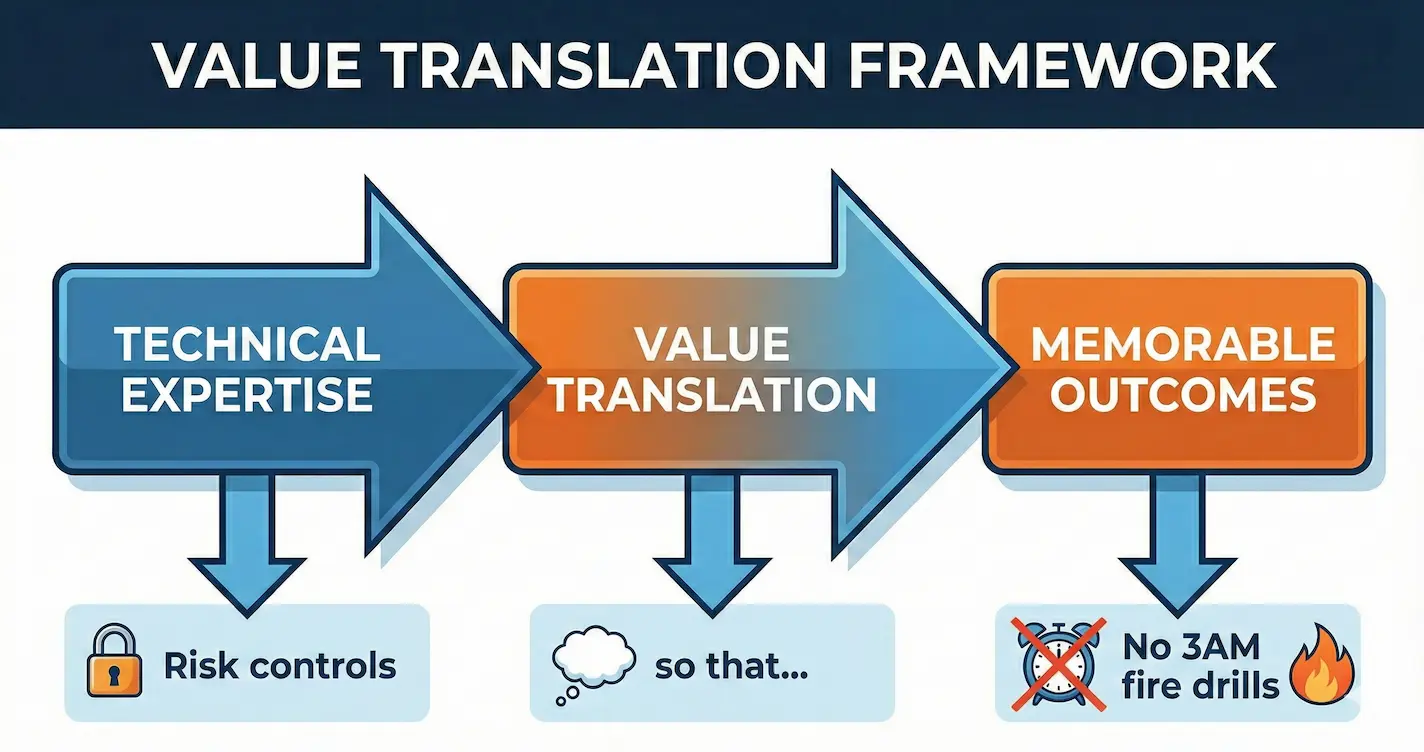
The solution isn’t better work. It’s making your work visible and repeatable.
I call this the Value Translation Framework: a systematic approach to converting technical expertise into outcomes clients can picture, remember, and share.
Here’s the core principle: Every piece of client communication should translate what you do into what changes.
Not “new reporting system.” Instead: “No more late-night fire drills before board meetings.”
Not “improved workflows.” Instead: “A team that hits deadlines without burning out.”
Not “risk assessment.” Instead: “The confidence to sign off knowing nothing will blindside you.”
This isn’t dumbing down your work. It’s completing the communication loop. You know what the technical work creates. Prospects don’t…unless you tell them.
Why a Newsletter Forces This Translation
Here’s where the newsletter becomes powerful.
It’s not about the newsletter itself. It’s about what producing one regularly does to you.
When you write for clients every week or two, you can’t hide behind jargon. You can’t assume they understand why your methodology matters. You’re forced to translate.
Write about risk controls, and you have to explain why anyone should care.
Write about strategic planning, and you have to show what changes in someone’s business or life.
Do this once in a proposal, and it helps.
Do this every week in a newsletter, and it rewires how you communicate.
The translation becomes automatic. It shows up in sales calls. In project kickoffs. In how you describe your work at a networking event.
The newsletter is a training ground for value translation.
How Different Industries Apply This
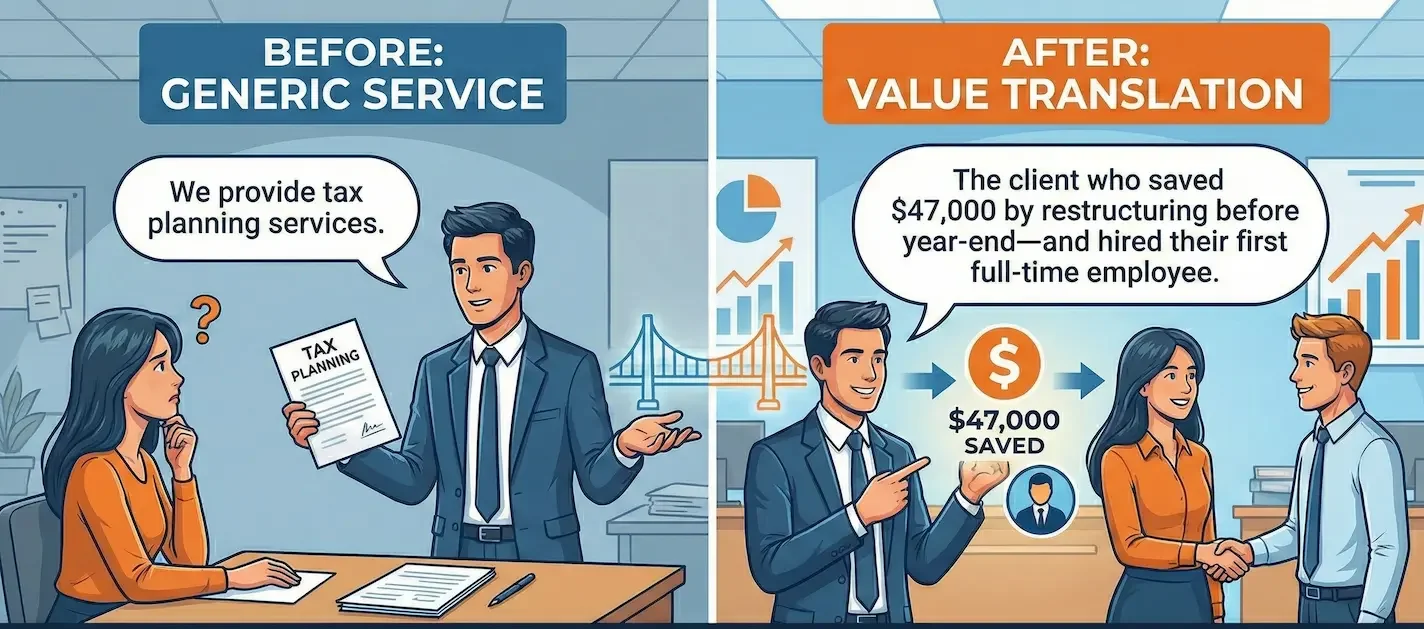
Accounting firm: Instead of “We provide tax planning services,” the newsletter tells the story of the client who saved $47,000 by restructuring their entity before year-end—and what they did with that money. Hired their first full-time employee. Finally took a real vacation.
IT consulting: Instead of “We implement cloud infrastructure,” the newsletter shares the story of the founder who used to wake up at 3 AM when servers crashed. Eighteen months later, she hasn’t had a single midnight emergency.
Management consulting: Instead of “We optimize operations,” the newsletter describes the manufacturing client whose team used to work mandatory overtime every month—and now finishes projects early with fewer people.
Same expertise. Different words. Completely different impact.
How to Build a Newsletter That Translates Value (For Consultants)
Making this work requires a specific approach. Not just “send a newsletter.” But send one that systematically trains you (and your readers) to think in outcomes.
Step 1: Choose Stories Over Information
Why This Matters:
Information is forgettable. Stories stick.
Your newsletter shouldn’t be a collection of tips. It should be a steady stream of examples that make abstract value concrete.
How to Do It:
Every newsletter should include at least one story. It doesn’t have to be a full case study. It can be:
- A problem a client faced (anonymized if needed)
- A mistake you made and what you learned
- A pattern you see across multiple clients
- Something from your own career that illustrates a principle
The story creates a hook. Then you extract the principle. Then you give them something to do about it.
Bad Example:
“Proper documentation is important for professional service firms. Here are five best practices for documenting your processes…”
Why it fails: No story, no stakes, nothing memorable. Sounds like every other business blog.
Good Example:
“Last month, a client asked me why their proposals weren’t converting. Turns out, the proposals were excellent. Detailed, thorough, professionally designed. But they were written in consultant-speak. When I asked a prospect what they remembered from the proposal, they said: ‘It seemed comprehensive.’ That’s not a buying decision. Here’s what we changed…”
Why it works: Specific situation, clear stakes, relatable problem. The reader sees themselves in it.
Common Mistake to Avoid:
Don’t wait for perfect case studies with permission and dramatic results. Most of your stories will be small observations, teaching moments, and everyday examples. Those are often more relatable than the big wins.
Step 2: Translate Every Technical Concept
Why This Matters:
Your readers don’t care about your methodology. They care about what it does for them. Every time you mention a technical concept, complete the thought with an outcome.
How to Do It:
Create a simple rule: Every time you write about what you do, immediately follow it with what changes.
Use this formula: “[Technical thing] so that [outcome they can picture]”
The Process:
- Write your first draft without worrying about this
- Go back and highlight every technical term, process name, or deliverable
- For each one, add “…so that…” and complete with a concrete outcome
- If you can’t think of an outcome, ask: “Why does anyone care about this?”
👎 Bad Example:
“We conduct stakeholder interviews to understand organizational dynamics and identify process bottlenecks.”
Why it fails: Accurate but meaningless to most readers. What does “identify process bottlenecks” actually get them?
👍 Good Example:
“We conduct stakeholder interviews—so you find out why your best people are frustrated before they start looking for other jobs. One client discovered three hidden conflicts that would have cost them their top salesperson.”
Why it works: Same activity, but now readers see what’s at stake. The outcome is concrete and emotional.
Questions to Ask Yourself:
- Would a client’s spouse understand why this matters?
- Could a reader explain this to their business partner?
- Is the outcome something they’d pay to achieve (or pay to avoid)?
Step 3: Build Consistency Over Brilliance
Why This Matters:
A newsletter’s power compounds over time. One great edition doesn’t move the needle. Showing up consistently, month after month, fundamentally changes how your audience perceives you.
How to Do It:
Set a sustainable frequency. For most consultants, that’s every two weeks or monthly (Learn more about newsletter frequency and content types for consultants). Weekly is better if you can sustain it, but consistency beats frequency every time.
Then protect that commitment. Write your newsletter before other content. Batch-write if that works for you. Create templates for the structure, so you’re not starting from scratch.
The Process:
- Pick a frequency you can maintain for a year (not a month)
- Block time on your calendar specifically for newsletter writing
- Build a running list of story ideas—add to it whenever you notice something
- Write in the same structure each time (easier to start, easier to read)
What to Look For:
After 6-12 months of consistent publishing, notice:
- Do prospects mention your newsletter before the first call?
- Are referral conversations more specific?
- Do clients reference specific editions or ideas?
- Is your sales cycle shortening?
Common Mistake to Avoid:
Don’t skip an edition because it’s not “good enough.” A B+ newsletter sent on time builds more trust than an A+ newsletter sent sporadically. Your readers expect consistency more than perfection.
Timeline Considerations:
Expect 6 months before you see noticeable effects. This isn’t a quick win. It’s an asset that compounds. The firms that benefit most from newsletters commit to consistency even when it feels like no one is reading.
Common Questions About Creating Better Newsletters for Consultants
My industry is too technical. Will this work?
A. Technical industries benefit most from value translation. Your competitors are almost certainly stuck in jargon. When you’re the one consultant who can explain outcomes in plain language, you stand out immediately.
The more technical your work, the bigger the differentiation opportunity.
I don’t have time to write regularly.
Start smaller than you think. A useful newsletter can be 400-600 words. One story, one insight, one action step. That’s 30-45 minutes of writing time.
If that still feels impossible, it’s a signal that marketing consistently isn’t a priority. That’s fine, but then don’t expect referrals and inbound leads to materialize on their own.
What if I run out of things to say?
You won’t.
Every client conversation, every pattern you notice, every mistake you make is potential material. The problem isn’t running out of ideas. It’s noticing which daily observations are worth sharing.
Keep a running note of “things that surprised me” and “questions clients ask.” You’ll have more material than you can use.
Won’t competitors steal my ideas?
Unlikely. And even if they do, execution matters more than ideas. Your unique combination of experience, perspective, and examples can’t be copied.
Firms that worry most about this are often underestimating how much their specific viewpoint matters.
How do I get people to subscribe?
Start with who you already know. Every current client, past client, and warm contact should be invited to subscribe. Mention it in your email signature. Add a simple form to your website. Reference it in conversations.
For most boutique firms, the list grows through relationships, not marketing funnels.
Should I use a platform like Substack or Mailchimp?
Use whatever makes it easy to be consistent.
Substack is simple for getting started. ConvertKit or Mailchimp offer more control. Beehiiv has nice features for growth. The platform matters less than hitting send.
Don’t spend three weeks evaluating tools. Pick one and start.
How long before I see results?
Expect 6-12 months for measurable impact on referrals and inbound inquiries. You’ll notice smaller signals earlier – clients mentioning specific editions, prospects who arrive pre-sold on your approach.
But the compounding effect takes time. This is a long game, not a campaign.
Real-World Example: How One Consulting Firm Transformed Client Perception
The Situation
A 5-person financial consulting firm had strong client retention. Nearly 90% renewed each year. But referrals were disappointing.
Despite asking satisfied clients for introductions, few converted to new business. The firm was stuck relying on the founder’s personal network for growth.
What They Tried First
- Asked for referrals at project completion → Got introductions, but prospects didn’t respond to outreach
- Created a capabilities brochure → Clients couldn’t remember what made them different
- Launched a blog → Sporadic posting, no consistent readership, felt like shouting into the void
The problem wasn’t effort. It was that clients couldn’t articulate the firm’s value. When they made referrals, prospects heard “they’re good financial consultants” but had no idea why that mattered.
The Shift
The founder committed to a biweekly newsletter with one rule: every edition would connect one piece of their technical work to a specific outcome a business owner would care about.
Instead of writing about “cash flow analysis,” she wrote about the manufacturer who discovered why profits didn’t match what was in the bank… and stopped feeling anxious every time payroll came up.
Instead of writing about “financial controls,” she shared the story of a founder who discovered an employee had been skimming for two years, and the simple system that would have caught it in week one.
Every technical skill became a specific story with stakes readers could feel.
The Results
After 12 months of consistent publishing:
- Referral conversion rate: Jumped from 15% to over 40%
- Time to first meeting: Dropped from 3-4 weeks to 1 week (prospects arrived pre-sold)
- Pricing discussions: Fewer objections; clients understood the value before seeing the proposal
- Inbound inquiries: 2-3 per month from newsletter shares (previously zero)
First noticeable improvement at 6 months. Significant results at 12 months.
Key Insight
The founder put it simply: “I used to think marketing meant convincing people we’re good. Now I realize it’s about helping them understand how we help. The newsletter forced me to make that concrete every two weeks. It changed how I talk about everything.”
The Bottom Line: Make Your Value Portable
A newsletter isn’t another marketing tactic to manage. Done right, it becomes a training system that changes how you communicate your value.
Here’s what to remember:
- Great work doesn’t speak for itself. You need to translate technical expertise into outcomes clients can picture and repeat.
- Consistency beats brilliance. Showing up regularly builds more trust than occasional masterpieces.
- Stories make value sticky. Specific examples do what abstractions never will.
- The newsletter trains you. The real benefit isn’t the list. It’s how regular writing changes your communication everywhere else.
- Results compound over time. Expect 6-12 months before the full impact becomes visible.
Your next step: Before your next newsletter (or your first one), write down one story from a recent client engagement. What technical thing did you do? What changed for them—in concrete, emotional terms?
That’s your starting point.
Six months from now, you’ll communicate differently. Referrals will be more specific. Pricing conversations will be easier. And you’ll have an asset that keeps working whether you’re in the room or not.
That’s what a newsletter does for a consultant. Not as a marketing chore. As the simplest way to show up as the expert who matters.
Want More Insights Like This?
Subscribe to The Business Builder, my weekly newsletter for boutique B2B and professional service firm founders who want to increase authority, generate consistent leads, improve sales effectiveness, and build stronger client relationships.
Every week, I share frameworks, strategies, and practical steps you can implement immediately—no fluff, no generic advice, actionable insights for professional service firms.
It’s free. Unsubscribe anytime.