
Your Team’s LinkedIn Profiles Are Working Against Each Other
Here’s a scenario that plays out at every professional services firm between 10 and 50 people:
A prospect gets referred to your firm. Before they respond to the intro email, they do what every buyer does…
…they look you up on LinkedIn. They check the partner who was mentioned. Then they click through to a few other people at the firm.
One profile says you’re a “results-driven consulting firm.” Another says you’re a “boutique advisory practice.”
A third doesn’t mention the firm at all. It only lists a job title and a college degree from 2009.
Three profiles. Three different stories. Zero confidence that this firm has its act together.
The prospect doesn’t say any of this. They just take an extra week to respond. Or they don’t respond at all.
This is the LinkedIn sales enablement problem that scaling firms don’t see coming. When you were five people, your founder’s personal brand carried the firm. Now you’re fifteen or twenty-five, and every team member’s profile is either a rogue marketing channel or a dead end.
It’s not limited to professional services. B2B SaaS companies, manufacturing/industrial, tech companies with sales teams – pretty much anyone with a sales force runs this same risk.
This post is the playbook for fixing it. You’ll get a framework for identifying where your team’s messaging breaks down, profile templates your sales team can implement this week, and a content strategy that scales beyond the founder.
Why LinkedIn Matters More for Professional Services Than Any Other Industry
If you sell software, prospects evaluate your product. If you sell professional services, prospects evaluate your people.
That’s why LinkedIn isn’t optional for professional services firms. It’s where the evaluation happens before you even know you’re being evaluated.
Three things LinkedIn does that your website can’t:
1. Individual credibility at scale.
Your website tells the firm’s story. LinkedIn tells each person’s story. When a prospect checks your associate’s profile before a discovery call, they’re not looking at your website. They’re looking at that individual’s credibility signals. That person’s headline, experience, content, and recommendations.
A firm with twelve people has twelve credibility checkpoints. Each of them reinforces or undermines the message.
2. Pre-meeting research is the norm.
Research consistently shows that 75% of B2B buyers use social media (LinkedIn chief among them) to research vendors before making a purchasing decision. I’d argue that number is higher for professional services, where the “product” is the people themselves.
Your prospect has already formed an impression before the first call. The question is whether you shaped that impression or left it to chance.
3. Social proof that travels.
When your team members post thoughtful content, engage with industry conversations, and maintain polished profiles, it creates ambient credibility. Prospects see your firm’s name attached to smart thinking. That’s not advertising, it’s social proof that builds trust before the sales conversation starts.
The problem isn’t that firms don’t know LinkedIn matters. The problem is that knowing and executing are two very different things – especially when you’re scaling.
The Consistency Problem Scaling Firms Can’t Ignore
When a firm is small, the founder’s LinkedIn presence IS the firm’s presence. Their profile, their content, their network. It works because one voice is easy to keep consistent.
Then the firm grows. You hire senior consultants, client managers, and business development reps, etc. Each person creates (or neglects) their own LinkedIn profile. And suddenly, your firm’s public-facing identity fragments.
What the fragmentation looks like:
Messaging inconsistency. Your partner’s headline says “Helping mid-market manufacturers optimize operations.” Your senior consultant’s headline says “Passionate about driving business transformation.” Your BD rep’s headline says “Open to new opportunities.” Same firm. Three completely different value propositions… or no value proposition at all.
Positioning confusion. One person describes the firm as a “strategic advisory.” Another calls it a “management consultancy.” A third uses “professional services firm.” A prospect comparing your team’s profiles can’t tell what you actually do or who you do it for.
Quality variance. The founder has a polished profile with a professional headshot, detailed experience section, and regular content. A senior hire’s profile hasn’t been updated since their last role. Another team member has a great profile but for a completely different brand voice than the rest of the firm.
The founder bottleneck. All the firm’s LinkedIn visibility depends on one person posting. If the founder stops posting (because they’re busy running the firm), the entire LinkedIn presence goes dark. That’s not a strategy. That’s a single point of failure.
The real cost isn’t vanity metrics. It’s lost deals you never knew about. Prospects who reviewed your team’s profiles were confused or unimpressed and quietly moved on to a competitor whose team appeared to be on the same page.
Your LinkedIn Presence: Finding Where Your Team’s Messaging Breaks Down
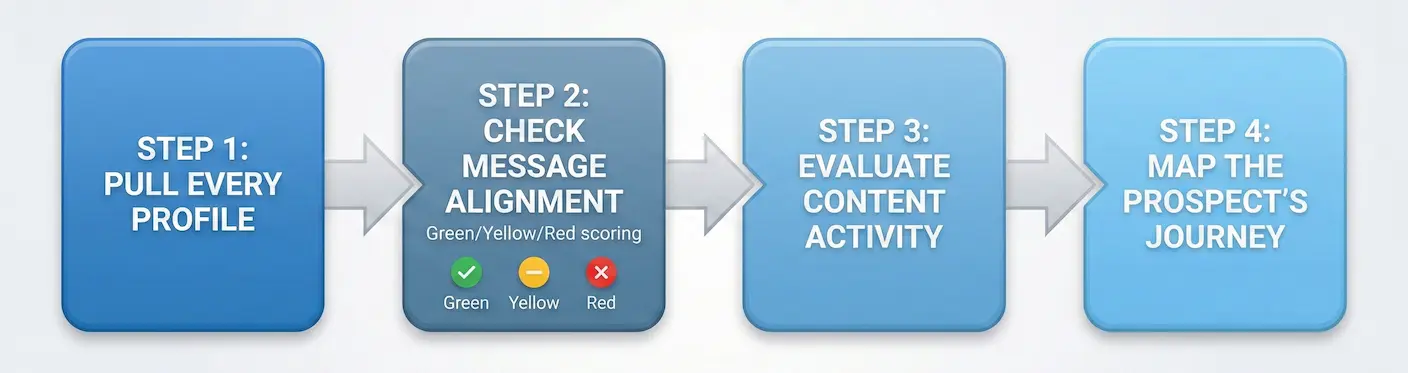
Before you fix anything, you need to see the problem clearly. Most firms are surprised—and a little uncomfortable—by what this audit reveals. The framework takes about two hours and shows you exactly where your team’s LinkedIn presence is helping or hurting your sales process.
Step 1: Pull Every Team Member’s Profile
Create a simple spreadsheet with every client-facing team member. Include:
- Name and role
- Current headline
- About section (first two lines – what’s visible before “see more”)
- Profile photo (professional/casual/missing)
- Last activity date
- Number of connections (rough range is fine)
You’re not judging individuals here. You’re mapping the landscape.
Step 2: Check for Message Alignment
Read every headline and about section back to back. Ask three questions:
- Could a stranger tell these people work at the same firm? If you removed the company name, would anything connect these profiles? Shared language, consistent positioning, similar value propositions?
- Does each profile describe the same firm? Not word-for-word, but do they tell a consistent story about what the firm does and who it serves?
- Is the value proposition clear? For each profile, can a prospect understand in 10 seconds what this person does and why it matters to them?
Score each profile: Green (aligned and clear), Yellow (partially aligned or unclear), Red (misaligned or empty).
Step 3: Evaluate Content Activity
Check who’s posting, what they’re posting, and how often:
- Active and aligned: Posting content that reinforces the firm’s positioning. This is your ideal state.
- Active but misaligned: Posting regularly but about topics unrelated to the firm’s expertise. Better than nothing, but a missed opportunity.
- Inactive: No posts in 90+ days. This is more common than most firms realize. And it creates a dead-end impression for prospects.
Step 4: Map the Prospect’s Journey
Put yourself in a prospect’s shoes. They’ve been referred to your firm and they search for you on LinkedIn. Walk through:
- Which profiles do they find first? (Usually the person they were introduced to)
- Do they click through to other team members?
- What story does each click tell?
- Where does the experience break down?
Document the gaps. That’s your roadmap for what to fix first.
What You’ll Typically Find
Most firms discover three patterns:
- The Founder Island: One great profile surrounded by neglected ones
- The Patchwork: Each profile is decent individually but tells a completely different story
- The Ghost Town: Almost everyone has a bare-minimum profile with no activity
Knowing which pattern you’re dealing with determines your strategy.
Profile Optimization That Works for Sales Teams (Not Just Personal Brands)
Individual LinkedIn optimization advice is everywhere: “Write a compelling headline!” “Tell your story in the about section!” “Use a professional photo!”
That advice is fine for solopreneurs. It falls apart for firms.
When you’re optimizing profiles for a sales team, you need consistency across individuals – not just quality on each profile. The goal isn’t twelve personal brands. It’s twelve profiles that work together to reinforce one firm positioning.
The Profile Template Approach
Create a lightweight template that gives team members structure without turning them into corporate clones:
Headline formula: [Role] at [Firm] | Helping [specific audience] [achieve specific outcome]The first half identifies them. The second half sells. And the “Helping [audience] [outcome]” structure keeps everyone aligned on who the firm serves and what it delivers.
Examples:
- “Partner at Apex Advisory | Helping mid-market manufacturers reduce operational costs by 15-30%”
- “Senior Consultant at Apex Advisory | Helping manufacturing leaders build scalable operations”
- “Client Director at Apex Advisory | Helping COOs turn operational bottlenecks into competitive advantages”
Same audience. Same general value proposition. Different angles based on role. A prospect clicking through three profiles sees consistency with depth—not contradiction.
The About Section framework:
Give each team member a three-part structure:
- The prospect’s problem (2-3 sentences describing the challenge your audience faces—in the audience’s language)
- How this person helps (2-3 sentences about their specific role and expertise within the firm’s methodology)
- The firm’s approach (2-3 sentences about the firm’s methodology or framework—consistent language across all profiles)
Part 1 and Part 3 stay largely the same across the team. Part 2 is personalized. This creates consistency without making everyone sound identical.
Profile photo and banner guidelines:
- Professional headshots (doesn’t need to be the same photographer, but should be a similar standard)
- Branded banner image that includes the firm name and tagline (create one template in Canva that everyone uses)
- Consistent visual identity signals “this team is organized”—and organized teams get hired over chaotic ones
What NOT to Do
Don’t write everyone’s profile for them verbatim. It looks robotic and kills authenticity. Give them the structure, the messaging guardrails, and 2-3 examples. Let them write it in their voice within those guardrails.
Don’t force everyone to post the same content. That can look worse than doing nothing. Prospects spot coordinated inauthenticity fast.
Don’t make it optional. If someone is client-facing, their LinkedIn profile is a sales tool. Treat it that way.
Content Strategy That Scales Beyond the Founder
The biggest LinkedIn vulnerability for scaling firms is founder-dependent content. When one person generates all the firm’s LinkedIn visibility, you’ve built a single point of failure into your business development engine.
A scalable content strategy distributes that visibility across the team without requiring everyone to become a content creator.
The 3-Tier Content Model
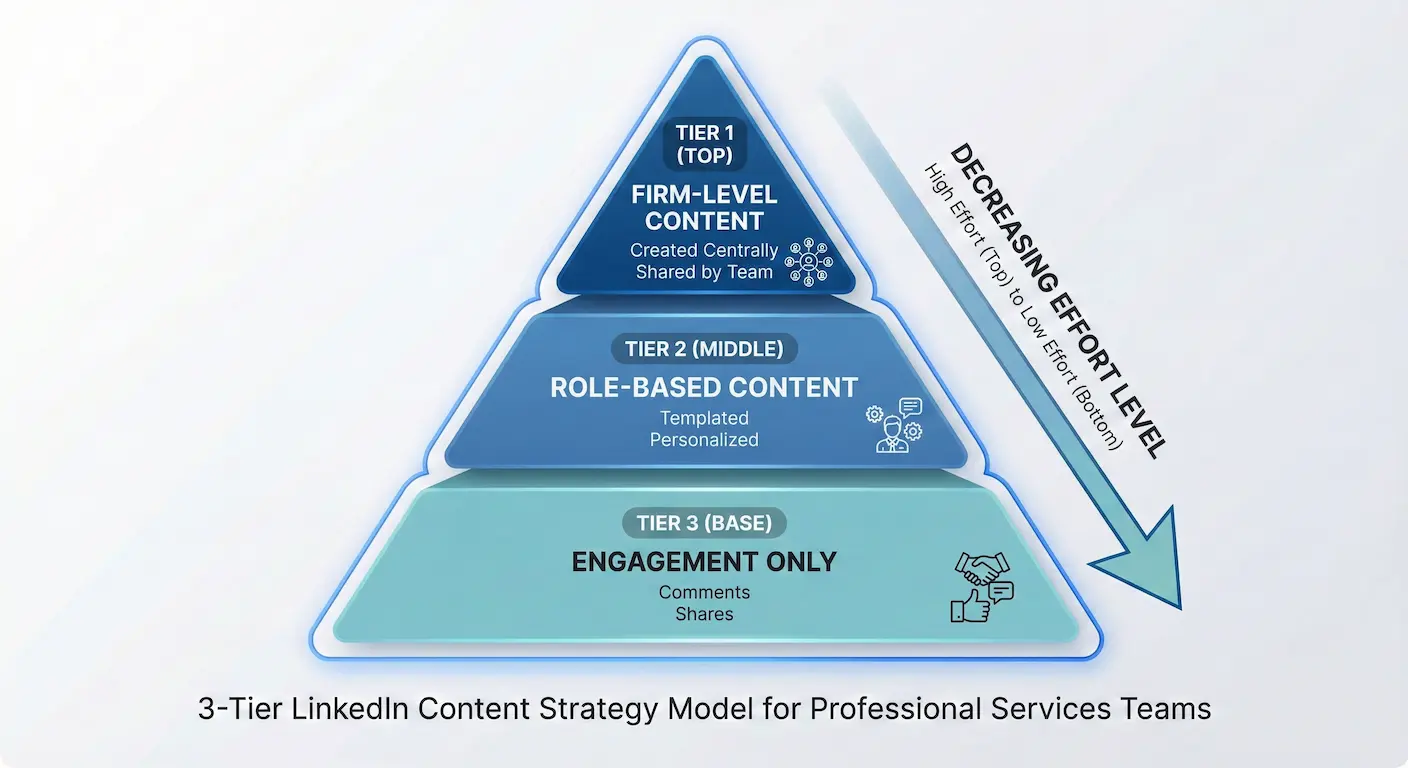
Tier 1: Firm-level content (created centrally, shared by team)
This is content your marketing team or an outside resource creates that reflects the firm’s positioning. Think: original insights, frameworks, industry analysis, and point-of-view pieces.
The team doesn’t create this content. They amplify it. Sharing a firm post with a one-line personal take (“This matches what I’m seeing with manufacturing clients in the Midwest – especially the point about…”) takes 30 seconds and can double or triple the post’s reach.
Tier 2: Role-based content (templated, personalized)
Create content templates tied to each role’s perspective:
- Partners/principals: Strategic insights, industry trends, client outcomes (anonymized)
- Senior consultants: Implementation lessons, methodology deep-dives, “what I learned from this project” posts
- Business development: Client challenges they’re hearing about, industry events, thought-provoking questions
Give each person a content prompt once a week. Not a finished post, a prompt. “What’s one thing you learned from a client conversation this week?” Most people can answer that in three sentences. That’s a LinkedIn post.
Tier 3: Engagement-only (no content creation required)
For team members who won’t post (and there will be some), the minimum viable activity is engagement: commenting thoughtfully on firm content and industry conversations. A senior consultant who comments insightfully on three posts per week generates more profile views and connection requests than one who posts generic content once a month.
Making It Sustainable
The content strategy that actually works is the one people will follow. Keep the bar low:
- Weekly time commitment: 15-30 minutes per person
- Minimum activity: 2-3 meaningful comments OR 1 short post per week
- Content support: Provide prompts, not mandates
- Recognition: Highlight team members who are doing it well (internally)
- No policing: Don’t micromanage tone or timing—just maintain messaging guardrails
The goal isn’t to turn every consultant into a LinkedIn influencer. It’s to ensure that when a prospect checks your team’s profiles and recent activity, they see a firm that’s active, knowledgeable, and aligned.
How to Maintain Consistency as You Grow
The audit is done. Profiles are optimized. Content is flowing. Now the hard part: keeping it consistent as you add people.
Build LinkedIn Into Your Onboarding
Don’t wait until someone’s been at the firm for six months to realize their LinkedIn profile still shows their old job. Make profile optimization part of the first-week onboarding:
- Day 1-2: Provide the profile template, headline formula, and about section framework
- Day 3-5: Review their updated profile and give feedback
- Week 2: Add them to the content distribution list and explain the 3-tier model
New hires are motivated. They want to represent the firm well. Catch them early.
Quarterly Profile Reviews
Set a quarterly calendar reminder to re-run the audit framework (it gets faster after the first time). Look for:
- New hires who haven’t updated their profiles
- Team members whose profiles have drifted from the messaging
- Content activity levels dropping off
- Headline or about section language that no longer matches the firm’s current positioning
This isn’t about policing. It’s about maintenance. The same way you’d review your website quarterly, review your team’s LinkedIn presence.
Create a Living Messaging Guide
A one-page document (not a 30-page brand book) that captures:
- The firm’s current positioning statement
- Target audience description (in plain language)
- 3-5 approved ways to describe what the firm does
- The headline formula with 3-4 examples
- The about section framework
- What NOT to say (common phrases that undermine positioning)
Update it when your positioning evolves. Share it with every new hire. Reference it in quarterly reviews.
Assign Ownership
Someone at the firm needs to own LinkedIn sales enablement. Not as a full-time job but as a responsibility. This person:
- Runs the quarterly audit
- Onboards new hires on LinkedIn expectations
- Creates or curates weekly content prompts
- Flags profiles that need attention
- Reports on team LinkedIn activity (not vanity metrics—are we showing up consistently?)
Without ownership, LinkedIn enablement dies within 90 days. Every firm initiative without an owner does.
Common Questions About LinkedIn Sales Enablement
“Won’t this feel too corporate or forced?”
Only if you do it wrong. The template approach gives structure, not scripts. Each person writes in their own voice within shared guardrails. The result should feel like a team that’s aligned—not a team that’s been issued identical talking points.
“What if team members resist updating their profiles?”
Start with the people who are willing. Early wins create momentum. When a consultant sees that their colleague’s updated profile led to a prospect commenting, “I found you on LinkedIn and loved your headline,” resistance tends to fade.
For persistent holdouts, frame it as a professional expectation. No different from maintaining a clean email signature or dressing appropriately for client meetings. If someone is client-facing, their LinkedIn profile is part of their professional toolkit.
“How do we handle team members who are active on LinkedIn with their own personal brand?”
This is a good problem to have. Don’t suppress it. Instead, work with them to align their personal content with the firm’s positioning. A consultant who posts regularly about supply chain optimization (your firm’s specialty) is a massive asset. Just make sure their profile connects their expertise back to the firm.
“Do we need LinkedIn Sales Navigator or premium tools?”
Not to start. Profile optimization and content strategy cost nothing. Tools like Sales Navigator add value later, when you’re using LinkedIn for outbound prospecting. Get the foundation right first. Too many firms buy tools to solve what’s actually a messaging and consistency problem.
“What about LinkedIn company pages?”
They matter less than you think. Prospects research people, not company pages. Your team’s individual profiles will consistently get more views and more engagement than the company page. Maintain the company page, keep it current, and post occasionally. But invest the majority of your effort in individual profiles.
“How long before we see results?”
You’ll see profile views increase 50-200% within the first two weeks of updating profiles. Content engagement builds over 60-90 days of consistent activity. The real payoff comes with prospects mentioning they found you on LinkedIn, shorter sales cycles, and warmer first calls. Those usually start within 90-180 days. LinkedIn sales enablement is a compounding investment, not a quick win.
Real-World Application: A 20-Person Advisory Firm Gets Aligned
This is a composite example based on patterns I’ve seen across multiple firms.
The Situation
A management advisory firm had grown from 8 to 22 people in eighteen months. The founder had a strong LinkedIn presence – 2,500+ connections, regular posting, a polished profile. The rest of the team? Patchwork.
Five profiles still listed previous employers in the headline. Three had no profile photo. Only two people besides the founder had posted anything in the last six months. The firm’s positioning – operational excellence for mid-market manufacturers -was visible on exactly one LinkedIn profile.
What They Did
Week 1: Ran the audit framework. Found 18 of 22 profiles scored Yellow or Red on message alignment.
Weeks 2-3: Rolled out profile templates. Every client-facing team member updated their headline and about section using the shared framework. The firm created a branded banner template in Canva.
Week 4: Launched the 3-tier content model. Partners committed to one original post per week. Senior consultants received weekly prompts. Everyone else was asked to comment on firm content at least twice per week.
Ongoing: Assigned LinkedIn ownership to their marketing coordinator. Added profile setup to new-hire onboarding. Set quarterly audit reminders.
The Results
After 90 days:
- Team profile views increased 340% across the firm
- Three inbound inquiries mentioned “I saw your team on LinkedIn” in the first conversation
- Average time from referral introduction to first meeting dropped from 11 days to 4 days
- The founder’s content reached 3x more people through team amplification
The insight that mattered most: Prospects stopped asking “So what does your firm do?” on first calls. They already knew—because the team’s LinkedIn profiles told a consistent story before the meeting started.
The Bottom Line: LinkedIn Sales Enablement Is a Team Sport
LinkedIn sales enablement for professional services isn’t about individual tips and tricks. It’s about building a system that makes your entire team’s presence work together.
Here’s what to remember:
- Your team’s LinkedIn profiles are being evaluated before you know a prospect exists. Shape the impression or leave it to chance.
- Consistency across profiles matters more than perfection on any single one. A team that tells the same story builds trust faster than a founder with a great profile surrounded by empty ones.
- Content doesn’t need to be created by everyone, but everyone should be visible. Comments and shares count.
- Build LinkedIn into your systems: onboarding, quarterly reviews, messaging guides, and clear ownership.
- Start with the audit. You can’t fix what you can’t see.
Your next step: Block two hours this week to run the audit framework. Pull up every client-facing team member’s profile, map the landscape, and score each one. That spreadsheet becomes your roadmap.
Six months from now, when a prospect researches your firm before a first meeting, they should see a team that looks aligned, active, and authoritative. That impression starts forming before anyone picks up the phone—and it’s either working for you or against you.
Right now, your team’s profiles are telling a story. The question is whether you wrote it…or left it to chance.
Want More Frameworks Like This?
Subscribe to The Business Builder, a weekly newsletter for boutique B2B and professional service firm founders who want to increase authority, generate consistent leads, and build stronger client relationships.
Every week: actionable frameworks, zero fluff, built specifically for professional services. Free, weekly, unsubscribe anytime.