
I was scrolling through posts online this week looking for a newsletter topic, I came across a quote from Claude Hopkins that had sparked a debate.
Hopkins was one of the pioneers of modern advertising. His book *Scientific Advertising*, written in the early 1900s, remains foundational reading in direct-response marketing. Testing, measurable results, copy written for the customer rather than the company. Most of what we take for granted now traces back to him.
The quote being discussed:
“People can be coaxed but not driven. Whatever they do they do to please themselves.”
Someone pushed back. Said Hopkins got it wrong. That fear-based marketing clearly does drive behavior.
What caught my attention wasn’t the disagreement. It was that the person making the argument implied they hadn’t actually read the book.
They’d seen the quote, formed a view, and were ready to argue.
If you’ve spent any time selling your consulting services, making a case to a new prospect or presenting a proposal, you’ve seen this exact pattern. A prospect hears something you say, forms an immediate interpretation, and responds with confidence. Sometimes they push back directly. Sometimes they go quiet. Either way, the instinct on your side is the same: explain more clearly, make the case more airtight.
It usually makes things worse.
In this article, I want to explain why that happens and offer a better approach for sales conversations that actually move forward. The approach comes from understanding how people actually process information, not how we wish they would.
The Problem: Treating Every Objection Like an Information Gap
Most sales training tells professional service firm owners to get better at explaining their value. Build a stronger case. Develop proof points. Create a more compelling story about your methodology.
There’s nothing wrong with any of that exactly. Clear communication matters. Proof helps.
The problem is the underlying assumption: if a prospect doesn’t buy, it’s because they don’t understand enough yet.
So the fix becomes more information, more detail, better explanation. And the conversation turns into a pushing contest.
Where the “Explain More” Instinct Comes From
In most professional contexts, more information does solve problems. If your client doesn’t understand the tax implications of a decision, you explain them. If they don’t understand the scope of a project, you clarify it.
The assumption is that understanding leads to agreement. In technical contexts, it often does.
Sales conversations work differently.
In a sales conversation, a prospect isn’t just processing information. They’re evaluating whether what you’re saying fits with what they already believe: about their problem, about solutions like yours, about what’s worked before, about people who do what you do.
Claude Hopkins was getting at something real. People don’t make decisions based on rational evaluation of new facts. They make decisions based on how new information fits relative to what they already believe. If it fits, they accept it. If it doesn’t, they reject it. Often without knowing they’re doing it.
Researchers who study belief formation sometimes call this “identity-protective cognition.” When new information threatens how someone sees their situation, the brain tends to reject it regardless of how well-reasoned the argument is.
What that means for sales: when a prospect pushes back, they may not be asking “is this true?” They may be asking “does this fit what I already believe?” Those require very different responses.
The Hidden Cost of Explaining More
When you respond to resistance by going deeper into your case, a few things happen.
First, the prospect digs in. Behavioral research on persuasion consistently shows that when people are challenged directly, they tend to defend their original position more strongly, not less. Counterarguments can actually reinforce the belief they’re meant to challenge.
Second, you start to seem pushy. Even when you’re not trying to be. The prospect may not be conscious of this, but the dynamic shifts from conversation to pressure. That changes the relationship.
Third, you often miss the real objection. A prospect who says “I don’t think this will work for our business” may actually be saying “I’ve been burned before,” or “I’m not sure I trust you yet,” or “I don’t want to acknowledge we have this problem.” None of those are solved by more explanation of your methodology.
The biggest mistake I see in sales conversations is treating every objection as an information problem.
How People Actually Process Information in a Sales Conversation
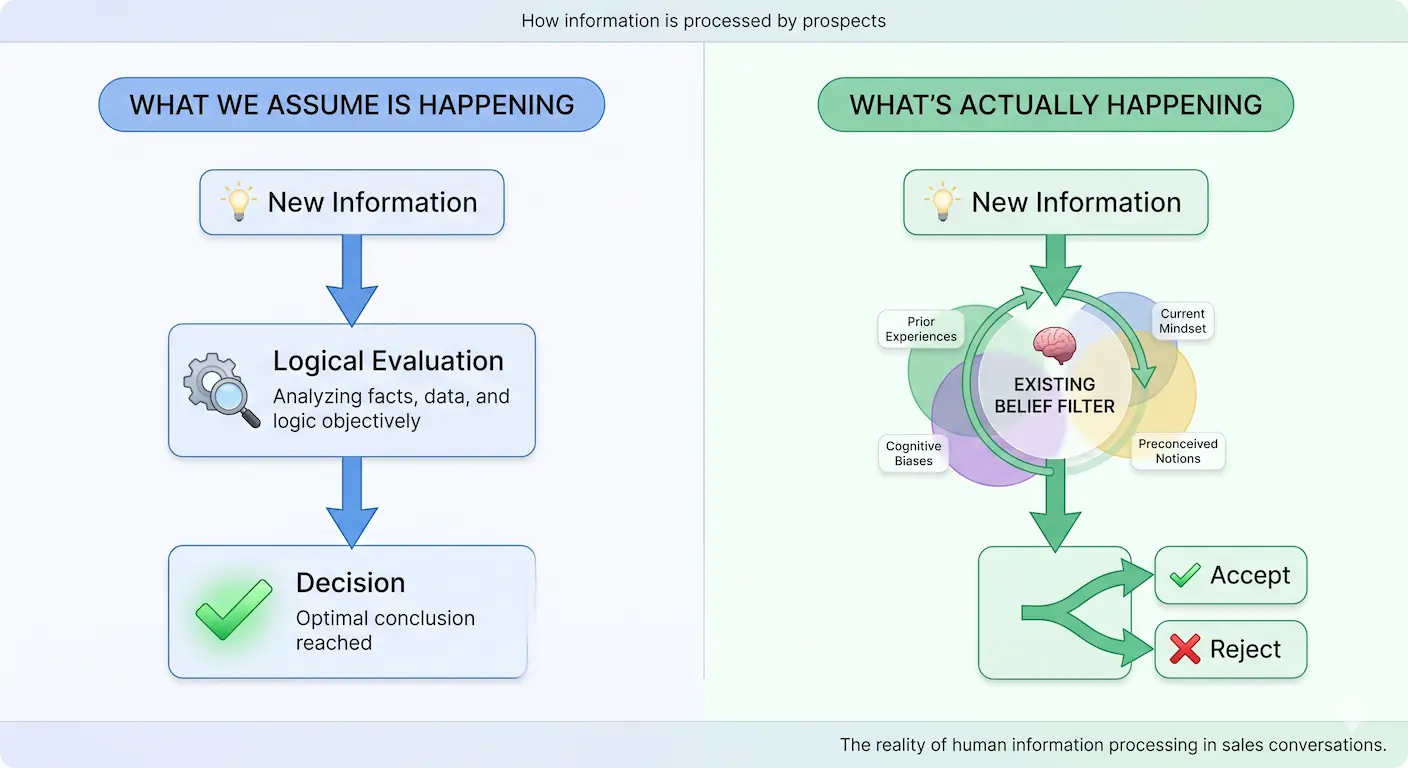
There’s a better mental model for what’s happening when a prospect pushes back.
When your prospect hears what you say, they run it through a filter. That filter is built from everything they already believe: about their problem, about solutions like yours, about what firms in your category typically deliver, about whether they can afford to be wrong again.
If what you say matches their existing beliefs, they accept it and move forward. If it doesn’t, one of two things happens: they ask a question (curiosity) or they push back (protection).
The key signal is confidence. A prospect who says “that won’t work for us” with high confidence and no follow-up questions is pattern-matching. They’ve mapped your idea onto something they already have an opinion about, and they’re responding to that opinion, not to what you actually said.
A prospect who says “I’m not sure I follow, can you explain what that means for our situation?” is engaging with something new. They want to understand.
The mistake is responding to the first scenario as if it were the second. You explain more, add evidence, build a stronger case.
You can’t out-argue identity protection. The more you push, the more they dig in.
The Part Nobody Likes to Admit
We do the same thing to our prospects.
I’ve sent proposals I was certain were clear, only to get on a follow-up call and find out the prospect had interpreted the whole thing differently. I assumed they understood what I meant. I overestimated my own clarity. We all do it.
We dismiss objections as wrong instead of asking why they make sense from where the prospect is sitting. We assume that because we know our own methodology well, we’ve communicated it well. Those are not the same thing.
Good marketing, and every good sales conversation, requires a baseline assumption: your message will be misunderstood. Your prospect is reading it through their own lens. What seems clear to you often isn’t clear to them.
That’s not a failure. It’s just how information gets processed. The question is whether you build for that reality or fight against it.
A Better Approach: Guide Instead of Convince
The shift that makes the most difference isn’t better explanation. It’s a different goal entirely.
Instead of trying to convince prospects, guide them.
People adopt ideas they feel they arrived at on their own. That’s the only kind that actually sticks.
So…
How to Apply This in Practice
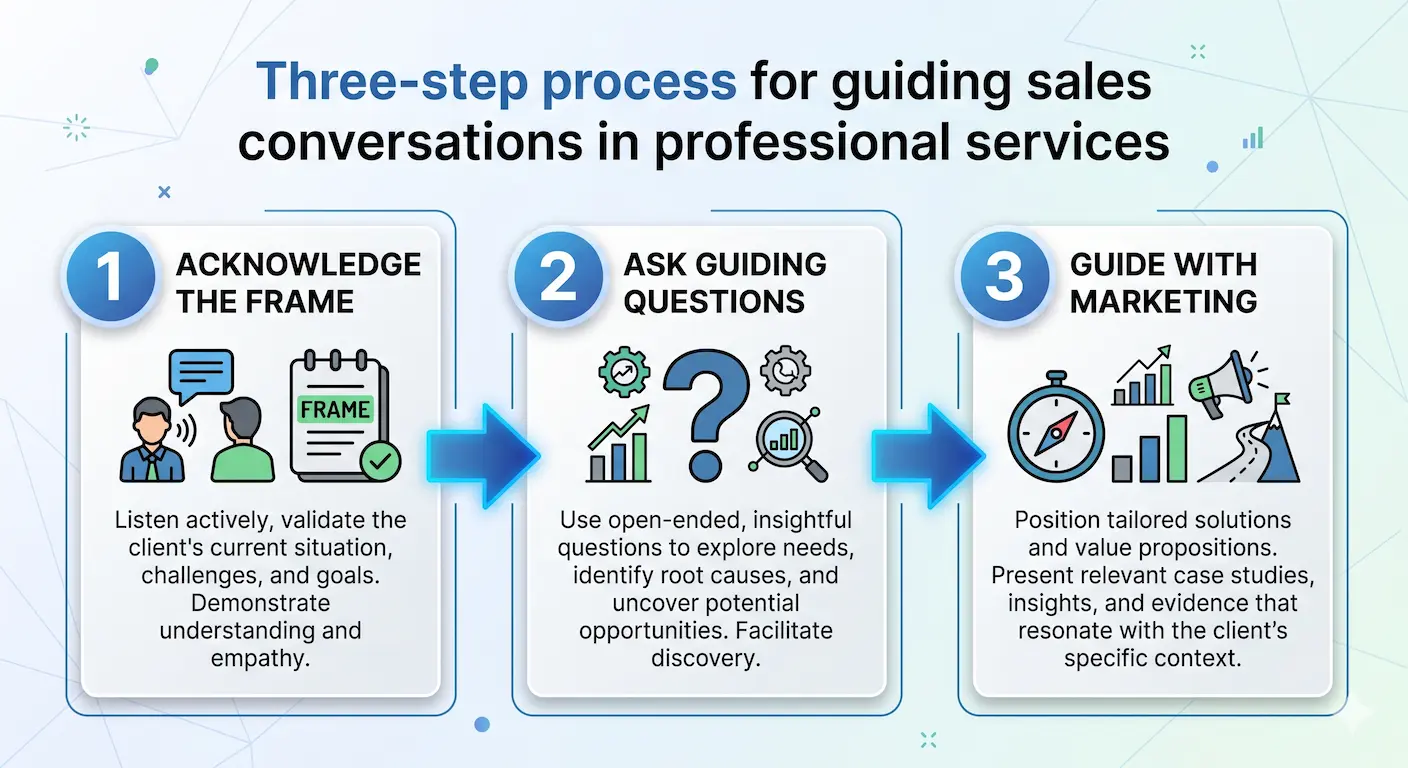
Step 1: Acknowledge the Frame Before You Challenge It
When a prospect pushes back, the instinct is to correct them. To clarify what you actually meant. To explain why they misunderstood.
Don’t do that first.
Acknowledge what they said. Not as a technique, but because you actually want to understand their perspective before you respond to it. Acknowledgment tells them you heard them. That alone lowers the defenses that make new ideas hard to get through. The prospect stops protecting their position and starts listening.
What this looks like:
A prospect says: “We tried bringing in outside help for this a few years ago. A lot of disruption and not much came from it.”
The instinct response: “I understand, but our process is specifically designed to minimize disruption. Here’s how it works…”
The better move: “That makes sense. A lot of firms have had that experience. Brought someone in and got more work, not less. What made it feel that way? What was the disruption specifically?”
Now you know what actually happened. And the prospect, having been heard, is ready to consider something different.
👎 Bad example:
“Actually, that’s not quite right. What I said was that referrals alone won’t build a predictable pipeline. I wasn’t saying referrals are bad.”
👍 Good example:
“You’re right that referrals have built most of your business, and that tells me you deliver strong work. The question is whether referrals alone will get you where you want to go.”
The second approach doesn’t abandon your position. It meets them where they are before asking them to move.
Common mistake to avoid:
Acknowledging what someone said is not the same as agreeing with it. You can say “that makes sense given what you’ve seen” and still hold a different view. The acknowledgment buys you the space to share it.
Questions to ask yourself:
- Do I know what the prospect’s actual concern is, or am I guessing?
- Am I correcting what they said, or am I engaging with why they said it?
Step 2: Ask Questions That Let Prospects Work Through It Themselves
Once you’ve acknowledged their frame, the next move is questions, not arguments.
The goal isn’t to lead the witness. It’s to create space for the prospect to think through their own situation. Often, they’ll arrive at the conclusion themselves, without you making the case.
When a prospect reaches a conclusion on their own, they own it. They can act on it without having to defend it. When you push a conclusion on them, they have to defend against it.
What this looks like:
Instead of: “Your messaging is too generic. It doesn’t differentiate you from the other firms competing for the same work.”
Try: “When a potential client visits your website, what do you want them to understand about why your firm is different from the others they’re considering? Does that come through clearly?”
When a prospect sits with that and says “honestly, no, I don’t think it does”… they’ve identified the problem themselves. They got there. You didn’t push them. That changes what comes next.
👎 Bad example:
“Here’s why your messaging isn’t working: it’s too generic and it doesn’t differentiate you from your competitors.”
👍 Good example:
“When a prospect visits your website, what do you want them to understand about why you’re different from the other firms they’re considering? Is that coming through right now?”
Common mistake to avoid:
This approach requires genuine curiosity. If you’re asking questions already knowing exactly where you’re going to steer the conversation, prospects feel that. Ask because you actually want to understand the answer.
What to look for:
You’ll know a prospect is engaging rather than pattern-matching when they start asking you questions, especially questions about their own situation and not just your methodology. That’s the shift you’re after.
Note on timing:
Some prospects need a bit of silence after a question. Don’t rush to fill it. Give them time to think. The answer that comes after a pause is usually the real one.
Step 3: Write Your Marketing Like You’re Guiding, Not Convincing
The same dynamic that plays out in live conversations shows up in your marketing assets: your website, your content, your proposals.
Most professional services marketing is written to convince. It makes claims, backs them up with credentials, and asks for the meeting. The problem is that readers filter those claims through the same pattern-matching process. They’ve seen the claims before. They’ve been burned by firms that made similar promises. They read “we help companies achieve better results” and their pattern-matching immediately files it alongside every other firm that says the same thing.
Marketing that guides works differently. Instead of making claims, it describes situations with enough specificity that the right prospect says “that’s exactly what I’m dealing with.” It creates recognition, not persuasion.
👎 Bad example:
“We’re a leading consulting firm serving professional services organizations. Schedule a call to learn how we can help you grow.”
👍 Good example:
“If your best clients can’t explain why they hired you (not just ‘they’re great’ but specifically what you do and what makes you different), that’s usually where the pipeline problem starts.”
The second version isn’t selling. It’s describing a situation. A specific type of prospect reads that and thinks “that’s us.” They feel understood before they’ve talked to you. That’s the starting point for a sales conversation that actually goes somewhere.
Why this matters beyond the first impression:
Marketing that describes problems accurately also pre-qualifies. Readers who don’t have the problem you’re describing won’t respond. Readers who do will feel like you already understand their situation. The conversation starts further along because the hard work of establishing “you get it” is already done.
When your marketing and sales conversations work with how people actually think, the result is this: prospects stop defending their positions and start engaging with yours. The conversation gets easier because you’ve stopped fighting how they process information, not because you’ve become more persuasive.
Common Questions About This Approach
“But what if the prospect genuinely needs more information? Some objections really are information gaps.”
True. Not every pushback is identity protection. Some prospects are trying to understand something they don’t know yet.
The way to tell the difference: genuine information gaps come with questions. “How does that actually work?” or “What does that look like for a firm our size?” A prospect who’s asking is curious. A prospect who’s telling you that you’re wrong is usually protecting something.
The acknowledge-first approach works either way. You acknowledge, ask a clarifying question to understand what the actual gap is, then fill it. The difference is you don’t rush to fill it before you know what it actually is.
“Doesn’t this take longer than just making your case?”
In any single conversation, it might feel slower. But explaining more rarely closes the deal faster. It delays it or loses it because the prospect digs in. Guiding conversations tend to move faster because the prospect isn’t spending energy defending against your position.
“What if I’ve been approaching this wrong? Do I need to rebuild my whole sales process?”
No. Start with one change: before responding to any objection, acknowledge it first. That alone shifts the dynamic in most conversations. You don’t need a new process. You need a different opening move.
“My buyers are technical. They want data and proof points, not guided conversations.”
Technical buyers pattern-match too. They may need data to feel comfortable moving forward, and that’s worth providing. But the pattern-matching happens before and after the data. They decide whether to consider what you’re saying before they evaluate your evidence. Acknowledgment and guiding questions operate at that level, not at the level of proof.
“My firm is highly consultative and relationship-driven. Does this still apply?”
The more consultative your work, the more it applies. Consultative sales are conversations. Everything here is about how to have them better.
What to Take From This
Most persuasion failures in professional services sales aren’t about the quality of the firm or the value of the offer.
They happen because the idea never made it through the filter of how people actually process information.
When you treat every prospect objection as an information gap, you set up a pushing contest. The prospect digs in, you explain more, they dig in further. Most deals die in that cycle.
A few things worth keeping:
- When a prospect pushes back, acknowledge what they said before you respond to it.
- Ask questions that help them work through their own thinking rather than handing them your conclusion.
- Write marketing that describes their situation with enough specificity that they recognize themselves. Not claims they have to evaluate from a distance.
- Assume your message will be misunderstood. Build for it.
Hopkins had this right in 1923. People can be coaxed but not driven. Whatever they do, they do to please themselves.
Your job in a sales conversation isn’t to be more persuasive. It’s to make it easy for the right prospect to convince themselves.
One thing to try this week: In your next sales conversation where a prospect pushes back, don’t explain your position right away. Acknowledge what they said, and ask one question to understand where they’re coming from. See what happens.
—
Want More Insights Like This?
Subscribe to The Business Builder, my weekly newsletter for boutique B2B and professional service firm founders who want to increase authority, generate consistent leads, improve sales effectiveness, and build stronger client relationships.