
Ever notice how most email marketing advice just feels “off” for your high-trust business?
You read the HubSpot blog. Listen to a couple of B2B marketing podcasts. Watch the videos of the latest darling SaaS company.
The advice always arrives with confidence and a clean framework attached. But when you sit down to run it inside your 4-person advisory firm, and something doesn’t fit.
The cadence sounds aggressive.
The CTAs feel out of step with how you actually win clients.
The “lifecycle stages” don’t match how anyone actually buys what you sell.
Even the “personalization” reads as fake.
In this post, I want to break down why the advice you’re hearing doesn’t work for professional service firms and what you can do instead.
If the current “best practices” in email marketing don’t seem to fit your business, you’re not alone. The alternative below is an email program that compounds trust over months without going soft on asking for the business.
Let’s start with why the advice misfires.
The Problem: The Advice Was Built for a Different Game
Most email marketing advice wasn’t built for what you’re trying to do.
Most of it comes from businesses whose goal is to move large numbers of buyers through predictable stages as fast as possible. Think eCommerce. Or SaaS. In those worlds, the goal is conversion velocity, and the tactics (lead scoring, behavior triggers, cart abandonment, breakup sequences) are built to engineer movement through a funnel.
That works inside those businesses because their economics demand it. eCommerce wins on volume. SaaS wins on activation and expansion. The buyer in those worlds is making a relatively contained decision they can reverse: return the candle, cancel the subscription. The tactics match the stakes.
You are playing an entirely different game.
You sell judgment to people making high-trust decisions they can’t unmake without consequence. Often six figures. Visible to the rest of their leadership team. They are trying to decide whether to invite you into one of the most important conversations in their business.
The hidden cost of importing the wrong playbook
Bolting lifecycle-style tactics onto that buyer won’t get you invited into that conversation. It usually pushes you further away from it.
Fake scarcity. Countdown timers. Behavioral triggers that say “I noticed you opened the last three emails.” Breakup sequence asking if you should “close their file.” These tactics aren’t what successful professionals do.
Boutique firms succeed by feeling like the calmer, more confident, trusted option. The funnel playbook makes them sound like a marketer wearing a costume.
They’re running advice optimized for the wrong job.
The Reframe: Stay Useful, Be Memorable, Lead When It’s Time
Your playbook is closer to this: stay useful and memorable while trust accumulates naturally.
Your emails should feel like correspondence from a smart, trusted advisor, not templates spit out of a marketing machine.
That sounds soft. Until you look at how high-trust buying actually works.
When a managing partner finally hires an outside firm, the trigger is almost never the email they got that morning. Something has shifted internally. A board demanded a new strategy. The COO left. Q4 numbers came in flat. A merger conversation surfaced. Now they need someone they already trust to help them think through it.
Who do they call? The firm whose perspective has been compounding in their inbox for months. The firm they’ve been reading on the plane, forwarding to a partner, quoting in meetings. The firm that already feels like part of their thinking.
I call this trust accumulation. It has a few core properties:
- It happens over months, not weeks.
- It’s built on perspective, not promotion.
- It compounds when you stay consistent and ignore short-term funnel metrics.
- It only works when the writing actually sounds like a real person.
Trust accumulation is not the absence of selling
Some firms read about relationship-based email and conclude they should never make an offer. Don’t fall into that trap.
Trust accumulation and selling are not mutually exclusive. Sales is about leadership. Your clients and prospects expect you to lead.
After all, you’re the professional expert. When you see a problem they need to address, the right move is to say so directly and offer a way to work on it together. That’s part of what you’re being trusted to do. Leading the conversation toward action when action is needed is exactly the kind of judgment they’re paying for.
The difference is in tone and timing. A firm that accumulates trust asks for the business from a position of authority, not than urgency. When your emails feel like correspondence from someone whose judgment is worth paying for, the offer to work together lands as leadership – not pressure.
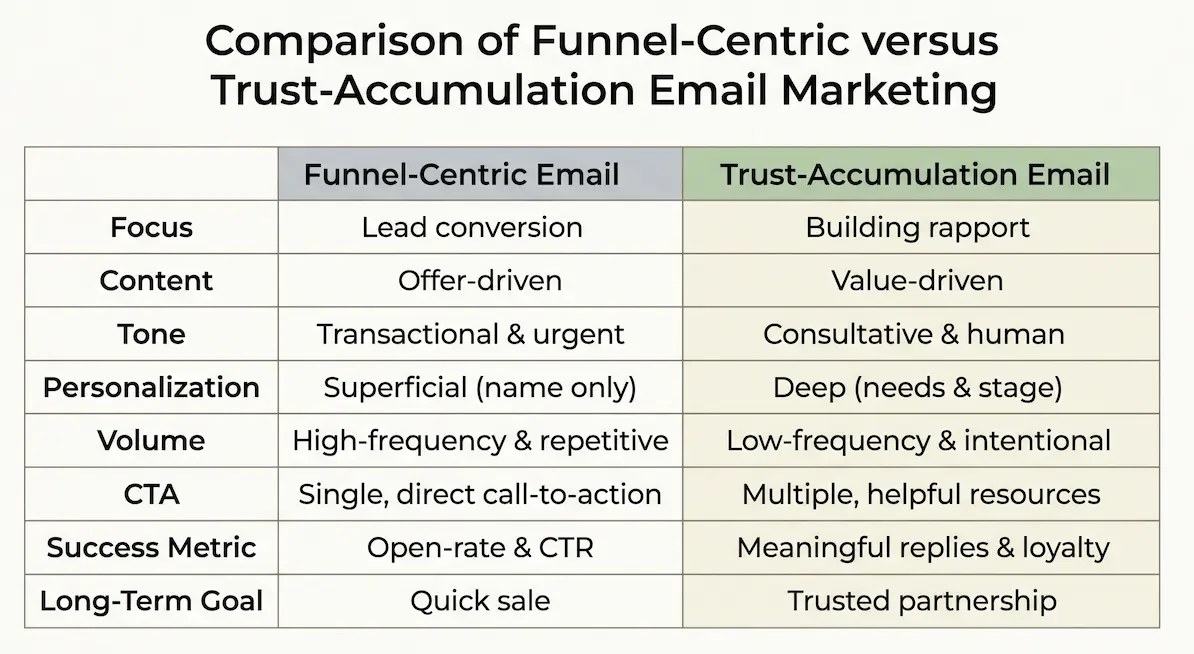
Funnel-centric email vs. trust-accumulation email
| Funnel-Centric Email | Trust-Accumulation Email |
|---|---|
| Optimize for clicks today | Optimize for memory in six months |
| Write to a list | Write to one reader |
| CTA in every send, always the same | Lead with perspective, offer when right |
| Automated cadence | Human cadence |
| “Book a call now” | “Here’s what I’m noticing” |
| Measure open rates | Measure how clients describe you |
| Lead scoring | Relationship judgment |
| Sequence the buyer | Be a presence the buyer can return to |
Here’s the key difference – the funnel model treats the buyer as a target to be moved. The trust model treats the buyer as a peer who already knows what they need and is choosing whom they want to invite to help them.
This is marketing that matches what you actually sell.
Inboxes are flooding with AI-generated content right now. The average B2B prospect gets 30 automated nurture sequences a week, all written from the same prompt template and saying roughly the same thing. Human, perspective-driven communication is becoming more of a differentiator by the month, not less.
In high-trust markets, authority sounds calmer. The firm with messaging that sounds least like marketing usually wins.
Here’s how to build it.
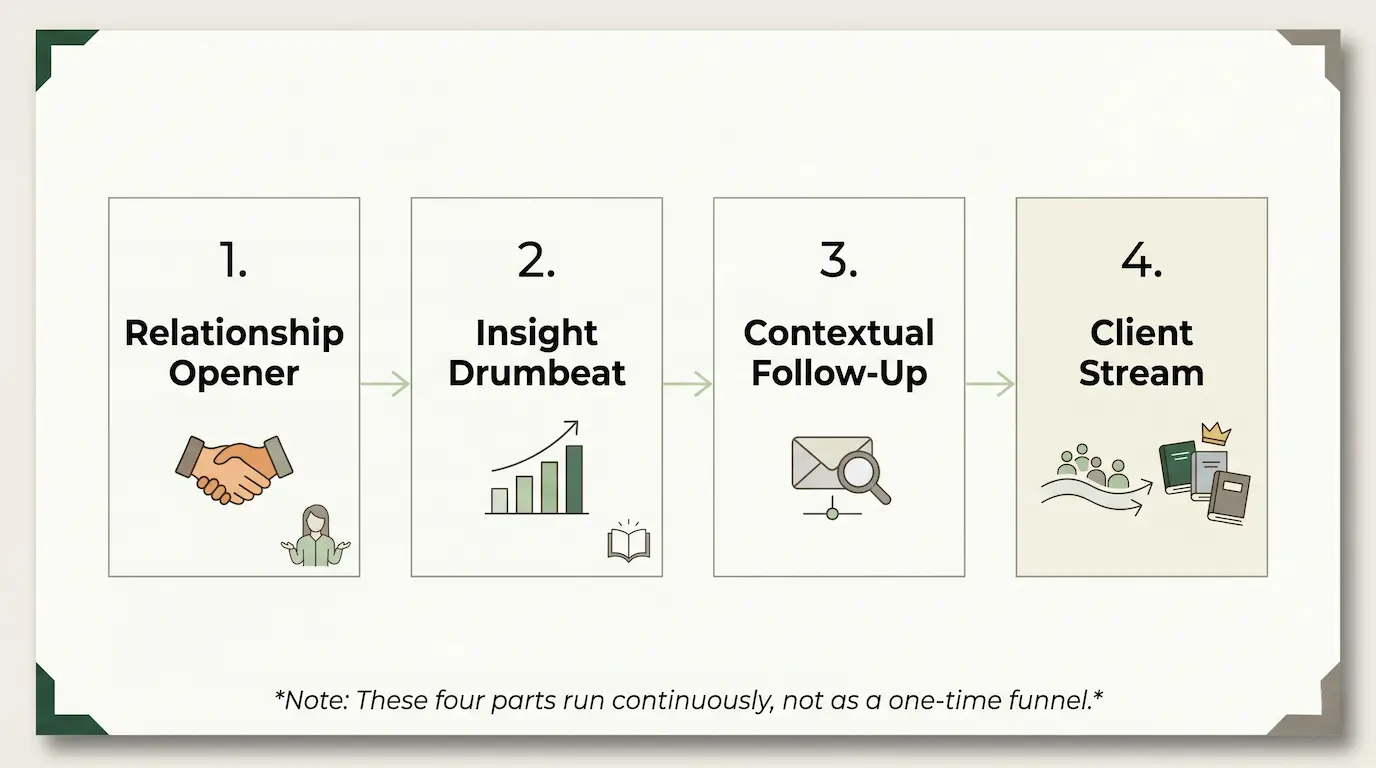
Step-by-Step: A Four-Part Email Architecture for Boutique Firms
Step 1: Replace the Welcome Funnel With a Relationship Opener
Why this matters. The first emails a new subscriber gets set the entire frame for the relationship. Most welcome funnels signal “you’re a lead now, and we’re going to process you.” A relationship opener signals “you’re a person who got curious. Here’s how we think.”
How to do it.
Write a short series of three to five emails (not seven, not twelve) that introduce your worldview, explain how you think about the problem your firm solves, and invite a reply. Don’t introduce your services in detail. Don’t push toward a meeting. The job is establishing posture.
A useful structure:
- Email 1: Why you wrote this (your point of view in one email)
- Email 2: The mistake you see most often
- Email 3: How you’d think about it instead
- Email 4: A short case (no pitch)
- Email 5: An invitation to reply if a topic resonates
Send them at a human cadence. Two days apart, not two hours. No urgency. No countdown timers.
👎 Bad example. A seven-email welcome sequence ending in “Book your strategy call before this week’s spots fill up.”
👍 Good example. Five emails over ten days, each 200 to 400 words, each ending with a soft invitation to reply if the topic is live for the reader. No call-booking link until the reader asks for one.
Why it works. You’re filtering for the right people instead of pushing the wrong people through a funnel. The readers who reply self-identify. Readers who don’t may still convert in eight months when the timing changes, and you haven’t burned the relationship in the meantime.
Step 2: Build a Steady Drumbeat of Insight, Not Promotion
Why this matters. The bulk of your sends should be insight-driven. This is where trust actually accumulates. Every email is a small deposit. Most should be perspective. Some can be invitations. Almost none should be sales.
How to do it.
Build a weekly or biweekly cadence around the patterns you’re seeing in your client work, the questions clients keep asking, contrarian takes on conventional wisdom in your niche, and lessons from specific engagements you’ve handled (anonymized).
A useful filter: would you send this email to one specific client you respect, by name, with no edits? If yes, send it to the list. If not, the email isn’t ready.
👎 Bad example. A “weekly tip” email written to a generic audience: “Five ways to optimize your team’s productivity.”
👍 Good example. A 500-word email starting with “I’ve been thinking about a conversation I had last week with a CEO who’s about to take her firm through a partnership transition. Here’s the thing she got right that most founders miss.”
Why it works. Specificity earns attention. Generic advice doesn’t. When the email feels like it could only have come from your firm, the reader starts associating you with how they think about their problem.
Step 3: Use Contextual Follow-Up, Not Automated Pressure
When a reader’s behavior changes (a flurry of opens, a reply to a specific email, a comment on a topic), the right response is human follow-up. Automated escalation sequences signal “you tripped a trigger.” A human follow-up signals “I noticed, and I’m curious.”
How to do it.
Tag readers when they engage meaningfully (a reply, a long-thread response, a forwarded share). When you see the signal, send a short personal email asking a direct question. No template. No CTA. Just a real question.
👎 Bad example. “I see you’ve been engaging with our content. Would you like to schedule a 15-minute discovery call to see if we’re a fit?”
👍 Good example. “Hi Sarah, you mentioned in your reply that the partnership transition has been weighing on you. Without offering a sales call, I’m curious: what’s making it feel different from previous transitions you’ve handled? I keep seeing this pattern and I’d like to understand it better.”
Why it works. You’re treating the conversation like a conversation, not a conversion event. If the reader wants to talk, they’ll say so. If they don’t, you’ve reinforced trust without selling anything.
Step 4: Keep Emailing Existing Clients With Strategic Perspective
Most boutique firms stop emailing clients once an engagement starts and never re-engage them after it ends. That’s a massive missed opportunity. Your clients are your highest-trust audience. They’re also your most likely source of expansion work and warm referrals.
How to do it.
Add current and past clients to a separate communication stream that gets the same insight-driven content as prospects, plus occasional client-only commentary. Twice a year, send a short check-in: “What’s the one thing keeping you up about the next six months?” Then actually read the replies and follow up.
👎 Bad example. A quarterly “newsletter” to clients summarizing your firm’s wins, awards, and recent hires.
👍 Good example. A monthly note that opens with “I’ve been watching three patterns in client conversations lately. Two of them might be relevant to where you’re sitting right now. Reply if either resonates.”
Why it works. You stay strategically present. When the client has a new initiative, you’re the person they message first. Most expansion deals and warm referrals come from clients who feel like you’ve been walking alongside them, not from a pitch deck you sent at engagement-end.
Common Questions About Trust-Based Email Marketing
“This sounds slow. How long does it take to see results?”
Honestly, six to eighteen months. That’s the actual cycle. The first three months feel like nothing is happening. By month six the reply rates change. By month twelve you’re getting inbound from people who’ve been reading you for a year. If you need leads in the next thirty days, this isn’t your channel. If you want a sustainable engine that compounds, it is.
“My industry is hyper-specific. Will this work for me?”
Yes, more so than for generic services. The narrower the niche, the higher the value of being the firm with the perspective. A 14-person advisory firm focused on PE-backed manufacturing CFOs has a smaller audience than a generalist consultancy, but every reader is dramatically more valuable. Trust accumulation works better in narrow markets, not worse.
“What about lead magnets? Should I still have one?”
You can. Make it a real resource, not bait. A 12-page playbook that helps the reader think through a specific decision is worth giving up an email address for. A “5-minute checklist” extracted from a blog post is not. The tone of the lead magnet sets the tone of the relationship.
“How often should I send?”
Once a week is plenty for most boutique firms. Twice a month is fine. The cadence matters less than the consistency. A 14-person advisory firm I work with sends one email every other Wednesday and has done so for four years. They’re booked solid.
“Won’t unsubscribes hurt me?”
Unsubscribes are signal, not damage. People who don’t want your perspective shouldn’t be on the list. The email that loses you 30 subscribers and books you a $200K engagement is the email that’s working. Stop measuring list size and start measuring list quality.
“Can I automate any of this?”
Yes. Automate the welcome opener and the basic infrastructure. Don’t automate the perspective-driven sends or the follow-up to engagement signals. Those have to come from a person.
“What about pop-ups, exit intent, and conversion optimization?”
Use the basics if they work. Don’t get cute. A clean subscribe form on the right pages is fine. Aggressive overlays that interrupt the reading experience cost more in brand than they’re worth.
The Bottom Line: Build a System That Compounds
Most email marketing advice for boutique firms is borrowed from companies that don’t sell what you sell. The result is generic, automated, slightly desperate copy that erodes the very thing your firm is trying to build.
Here’s what to remember:
- Funnel tactics work for products, not for high-trust judgment work.
- Email’s real job is trust accumulation, measured over months.
- The four-part architecture (relationship opener, insight drumbeat, contextual follow-up, ongoing client stream) replaces the funnel without giving up any business outcome.
- The right metric is whether the right buyers remember you when their timing changes.
- Specificity and human cadence beat optimization, automation, and short-term urgency.
Start here. Open your last five sends. Read them as if you were a busy managing partner who already gets thirty newsletters a week. Ask yourself: would I keep reading this? If not, the next email you send should be a 300-word note about something you actually noticed in client work this week. No CTA. Just perspective. See what happens.
Six months from now, you’ll have an email program that sounds like your firm and works like an asset, not a chore.
Want More Insights Like This?
Subscribe to The Business Builder, my weekly newsletter for boutique B2B and professional service firm founders who want to increase authority, generate consistent leads, and build stronger client relationships.
Every week I share frameworks, strategies, and practical steps you can implement immediately, written for firms like yours, not for SaaS startups.